Jump to:
Qur’an 30 for 30 | Season 7
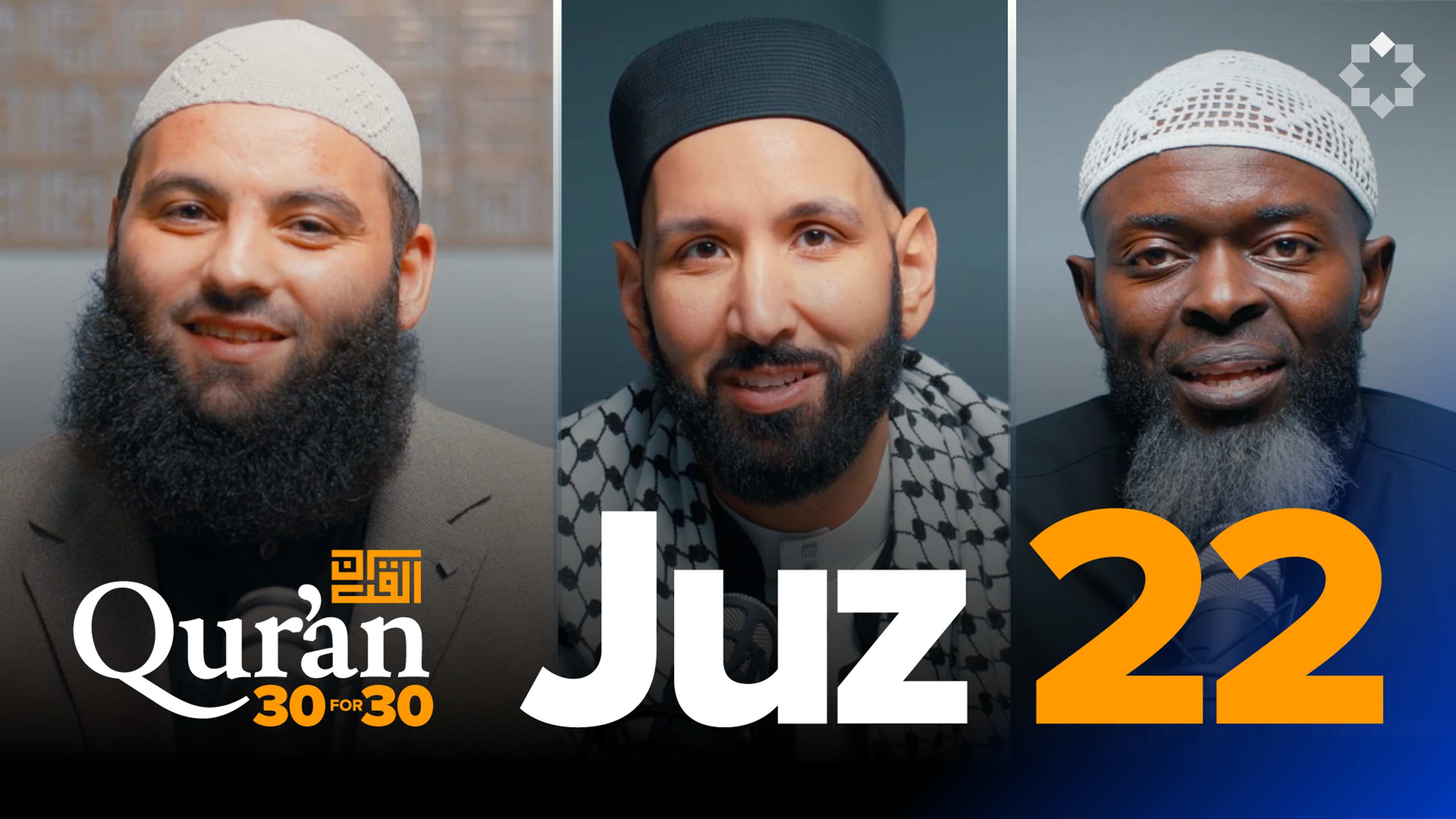
Juz 22: Appreciating Muhammad ﷺ | Sh. Omar Hajjaj
When Allah gives you more, do more.
Sh. Omar Hajjaj joins Dr. Omar Suleiman and Sh. Abdullah Oduro to reflect on what true gratitude to Allah really looks like, following the example of the Prophet ﷺ. Instead of taking Allah’s countless blessings for granted, we’re reminded to express our gratitude through action: serve your community, increase in good deeds, and use every blessing you’ve been given in ways that please Allah.
This transcript was auto-generated using AI and may contain misspellings.
No matter who you are, where you've been in your life, how many mistakes you committed,
how far you believe you are from Allah subhanahu wa ta'ala, Allah subhanahu wa ta'ala doesn't see you as far away from Him. I just came away from this juz like with an immense sense of gratitude to the Prophet sallallahu alayhi wa sallam because it just dawned upon me like how much he had to go through.
Oh believers, sallu alayhi, right? Send your prayers upon him, send your salam upon him sallallahu alayhi wa sallam as Allah and the angels do. So that's what's so beautiful about Al-Fattah because we say the opener, you know, it's
so deep is that those doors are probably already open. You just haven't seen it yet. Assalamualaikum warahmatullahi wabarakatuh everyone. Welcome back to Quran 30 for 30.
Alhamdulillah, as we are in the last 10 nights, we want to remind you all bi-idhnillahi ta'ala to please keep us in your du'a and to please support Yaqeen. This is the time in which we rely most on your support. You're still on just the second of these last 10.
If you'd like to plug in inshallah donate for the remaining 10, the remaining odd nights, whatever it may be, please do at the link below inshallah ta'ala. This is the time we count most on your generosity and we pray that you've benefited and you've
seen the growth of Yaqeen walhamdulillah and that's only possible first and foremost by the grace of Allah subhanahu wa ta'ala and then your support. Alhamdulillah, we're blessed to have my brother from Lifta, Palestine?
Yeah, Lifta is from my mother's side. MashaAllah, where's your father's from? Jaffa. Jaffa, MashaAllah. Sheikh Omar Suleiman, Alhamdulillah. The British-Palestinian. There's something about British-Palestinian. Something doesn't match about those.
You know, it's like American-Palestinians are confused. Palestinian-Americans are confused with like Palestinian-Brits like Kayf Yani, the colonizer and the colonized. How does that work? It's true, true, true. How are you integrated into the Khalas life?
That's a hard question. How are you supposed to answer that? It's like, um… That's what I'm thinking about. I think security first, so I said, you want to… Sheikh, how is it like being a British-Palestinian? Palestinian-Brit?
Why should I say Sheikh Abdullah? I don't know. I'll say Balfour. Balfour. You know what? Serious, serious question though. What is unique about… There aren't like, it's not a huge community. There's actually a much bigger Palestinian-American community.
Palestinian-British community. What's it like? I have more family in America than in the UK. Yeah. SubhanAllah. The Lifta Society in Dallas. That's where, yeah, you came and you got welcomed. They had a whole like… Yeah. MashaAllah. Yeah, you're right.
There's probably not more than 50,000 of us in the UK. Wow. Very small number. I think Britain got away with it.
Like, not many people speak about Britain's role in terms of the new entity or the occupation. It's quite interesting how much they got away with it. They look like the good guys. Yeah.
They facilitated everything and then they withdrew. And they said, it's not our problem anymore. Sounds very British. That's their sentiment. That's their sentiment. Absolutely. So, Sheikh, on a more like spiritual question, I'll ask you two questions before we get started with the juz bi-idhnillah ta'ala.
The first one is, we're in the last 10 nights. If you are giving someone like the most unique advice, something you don't hear much in the last 10 night reminders, what do you tell someone about how to take advantage of these last 10 nights?
The last 10 nights, of course, these are the nights where, subhanAllah, the most amount of blessings descend, sakinah, tranquility,
millions or uncountable angels descend. The rahmah of Allah subhanahu wa ta'ala descends. And as you know, the month of Ramadan is the month of Qur'an. But in particular, the last 10 nights, the Prophet ﷺ
would exert so much effort in terms of ibadah, but in particular, the Qur'an, connecting with the Qur'an. And we know the special virtue of just reciting the Qur'an in the house of Allah subhanahu wa ta'ala,
where the Prophet Muhammad ﷺ said, not a group of people that gather in one of the houses of Allah subhanahu wa ta'ala for the sake of reciting the Qur'an, except that Allah subhanahu wa ta'ala will allow
the sakinah, the tranquility, the peace in someone's heart to descend, and will allow the angels to spread their wings over them, and the rahmah of Allah subhanahu wa ta'ala. So never lose hope,
no matter who you are, where you've been in your life, how many mistakes you committed, how far you believe you are from Allah subhanahu wa ta'ala, Allah subhanahu wa ta'ala doesn't see you as far away from Him. Allahu Akbar. Subhanallah.
So especially in the last 10 nights, connect with Allah, speak to Allah, you know, through making du'a, this is how we can speak to Allah, by making du'a, speaking to Him, in any language, from your heart, and Allah speaks to us through the Qur'an. Beautiful.
And your life can change in these last nights, subhanallah. I have, Shaykh Omar, the other question, what's your favorite name of Allah right now? Al-Fattah. Right now, it is. Oh, perfect. In this instance. The name we'll talk about, inshallah. Yeah. The opener.
One of the names of Allah subhanahu wa ta'ala. Tayib. Alhamdulillah, I mean, as we come to Juz 22, you know, last Juz, we talked about Allah subhanahu wa ta'ala as the author of history. All right, Surah al-Rum. Then you get into Al-Ahzab, the author of history, the ultimate author of history.
And subhanallah, as you come into Juz 22, Allah is the opener of impossible situations in history too. And as I was reflecting on how Allah subhanahu wa ta'ala talks about himself in this Juz, Allah subhanahu wa ta'ala talks about how people felt
when they thought they were in an impossible situation. So Allah azawajal mentions, wa balaghati al-qulubu al-hanajir. Like, you think of that scene, the hearts reaching the throats. Like, you are at the point where you think destruction is imminent,
where you have absolutely no end in sight to your tragedy, and you have no way of overcoming your enemy. And I think that's, subhanallah, that's truly indicative of how so many of us feel at various points in these days where, you know,
the oppressors seem to have, like, you know, this control of everything, right? Like, they shut that path off. They should, okay, they just broke another international law. Okay, they just took over something else. Okay, it just got that much more impossible. And when Allah subhanahu wa ta'ala mentions,
wa balaghati al-qulubu al-hanajir. Like, that really exemplifies how we feel sometimes, right? The hearts reaching the throats. Imagine being in that place where you really see no opening, no fatah. And you can only look to al-Fattah,
Allah subhanahu wa ta'ala, to open up a way for you. And so that's one thing that I noticed of Allah subhanahu wa ta'ala, how he speaks about himself, you know, building upon what we already have from Surah al-Rum and going into al-Ahzab.
But also Allah azza wa jal being the guardian of those that he loves, particularly the Prophet sallallahu alayhi wa sallam. And here's the thing, Allah azza wa jal will make incredible openings
for someone that he loves. Like, you know, we talk about, and you were just talking about this right now, how much Allah subhanahu wa ta'ala will extend of his rope to a sinner, to someone who's going far away from him and Allah azza wa jal calls him back. What about the one who exerts himself for Allah subhanahu wa ta'ala?
How much more will Allah subhanahu wa ta'ala open for him? And there's no one more beloved to him subhanahu wa ta'ala than the Prophet sallallahu alayhi wa sallam. And so in this Juz, inna Allaha wa malaikatahu yusalloon ala al-nabiyy
Allah and his angels send their praise on the Messenger of Allah sallallahu alayhi wa sallam, their prayers on the Messenger sallallahu alayhi wa sallam. Not just on Laylatul Qadr, not just in the last 10 nights, it's a constant praise and prayer being showered on the Messenger of Allah
sallallahu alayhi wa sallam without pause, right? So how much did Allah open for his Prophet sallallahu alayhi wa sallam? He literally opened his heart, cleansed his heart alayhi salatu wa sallam
and opened for him and facilitated for him in ways that no historian, that no political scientists could ever predict or go back and say, this looked like it was going to happen.
Allah subhanahu wa ta'ala opened and opened and opened. But before that, alam nashrah laka sadrak Allah opened the heart of the Prophet sallallahu alayhi wa sallam, removed the burden and the heart of the Prophet sallallahu alayhi wa sallam was full of the love of Allah azawajal. So there's something here about like,
who Allah will open for? For anyone who seeks him, Allah azawajal will make sure that there is something to be sought that is greater, right? You won't put an effort and be rejected.
But the more that you exert yourself in your love of him, the more that things are going to happen that are quote unquote supernatural beyond anyone else's prediction or control. And that is definitely the cases we see here in this juz.
So this is not just like Allah subhanahu wa ta'ala telling us to send our peace and blessings then on the Prophet sallallahu alayhi wa sallam, to send our salawat on the Prophet sallallahu alayhi wa sallam. When Allah azawajal says that he does so,
then that's like divine endorsement of the Prophet sallallahu alayhi wa sallam. Like I love him, I send salawat on him. So you should as well, O believers, sallu alayhi, right? Send your prayers upon him,
send your salam upon him sallallahu alayhi wa sallam as Allah and the angels do. Then I'll say one other thing I noticed about this juz is Allah azawajal mentions that he and the angels send their prayers upon the Prophet sallallahu alayhi wa sallam
and Allah azawajal ends al-Ahzab, ya ayyuha alladheena aamanu la takoonu kalladheena aathaw Moosa fabarra'ahu Allahu mimma qaalu, right? Allah azawajal says, don't be like those who harmed Moosa alayhi salaam.
And Allah subhanahu wa ta'ala frees Moosa alayhi salaam from those who harmed him. And Allah is telling us not to harm the Prophet sallallahu alayhi wa sallam the way that Moosa alayhi salaam was harmed. And then you go to the end of the juz, Surah Yasin,
ya hasratan ala al-ibad ma ya'teehim min rasulin illa kanu bihi yastahzi'oon, you know? Woe to the servants, right? No messenger comes to them except that they used to mock him, right? That they used to make fun of him
and in some cases kill the messenger, right? Which is the case in Surah Yasin. So the adab that we should have with the messenger of Allah sallallahu alayhi wa sallam, the way we should behave with the messenger of Allah sallallahu alayhi wa sallam is definitely put there. And I just came away from this juz
like with an immense sense of gratitude to the Prophet sallallahu alayhi wa sallam because it just dawned upon me like how much he had to go through, right? And that's also a part of it, like Allah azawajal talking about the hardship that he went through. He was in the trench sallallahu alayhi wa sallam
and the hearts were in the throats and the Prophet sallallahu alayhi wa sallam also had to deal with hardship from the community as well. He had to deal with constant other, constant harm. And yes, Allah opened up great things for this Ummah
but the one who was chosen as the vehicle was the Prophet sallallahu alayhi wa sallam. So all those openings came through the Prophet sallallahu alayhi wa sallam, right? So there's an immense sense of gratitude, a depth of gratitude that we owe him sallallahu alayhi wa sallam as well.
So those were my thoughts, first and foremost, the opener of history. And we'll talk about Al-Fattah in a bit inshallah ta'ala but the one who opened the heart of the Prophet sallallahu alayhi wa sallam and opened impossible situations and made these things happen for us.
I mean, subhanAllah, when you think about, in this Juz, I think it was, you're talking about Saba and giving da'wah and what's so beautiful about giving da'wah in the Deen of Islam and knowing Allah subhanahu wa ta'ala
is having fiqh and being sure of who he is and his capabilities. When you have surety and confidence in Allah subhanahu wa ta'ala by his names and attributes and his capabilities, it is always an opportunity for you to become stronger
in who you are as a human being and who you are as a Muslim because the more confidence you have in Allah, the more confidence you have in yourself and your capabilities. So always using any trial or tribulation and any fortune, good things that you have, like the people, you know, Saba themselves,
the fortune that you have is to, you know, when you're given time, things of good, things that you want or even more than you expect, it could be a test from Allah subhanahu wa ta'ala. So having confidence in Allah that you will be thankful to him and thankful to the ones that have given you
what Allah has chosen. In the same token, when things are taken away from you, the goal is to have the same attitude. It's to be alhamdulillah ala kulli hal. As I used to say about the Prophet sallallahu alayhi wa sallam is you're praising Allah in every situation. And that is the affair of the mu'min.
a'jaban li amri al-mu'min inna amrahu kullahu lahu khayr As the Prophet sallallahu alayhi wa sallam said, the affair of the mu'min amazes me. For really every situation for him is good, al-Hadith. And this is important because when looking at, you know, with Allah, I love the Hadith
the Prophet sallallahu alayhi wa sallam where he talks to the companions and he tells them that you are like al-ghuthaa' as-sayl, wa yusibukum al-wahan. He said, you will be like the foam on the ocean. And what's beautiful about this Hadith is that some of the scholars mentioned the foam on the ocean,
like the little bubbles on the ocean that sometimes they stick together and then they separate. So two characteristics of them is, one of them is that there's no substance. It's so light, it has nothing. And also that they will end up separating
because they're just going with the wave. And you have no effect in this dunya. You have no effect with people. You have no effect when you're calling people to your way of life, whether the way that you act or how you talk, how you carry yourself as a Muslim.
So that Hadith is so beautiful because it is the faith. It is the belief in God. And that's your purpose of life. When understanding that purpose and trying your best to live through that purpose with Allah being al-Ghafoor and at the same time al-Fattah,
the one that forgives you for the mistakes that you have. And then also opening doors that hopefully you'll recognize that when whatever is given to you, it's given to me by Allah Subhanahu wa ta'ala. And I'm okay with that. And I'm thankful.
And whatever is taken away from me, it's taken away from Allah Subhanahu wa ta'ala ultimately. And I'm thankful as well because I have good thoughts about him. I'm confident about what he has done. Therefore, I'm confident in myself and my capabilities from what he has done.
And that is how the Muslim has substance. The substance because they have that initial belief in Allah Subhanahu wa ta'ala. And that is what brings them the ultimate tranquility, not anything outside of themselves.
Rather, it is that initial tranquility, ease, which emanates from knowledge of Allah Subhanahu wa ta'ala. So when you're seeing, you know, with the people of Saba and what they've been given, how they're being called to Islam, and how SubhanAllah, it's more of the internal,
the introspection that you need to start with in order to be successful. That's what's so beautiful about this. SubhanAllah, we can actually summarize the life of the Prophet Sallallahu Alayhi Wasallam, the Hadith that you mentioned that estranges the affairs of the believer.
So when anything difficult or hardship happens, he is patient and that is good for him. And when good things happen to him, he is shakir. He is grateful. He shows gratitude to Allah. That's also good for him. And the Prophet Muhammad Sallallahu Alayhi Wasallam
was the most selfless individual. He was actually thinking about us when he was going through the hardship to deliver the message. And he, Sallallahu Alayhi Wasallam, he was a visionary person, where he, Sallallahu Alayhi Wasallam, said,
there'll be messengers and prophets on the Day of Judgment, some with a few followers, some with many followers. fa arju anni akthuruhum tabi'an yawma al-qiyamah I wish to be the messenger where I can boast to Allah with the amount of followers I have.
And this is what made the Prophet Sallallahu Alayhi Wasallam strive and not give up, and his strength. So can you imagine, for example, 'aam al-huzn, the year of sadness, where his most beloved Khadijah radhiAllahu anha, she died.
And his beloved uncle, who was like the governor or the chief of Mecca, who was protecting him in Mecca, he also died. And the companions radhiAllahu anhum, they were being tortured. Some were exiled.
Yet he still decided to go to Ta'if to spread the message. Any of the du'at today, if they have like a media campaign against them, some might give up and say, you know what, maybe that was not for me. But the Prophet Sallallahu Alayhi Wasallam,
regardless of all these situations and circumstances, he went to Ta'if. And even Ta'if, the tribes there, they rejected his message. They mocked him, Sallallahu Alayhi Wasallam. They abused him. They physically abused him as well. And the Prophet here is nearly 50.
He's not young. And he's in this mountain, in Ta'if. And he's walking back to Mecca with no results. And he's resting under the tree. And the angels said,
Ya Rasulullah, just command us. If you want us to, these two mountains around these tribes, we can crush them right now. But he was a merciful Prophet Sallallahu Alayhi Wasallam. And hopeful. He Sallallahu Alayhi Wasallam said,
Allahumma ighfir li qawmi fa innahum la ya'lamoon. Or, as he said, Sallallahu Alayhi Wasallam, O Allah, forgive, guide my people. He still called them qawmi, my people. For they do not know. They are ignorant. And subhanAllah, some of the greatest tribes
became Muslim from Ta'if. From the Thaqafi tribe, who governed Iraq and had a good contribution towards the Islamic civilization, Islamic state in the future from the Prophet Sallallahu Alayhi Wasallam.
So, two occasions where the Prophet Sallallahu Alayhi Wasallam went through hardship, yet he was thabit, steadfast, and he was sabir. And when good things happen, he was shakir. So when Aisha radiAllahu anha, she narrated
that the Prophet Sallallahu Alayhi Wasallam was praying qiyam, and he was praying so much that, you know, it was affecting his body. And Aisha said, Ya Rasulullah, you are Rasulullah. Allah forgave your past and future sins. But his response is so strange. He, Sallallahu Alayhi Wasallam, said,
If Allah granted me this position, should I not therefore be a grateful servant? And what we can learn from this is when Allah gives you more, do more. If Allah gives you more money, give more sadaqah, to yaqeen as well.
There you go. If Allah gives you like a position in society, help more people, do more shafa'ah hasanah, do good words of recommendations where you can help people get jobs,
where you can help people get married, where you can help people in society. Allah gave you this position. So al-shukr huwa alladhi yastakhdim, or al-shakir huwa alladhi yastakhdim al-ni'am fi ta'atillah, wa la yastakhdim al-ni'am fi ma'siyatillah.
A true believer who's grateful, he uses the blessings Allah gave him to please him, subhanahu wa ta'ala, and he doesn't use these blessings to disobey him, subhanahu wa ta'ala. JazakAllah khair. Beautiful reflection. SubhanAllah, if you notice,