fbpixel
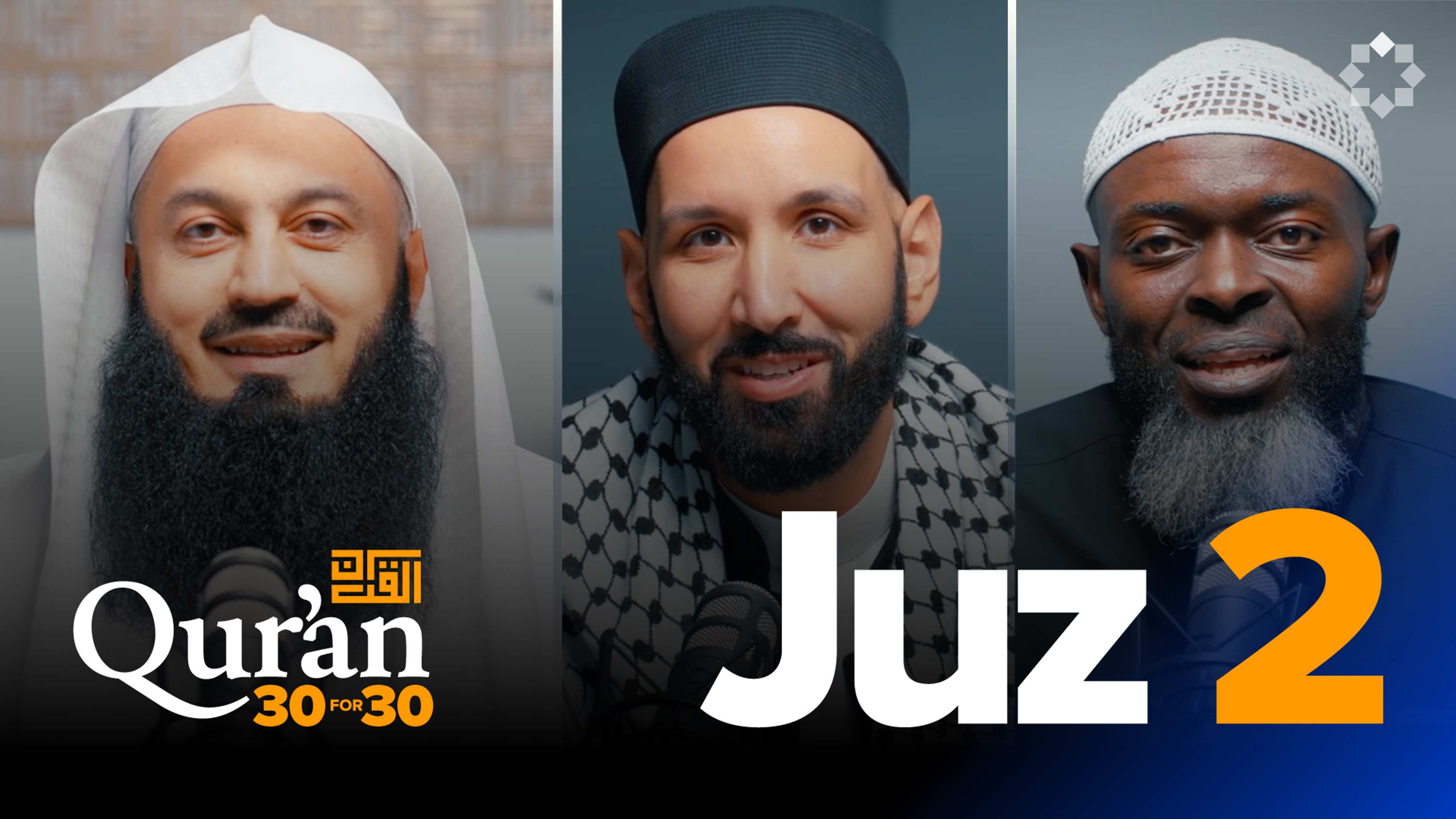
Juz 2: The Lord of Rituals | Mufti Menk
TRAILER | Qur’an 30 for 30 Season 7 | Dr. Omar Suleiman and Sh. Abdullah Oduro

TRAILER | Qur’an 30 for 30 Season 7 | Dr. Omar Suleiman and Sh. Abdullah Oduro

Juz 1: Allah’s Names in the Qur’an | Sh. Mohammad Elshinawy

Juz 1: Allah’s Names in the Qur’an | Sh. Mohammad Elshinawy

Juz 2: The Lord of Rituals | Mufti Menk
Playing

Juz 2: The Lord of Rituals | Mufti Menk

Juz 3: How The Qur’an Makes You Rich | Dr. Tahir Wyatt

Juz 3: How The Qur’an Makes You Rich | Dr. Tahir Wyatt

Juz 4: The Final Moments of This Life | Ahmad Hraichie ( The Muslim Undertaker)

Juz 4: The Final Moments of This Life | Ahmad Hraichie ( The Muslim Undertaker)

Juz 5: You Can’t Fight Fire with Fire | Ust. Fatima Lette

Juz 5: You Can’t Fight Fire with Fire | Ust. Fatima Lette

Juz 6: Signs of A Hypocrite | Sh. Asim Khan

Juz 6: Signs of A Hypocrite | Sh. Asim Khan

Juz 7: They Know Al-Lateef in Gaza | Dr. Farhan Abdul Azeez

Juz 7: They Know Al-Lateef in Gaza | Dr. Farhan Abdul Azeez

Juz 8: Whose Validation Do You Need? | Sh. Shabbir Hassan

Juz 8: Whose Validation Do You Need? | Sh. Shabbir Hassan

Juz 9: How To Memorize Allah’s Names | Dr. Haifaa Younis

Juz 9: How To Memorize Allah’s Names | Dr. Haifaa Younis

Juz 10: When Allah Goes To War For You | Dr. Suleiman Hani

Juz 10: When Allah Goes To War For You | Dr. Suleiman Hani

Juz 11: Stop Playing Games | Dr. Ovamir Anjum

Juz 11: Stop Playing Games | Dr. Ovamir Anjum

Juz 12: Allah Is Not Far | Sh. Omar Hedroug

Juz 12: Allah Is Not Far | Sh. Omar Hedroug

Juz 13: What Is 1% of Allah’s Mercy? | Dr. Mohamed AbuTaleb

Juz 13: What Is 1% of Allah’s Mercy? | Dr. Mohamed AbuTaleb

Juz 14: The Surah of Blessings | Ust. Taimiyyah Zubair

Juz 14: The Surah of Blessings | Ust. Taimiyyah Zubair

Juz 15: Join the Heavens in Glorifying Allah | Sh. Mohamud Mohamed

Juz 15: Join the Heavens in Glorifying Allah | Sh. Mohamud Mohamed

Juz 17: When Allah Chooses You, How Will You Respond? | Sh. Yousef Wahb

Juz 17: When Allah Chooses You, How Will You Respond? | Sh. Yousef Wahb

Juz 16: Can You Be Patient With Allah? | Ust. Lobna Mulla

Juz 16: Can You Be Patient With Allah? | Ust. Lobna Mulla

Juz 18: The Qur’an Is A Cure | Dr. Tesneem Alkiek

Juz 18: The Qur’an Is A Cure | Dr. Tesneem Alkiek

Juz 19: What Makes You Valuable to Allah? | Ust. Roohi Tahir

Juz 19: What Makes You Valuable to Allah? | Ust. Roohi Tahir

Juz 20: Allah’s Loud and Silent Revelations | Sh. Hisham Abu Yusuf

Juz 20: Allah’s Loud and Silent Revelations | Sh. Hisham Abu Yusuf

Juz 21: Allah Is The Author of History | Sr. Sarah Sultan

Juz 21: Allah Is The Author of History | Sr. Sarah Sultan

Juz 22: Appreciating Muhammad ﷺ | Sh. Omar Hajjaj

Juz 22: Appreciating Muhammad ﷺ | Sh. Omar Hajjaj

Juz 23: Facing Your Trials With Honor | Dr. Farah Islam

Juz 23: Facing Your Trials With Honor | Dr. Farah Islam

Juz 24: Candid Conversations with Allah | Mufti Abdul Rahman Waheed

Juz 24: Candid Conversations with Allah | Mufti Abdul Rahman Waheed

Juz 25: God Is Not A Mystery | Sh. Ibrahim Hindy

Juz 25: God Is Not A Mystery | Sh. Ibrahim Hindy

Juz 26: Don’t Run From Struggle | Sh. Mikaeel Smith

Juz 26: Don’t Run From Struggle | Sh. Mikaeel Smith

Juz 27: The Night You Give Everything | Sh. Abu Bakr Zoud

Juz 27: The Night You Give Everything | Sh. Abu Bakr Zoud

Juz 28: How To Truly Be Conscious of Allah | Dr. Jinan Yousef

Juz 28: How To Truly Be Conscious of Allah | Dr. Jinan Yousef

Juz 29: Your Spiritual Report Card  | Dr. Nazir Khan

Juz 29: Your Spiritual Report Card | Dr. Nazir Khan

Juz 30: Love Al-Razzaq More Than Rizq | Sh. Navaid Aziz

Juz 30: Love Al-Razzaq More Than Rizq | Sh. Navaid Aziz

Qur’an 30 for 30 | Season 7

Juz 2: The Lord of Rituals | Mufti Menk

Allah does not need our rituals – so why do we do them?

Mufti Menk joins Dr. Omar Suleiman and Sh. Abdullah Oduro to talk about the importance of rituals, like salah, and how these acts are for our own growth and steadfastness. In this episode, you will learn why Allah ordained rituals and how they strengthen belief.

Plus, Mufti Menk shares a duʿa he makes regularly to remain steadfast.

This transcript was auto-generated using AI and may contain misspellings.
It becomes a point where I don't care why. The fact that Allah told me, I'm going to do it. الله أكبر. That's called Islam. You're a Muslim. You have surrendered. Now you begin to taste the sweetness of anything and everything that happens in your life. Like
we're talking about the deepness of seeking forgiveness from Allah. Like don't get lost in the ritual and just let me fast from the morning to the evening وخلاص, like I got it done. No, this is like a deep exercise of seeking forgiveness. The first day of Ramadan,
it may not hit you, but that seventh day of Ramadan, that twelfth day of Ramadan, it hits you. You may not even care about it being fun anymore because you really want the soul to be enriched, and that's
your main concern. السلام عليكم ورحمة الله وبركاته, dear brothers and sisters. Welcome back to Quran 30 for 30. الحمد لله رب العالمين. We are on Juz 2 now, and as we are
really beginning Ramadan, we ask Allah سبحانه وتعالى to bless you all in your journey towards Him. We pray that you are enjoying and engaging with the names of Allah series and getting to connect with those names بإذن الله تعالى. It's going to be a beautiful
journey with those names. We also want to remind you, as you get started, إن شاء الله تعالى, to check out all that Yaqeen has for this month and to donate بإذن الله تعالى. You can actually plug in your donations for the entire month بإذن الله تعالى, and we encourage that. So
if you've been with us before, إن شاء الله تعالى, you commit at least what you've committed before and more بإذن الله تعالى. And if you're joining us for the first time, this is your opportunity. We have so much that we're going to be announcing this month بإذن الله تعالى
of what's coming up بإذن الله تعالى. الحمد لله رب العالمين. We are joined by Mufti Menk, ماشاء الله. Mufti Menk, الحمد لله, a dear brother, a dear friend, someone that's inspired so many people. الحمد لله
رب العالمين. You know, ماشاء الله, every time you meet us, you meet us with a lot of love. الله أكبر. May Allah grant us love such that we can go into Jannah as we love each other for His sake. آمين. آمين. الله يبارك فيك, Mufti Sahib. How are you? Very well. الحمد لله, ماشاء الله
تبارك الله. Good to be in good company. Shaykh, who's the African king? You or Shaykh Abdullah Oduro? Abdullah Oduro. Okay, that's like a rapid-fire question. He didn't even like hesitate. I'm about to ask the real controversial question. All right, go ahead. Whose jollof is better? سبحان الله.
Okay, so the jollof, I've answered it before, whichever country you're in at that time. So the jollof of that country in that country is better. But if you're offering me the jollof of Nigeria in Ghana, that's not good enough because the Nigerians know how to cook it
in Nigeria, and the Ghanaians know how to make it in Ghana. The minute you're elsewhere, it's controversy. Okay, fine. You know what? That's a diplomatic answer. It's a good answer. But if you're in London, do you want Nigerian jollof or do you want Ghanaian jollof? There
is a special London jollof which is made by... All right, Shaykh. If you are in Lahore, do you want Nigerian jollof or Ghanaian jollof?
Pakistani jollof. اللهم بارك. اللهم بارك. It's called biryani. It's called biryani. So biryani is just a spin-off of jollof? It's a spin-off. Or maybe jollof is a spin-off of the biryani. Shaykh
Musa, you know how to negotiate all things. You got to find a way to pin you down. He might be able to even know. Who plays ping-pong better, me or Shaykh Abdullah Oduro? I haven't seen you guys play, but I think you're taller, so you probably played better. He's got a point, Shaykh. He's got a point, yes.
He has a point. You know, Shaykh, you and I are like wired together, man, because I was going to ask him the same question about jollof. Oh, really? Yeah, I'm asking him. الله أكبر. We've been vibing too much now over these last few years. Beautiful
thing. الله يبارك فيك. Mufti Menk, it's a blessing, seriously. And to get into the actual topic, before we get to the Juz, Shaykh, question for you. At this moment, what is your favorite name of Allah Subhanahu wa Ta'ala? I think when it comes
to the month of Ramadan, generally, all the names that are connected to the forgiveness of Allah, I really take great time to go through them, to use them to call out to Allah, to try and understand
them, ponder over them. It brings me great comfort because one of the most important achievements from Ramadan is forgiveness. With the taqwa that you achieve, it's also a month of forgiveness and freedom from hell. التواب، غفار،
رحمان، رحيم، ودود، these are some amazing names to ponder over in the month of Ramadan. I do that a lot because we all want forgiveness. You know, no one is sinless. And سبحان الله, that's Allah. Shaykh,
I'll go a little deeper and more personal. I just have to. People see us, and they go overboard with their praise. They go overboard with their criticism. They go overboard with their praise. Some people put us on a pedestal. Some people put us
under their feet in the dirt. And only Allah عز وجل knows who we truly are. If someone in your position, how does that affect your calling out to Allah عز وجل for forgiveness? You know, I consider it a humongous responsibility when you
call people towards Allah because the people mirror that message on you. And we are not on a level of perfection at all, very far from it. And the balance between the praise and the hate, if I can word the second of it
that way, is a good balance because while people are praising you, there are people who are actively out there to ensure that you fall, and you're the tightrope in the center asking Allah to help you, to protect
you, to forgive you, to cover you, to use you, and to continue to use you. And that keeps you humble. So in a way, if there was no balance and we only had people who praised, perhaps it would have been worse. And if we had only people who
hated, people would be discouraged. But because we have that balance, it's all about balance. You know, when we talk about the balance of Islam, the balance of Allah Almighty's system on earth, that's what it is. So we have
to remain grounded and keep reminding ourselves we can be replaced. We are not perfect. People see the good, and sometimes they don't see the other side of us. Not to say we're evil, but the little sins that sometimes,
you know, we are human. We should always be very grateful to Allah and thank Allah, seek forgiveness of Allah, and ask Him to continue to use us. I ask Him every day, "Oh Allah, use me to serve Your cause and continue to use
us and keep us humble and steadfast." Mashaykh, we come into the second juz, walhamdulillah rabbil 'alamin, and obviously we're doing a focus on the names of Allah in this Ramadan and how they relate. SubhanAllah, the way
Allah talks about Himself in this Juz is very interesting because it starts off as وَلِلَّهِ الْمَشْرِقُ وَالْمَغْرِبُ فَأَيْنَمَا تُوَلُّوا فَثَمَّ وَجْهُ اللَّهِ. That to Allah belongs the east and the west. So anywhere you turn, then there's the face of Allah Subhanahu wa Ta'ala. And there's something deeply profound when you
contextualize this in Al-Madinah Al-Munawwarah, where the Prophet (ﷺ) is coming to Madinah, and you have the people of the book who have lost substance and only maintained
form. And they're judging the Prophet (ﷺ) through the lens of their rituals, and they're looking to validate Islam through their rituals. "Oh, now he's facing this qiblah. Oh, now he's going this way. Oh, now he's doing this. This
aligns with us. This doesn't align with us." And the Prophet (ﷺ) is being judged, but really by extension and deeper than that, the Quran is being judged. Allah عز وجل is being judged.
Like they're trying to validate this revelation based upon what they have. And SubhanAllah, I was reading the tafasir of وَلِلَّهِ الْمَشْرِقُ وَالْمَغْرِبُ, and why would it start that way? And one of the benefits is that Allah
is saying to the people that, "I don't need to be validated by your rituals. Your rituals need to be validated by me. They need to be accepted by me. Your rituals don't make Allah سبحانه وتعالى Allah.
Allah عز وجل is the one who owns all rituals. Allah is the one who commands all rituals. And Allah سبحانه وتعالى is the one who is to be worshiped through those rituals." So it's like Allah عز وجل sets that tone before He gets into now some of the changes in the tashri',
the changes in the legislation. And of course, the ummah of Muhammad (ﷺ) is being viewed as like a child ummah to the Jews and the Christians. I think about this, by the way, growing up
in the United States and obviously having been in so many different dialogues with rabbis and pastors and Jews and Christians that a lot of times when you say the Abrahamic tree, you put Islam at the bottom. It's like you present Islam as
this new thing, right? It's almost like our little brother, right? And look how Allah عز وجل speaks of the ummah because that's the sentiment that was being driven to the Prophet and to the Muslims when they came to Madinah.
Allah says, "وَكَذَٰلِكَ جَعَلْنَاكُمْ أُمَّةً وَسَطًا لِّتَكُونُوا شُهَدَاءَ عَلَى النَّاسِ" وَيَكُونَ الرَّسُولُ عَلَيْكُمْ شَهِيدًا وَمَا جَعَلْنَا الْقِبْلَةَ الَّتِي كُنتَ عَلَيْهَا
إِلَّا لِنَعْلَمَ مَن يَتَّبِعُ الرَّسُولَ مِمَّن يَنقَلِبُ عَلَىٰ عَقِبَيْهِ. So Allah says, "And so We made you a justly balanced, upright ummah." We'll talk about ummatan
wasatan litakunu shuhada'a 'ala al-nas so that you can be witnesses upon the people. وَيَكُونَ الرَّسُولُ عَلَيْكُمْ شَهِيدًا and the Messenger will be a Shahid upon you. And We
did not assign this former direction of prayer except to distinguish those who would remain faithful to the Messenger of Allah from those who would turn on their heels. Like if you
were only following the Prophet on the basis of him praying towards that qibla, which is towards Al-Aqsa, towards Al-Quds, may Allah liberate Al-Masjid Al-Aqsa from the occupiers. Allahumma Ameen. So if this is the only
reason because they were telling the Prophet we might follow you or we feel a little bit of an affinity towards you because you pray towards Jerusalem, but then how dare you change the qibla from Jerusalem to Mecca? Who gave you that right, right? So if this is the idea, Allah
is filtering you out. Allah doesn't need you to face this Qibla or that Qibla, right? So We only made it as such to see who would stick around, basically, who would stick to this Ummah and who would stick to the Sharia from Allah Subhanahu wa Ta'ala. And Allah (SWT) says,
وَإِن كَانَتْ لَكَبِيرَةً إِلَّا عَلَى الَّذِينَ هَدَى اللَّهُ ۗ and it was indeed a difficult test except for those who are rightly guided by Allah. وَمَا كَانَ اللَّهُ لِيُضِيعَ إِيمَانَكُمْ ۚ إِنَّ اللَّهَ بِالنَّاسِ لَرَءُوفٌ رَّحِيمٌ and Allah will not lose
the faith of those who of anyone who worshiped Him sincerely. Verily, Allah Subhanahu wa Ta'ala is Ra'uf and Rahim. And we just talked about this in episode one of the Ramadan series, right? He is exceptionally merciful. Ra'uf is the most
gentle and tender form of mercy. Rahim is exclusively merciful, right? A very special type of mercy that exists for the believers. Now, a little bit about this, which is so important, SubhanAllah, from a context in how Allah is
speaking about Himself. The Prophet is being told to tell them that Allah doesn't need you. He doesn't need your rituals, that Allah is the one who makes rituals valid. Your rituals don't validate Allah Subhanahu wa Ta'ala and that the change of command is to see who will stick
to the one who legislates the commands in the first place, which is Allah Subhanahu wa Ta'ala. But then on the other side of the arrogance of how dare you change the qibla this way or do that, who gave you the right to do so, little brother? On the other
side of that, you have the Sahaba. And the Sahaba here that are being referred to, those that passed away before the change of the Qibla, they only prayed towards Jerusalem, and now the Qibla is towards Mecca. And
the Muslims that have outlived them are wondering, does that mean that all of their salah was lost? وَمَا كَانَ اللَّهُ لِيُضِيعَ إِيمَانَكُمْ Allah will not lose your faith. See, SubhanAllah, Allah referred to the ritual as the faith
because it's the faith that makes the ritual, not the ritual that makes the faith. Allah will not lose your faith. So they worshiped Allah Subhanahu wa Ta'ala sincerely. They were praying towards Jerusalem. The Qibla gives us a unified direction, but Allah is the one
who's being worshiped all along and throughout this. So Allah will not lose your faith. إِنَّ اللَّهَ بِالنَّاسِ لَرَءُوفٌ رَّحِيمٌ Verily, Allah is especially tenderly merciful and exclusively merciful. The tender
mercy is that the believers that prayed towards Al-Aqsa had the blessing of praying towards Al-Aqsa as well as having their salah accepted. Anas ibn Malik (رضي الله عنه) used to say, أنا آخر من صلى القبلتين منكم I'm the last one
alive who got to pray towards both qiblas. He outlived everyone else. He outlived everyone else. And that's how he defined himself. I got to pray towards Jerusalem and towards Makkah, right? Rahim, Allah is especially exclusively merciful on the Day of Judgment. So
that ra'fah, there was a reason why there was a prayer towards Jerusalem before Makkah. Allah could have just made it Makkah in the first place. There is a reason why that Allah combined for the Prophet (ﷺ) both qiblahs, both qiblahs, that he is the Sayyid
of Banu Isma'il and Banu Isra'il. He is the leader of them, صلى الله عليه وسلم. So he combines both qiblahs, عليه الصلاة والسلام. And this sort of really exemplifies this verse. And that was ritualized, right, that we faced Jerusalem and we faced Makkah. But on top
of that, on the Day of Judgment, you know there's a narration in al-Hakim. Most of the ulama say there's a weakness in the sanad, in the chain, but the meaning is authentic. It's exemplified through many ahadith that there's not a single person on the Day of Judgment
except that they would wish to be from the ummah of Muhammad (ﷺ). And there is not a single prophet of Allah that was belied, that was called a liar, except that the ummah of Muhammad (ﷺ), Sallallahu Alaihi Wasallam, will step in on his
behalf and affirm him and confirm the truthfulness of his message. سبحان الله. Like look at the privileging of the Ummah of Muhammad (ﷺ) on the Day of Judgment. So it's a beautiful Juz because it's like it
goes to how Allah sees ritual, how Allah sees ritual, and how He sees the performance of those rituals. And this is important as we get into Ramadan. Like we're talking about the deepness of seeking forgiveness from Allah. Like don't get lost in the ritual and just
let me fast from you know from from the morning to the evening and خلاص, like I got it done. No, this is like a deep exercise of seeking forgiveness. So I want to stop there first, إن شاء الله, before
we get into أمة وسطا, talk about the purpose of ritual. Like what do you take from this? You know every time الله سبحانه وتعالى has asked us to do something, it's always for our benefit. That's what I always look at it as, and that's what we're taught.
It's not for the benefit of Allah because if the whole world had to disobey Allah, it would never reduce the status of Allah. Allah is Allah. And if the whole world had to worship Him, it would not increase Him in status. He is Allah. And there is a hadith
to that effect as well that even if the whole of mankind from the beginning to the end had to do something, it wouldn't really affect Allah سبحانه وتعالى at all. So when He has asked us to do something, it's always for our benefit. Sometimes
we know the benefit. We can sense some of it, like in fasting, for example. There are so many health benefits because humankind is such that when you see a health benefit, I call it materialistic because it's connected to the world, we tend to say, "Oh wow."
But the spiritual and the other religious sort of benefits that we see, that which is connected to the hereafter, connected to Allah سبحانه وتعالى and that contact, many of us take that for granted. The minute
we come to realize that when Allah has ordained something and we do it wholeheartedly for the sake of Allah, we enjoy all the benefits, those we know and those we don't know. I remember you know
people give us verses of the Quran, and rightly so, sometimes this verse will help you, for example, protect you from something. There's شفاء in this verse, there's شفاء in this. There is, for example, you have Ayat al-Kursi and a few of the others. And I always tell people who
say, "I've only repeated these verses," I say, "Have you considered there may be benefit in so many verses of the Quran that you don't know about?" So if you were to read the Quran cover to cover with a good
intention for the sake of Allah, you'd automatically achieve the benefits that you may have known or not known of all the verses. Therefore, in Ramadan, we always encourage people, you're at the beginning of Ramadan, take it cover to cover, listen to it at least, read
it if not, or combine two. I had someone ask me today that because I can't read the Quran, can I just listen to it? So I suggested to them saying, "While listening, why don't you read along?" You know it's a double benefit. So that's a very
good thing. We can do it. This is Ramadan. We must make sure because we don't know the full benefit of it, and the idea is we will benefit. So this is Allah. And this is the way when Allah asks us to do something, it may not make sense. Why are you facing this direction? There comes a point
when I don't care why. The fact that Allah told me, "I'm going to do it." الله أكبر. The fact that Allah said, "Fast from this time to this time, I'm going to do it." People might say, "But you know this and that." They can say what they want. It's a matter of faith. Look at Ibrahim (عليه السلام).
So many things in his life did not make sense to the human being. And the fact he knew it was from Allah, he did. To the degree that his wife says, "آللَّهُ أَمَرَكَ بِهَذَا؟" Did Allah instruct you to do this when he was leaving them in Makkah?
And the answer was in the affirmative. Immediately she knew, they knew that, "Khallas, that's it." Because Allah said it, we trust Him. When we get to a level which is it's not going to be on that level, but a level
of surrendering, that's called Islam. You're a Muslim. You have surrendered. Now you begin to taste the sweetness of anything and everything that happens in your life. SubhanAllah, this reminds me of when I
was a student in the University of Madinah, and they had our dormitories next to Masjid Qiblatain. Interesting, ironically. Well, it was known as Qiblatain. And it was a brother from a certain continent, another brother from another continent. And they had their differences of
opinion on where the qiblah should be. So Salat al-Maghrib, we weren't able to make it to the Haram. We're there. The brother's about to lead. The other brother taps him and says, "No, brother, just slightly this way to the right." The other brother, "No." One brother just says, "Brother, brother, folk, folk, folk, khallas, folk,
folk." They said, "Above, above, this is what we're praying to. It doesn't matter if you go this degree, this degree." And that just reminds me of the beauty of the Shariah, you know that Allah Subhanahu wa Ta'ala just gives us these different types of actions to manifest that belief. And when you look at the month of Ramadan,
it's a time to manifest that in different ways. And SubhanAllah, the way Allah conditions the soul and the body with Ramadan, meaning that your soul is deprived, you know, from certain things that you may desire to do in order to do something much
greater for your soul in this month of Ramadan, reading the Quran, praying in the middle of the night, praying in congregation with your other brothers and sisters that have this same general practice and general understanding of the one that has legislated it.
So when you see the Sharia, like you mentioned, Shaykh, it doesn't really matter on what exactly we do as long as we know that it has been given by Him. And I think that's what's very, very important for the Muslim to realize, "Okay, this
action Allah has legislated it. I don't know fully why. I don't know the blueprints behind it, but I know that He has legislated it because He is العليم. And with that علم that He has legislated this, throughout me
performing that action, He is الرؤوف الرحيم. He's merciful throughout the implementation of this, whether it's إلى المشرق or المغرب, whether it's to the East or the West, whether it's to بيت المقدس or الحرم, right? It's so beautiful because when you look at Islam and how
Allah Subhanahu wa Ta'ala has legislated these actions, it's important for us to remember that this action is a manifestation of the first pillar. The second pillar is a manifestation. The third, fourth, and fifth is to say, "I recognize the first pillar, and I'm
willing to do this and other things to acknowledge and strengthen that throughout the trials and tribulations internally and externally." Allahu Akbar. And that's what's so important about this beautiful verse. Alhamdulillah. You know, one thing's come to my
mind while you were speaking, Shaykhna, and that is we're living in an age where everyone wants to ask, "What is in it for me?" SubhanAllah. Everyone wants, "Look, there's nothing in it for me. This doesn't make sense to me. This is this, this." And a believer is such
that once you connect with Allah and you've recognized Him at that juncture, you don't mind the fact that it's from Allah. That's it. And you begin to taste the sweetness of it at a certain point. I mean,
Ibrahim, alayhi as-salam, the sweetness of it to this moment, all of us, we mention him in every salah. We do so much, the reenacts a lot of what he's done, and that's Allah. And when it comes to, you
know, the wasatan. وَكَذَٰلِكَ جَعَلْنَاكُمْ أُمَّةً وَسَطًا If you look at وسط linguistically, it means the middle, right? The middle. But it has very, very deep meaning. When I think of this verse for many, many
years, since I was a student, we were taught a lot, and then we ponder over it, and it includes every aspect of being moderate in a way that doesn't
compromise. So it's a non-compromising moderation. What that means is if I say, "Just be moderate," people say, "Well, I'm a moderate. I drink sometimes. I don't drink sometimes. I go to this." That's not what we are referring to. We are referring to a non-compromising
moderation. So Allah Almighty, through His ra'fah and rahmah, ra'fah has in it an element of consideration in mercy. So Allah considers your condition when He legislates
something. You're supposed to fast, but what if you can't? Well, if you can't, you know what? You can make it up later. Even if you're just traveling, you have an option. What's that? That is Ra'uf. That's Allah. He's considerate of what part of it is the mercy of Allah
saying, "You pray standing. If you can't, you can sit. If you can't, you lie down." What's that? That's Allah. He's telling you, "Look, I consider you. I know what's going on," you know, to the degree that there comes a point, a little bit of an extreme where if there's
no food whatsoever, you are allowed to go into something that's otherwise haram because of the necessity. And now there is a law in the Sharia: الضَّرُورَاتُ تُبِيحُ الْمَحْظُورَاتِ الضَّرُورَاتُ تُبِيحُ الْمَحْظُورَاتِ. Necessity would make permissible
that which is prohibited to the degree of that necessity. Right. Right. So there are examples of it. All that is part of Allah's plan. So He knows. He's asked you to do things, but He's also considerate of what you might be going through.
That's also part of wasatan, where Allah's given you— this is one angle of it. Like I said, there's so many angles of wasat. If you want to talk about wasat, you can spend the whole month talking about it. But one angle of it is every time Allah said
something, it's always very, very balanced, very it's considerate of who you are, where you're from, what you're doing, and so on. Look at the cultures and the norms of people across the globe. Doesn't Islam take into
consideration the norms and the 'urf to a great degree, or to a certain extent? It does. Yeah. So they say this is according to the 'urf, according to the norms of the place. That Islam looks at it for as long as it doesn't cross a certain threshold, it's
good to go. That's Allah. Absolutely. I don't need to wear this particular clothing, you know? It's fine. So all of this is a part and parcel of it, but it's a very, very beautiful discussion, Shaykhna. You know what? SubhanAllah, I'll say something, and it just
occurred to me now, but I feel like it very much so exemplifies wasata here. Let me preface it by this. Wasata is afdal, the best. So some of the ulama say the balanced means the best, right? So you are
the most balanced ummah. You are the best ummah, al-afdal, الوسط الأفضل، الأوسط الأفضل. Correct. When I think of the people of Gaza, they don't have any tatarruf. They don't have any actual extreme in their religion. Like, if you think about them, they're actually
very moderate, balanced. Like, they don't have like, when you think of someone that's doing ghuluw, that's going to extremes in some element of their religion, so they get really caught up in one particular ritual, and then they go to extremes with that ritual. The people of Gaza
have no ghuluw. They don't have ghuluw in their hijab. They don't have ghuluw in their ibadat. They don't have ghuluw in their practice. They actually the way they practice the ritual of the deen is extremely moderate,
balanced, right? Like, it's adherent, but they haven't lost sight of the core of the religion, right? Like, the spirit of it. Yeah. They are an oppressed
people. And so what has happened is they are in a place that has been occupied, and they have to fight for their land. I mean, every day, so much is being taken away from them. So even though when
you look at them, they are normal people. They are normal people. You know, they have their they want to get on with their lives and do whatever, but the reason why they cannot is because every day they're being
pushed further and further away. And to this day, the occupier continues to take the land and continues to take. What do you expect from those people? Right. سبحان الله. May Allah make it easy for them. والله, you know,
I sometimes put myself in their shoes, and I can't even fathom what they must be going through. Yeah. And what holds them up is not some sort of ritual or inconsequential
type of symbol. Like, it's actual substance, right? They have something that no one can understand unless they have it on the inside, right? Like, that's not just a memorization of the Quran. They're people of Quran. You see them come out of, you know,
the most gruesome episodes of the genocide and have ceremonies of 500 new huffaz. They're not just memorizing the Quran. These people are living the meanings of the Quran in real time. And that's the early generation of Islam too. Like, again, the Quran was revealed on the Prophet (ﷺ) and his companions. Like, they
were living these meanings in the rawest and realist sense. And when I think of إِنَّ اللَّهَ إِذَا أَحَبَّ عَبْدًا ابْتَلَاهُ when Allah loves someone, He tests them. Allah tests the and another narration says, "The greater the test,
the greater the reward." These people, Allah loves them. And SubhanAllah, they—I think if it was anyone else in their place, one wonders how this would have panned out. But Allah chooses a people
at a place, at a time in order to serve Him in a certain way and, you know, go through whatever Allah has ordained. And if it was anyone else, if it was us in their position, one wonders to what level we would
have been able to endure. May Allah make it easy. Ameen. Tough times. Like you say, وَسَطًا, you know, الأفضل is also one of them. It has a very, very
broad translation. So many of the tafasir and mufassirun and even the ulama who have spoken about it, the spectrum is so broad. It like encompasses the entire deen. And Allah says, "This is the ummah that is
wasat in every aspect of that word." Barakallah feekum. Shaykh Abdullah, I want to ask you a final question because you came out of like a very vibrant form of Christianity, right? One that was heavily ritualized, right? There were a lot of theatrics in the
church. There was a lot of like stuff going on, man. Like, I'm using that term very intentionally, right? You know, we've talked about the stuff that you grew up witnessing. I grew up in the South, so I grew up around those churches as well. And you come into Islam, and I remember a brother coming. He said, "Don't take
this the wrong way, Shaykh." He said, "But it's kind of boring at the masjid." But I like that. It's boring, but I like that. It's more real. It's boring. What do you say to someone that's like trying to look at the rituals and like, "Alright, like you're talking about the spirit versus the ritual, but the rituals just
aren't all that exciting, you know, in terms of other faith traditions. Like, you didn't get baptized. You know, we didn't have a you know, this was it was take your shahada and that's it." You know, so how do you answer someone like that? That's a good question,
man. I mean, really, this is a huge opportunity to have some introspection, right? Really, okay, what's really fun to me and what really livens me? And when we say me, okay, my heart, what really
brings life to my heart? Was it something external only? Was it what other people could do for me individually or collectively only? Or was it the effort that I was making internally, like when I'm alone? You know, when the Prophet (ﷺ) received
revelation, he was alone. One of the best times to witness Allah Subhanahu wa Ta'ala internally is when you're alone at the last third of the night. So I always I mean, those times I say that to myself, but then I ask myself, when have I had that alone time with Allah to where I really, really feel it?
And I love what you said, Shaykh, when you mentioned you'll reach a point. Like, the first day of Ramadan, it may not hit you, but that seventh day of Ramadan, that twelfth day of Ramadan, it hits you. And then fun
may have a different type of approach to it. You may not even care about it being fun anymore because you really want the soul to be enriched, and that's your main concern. As they say, عَالِمٌ مَنْ عَالِمٌ وَجَاهِلٌ مَنْ جَاهِلٌ. Those that know, know, and those that don't, don't.
Really, the question is, what effort are we making to enrich our hearts in this Ramadan and outside of that till we reach that point, and we will always crave to go back? Because once you reach that point, insha'Allah, whether it's tahajjud, whether it's in the middle of the
night, whether it's at a gathering with your friends and you've just been spiritually uplifted, you want to get that feeling again. And things that are fun, quote-unquote, it's not your main priority. Allahu Akbar, you know, if I can add to this something amazing, a lot of people who
revert, they come and say, you know, this is what used to happen in the church and so on, and we used to get together and dance, and you know, the families come on a Sunday and so on. And with all due respect to them, and I always tell them,
look, Islam builds you from within. You actually get to a point where you realize this is solidifying your core, and it's not always about, you know, having fun. And the gatherings will be there, but they
will be that of service to others. So you come out, and the community means a lot to reach out to them, to help them, to try and educate them. The Jumu'ah happens. Everyone goes to the masjid, and by default, you listen to a decent message. You're supposed to
meet your brothers and, you know, your families, your brothers and sisters, and you get to know them and so on. Try to meet their needs, but you're not going to break into something that's only outwardly
good-looking without building the core. So the muraqabah and the muhasabah and all the introspection that happens with the Muslim, like you rightly said, the best part of it is the last third of the night,
tahajjud. You're alone, you and your Lord, and it's you. No one knows about this. And the hadith even speaks about صَلُّوا بِاللَّيْلِ وَالنَّاسُ نِيَامٌ pray at night when everyone is asleep. See what happens. You enter paradise easily. So it's not about me
and, you know, making a big show of thing and dressing up because everyone else is there and so on. You know, for us, it's more about building your relation with He whom you're going to return to. And then Allah gives you so many acts of worship that the reward
of it is paradise. Look at Ramadan, the door of Jannah known as Ar-Rayyan, especially for those who fast. And there are so many other aspects of the forgiveness of the month of Ramadan. The idea is to get paradise.
So Allah's looking for any excuse to actually get you in. So insha'Allah, we get in. بارك الله فيك. Shaykh, it's a pleasure to have you as always. MashaAllah. We love your presence. We appreciate you. Always an honor to be with you. Allah bless you in Zimbabwe and wherever you may be,
Shaykh. أكرمك الله. Shaykh Abdullah Oduro, جزاك الله خير for the beautiful insights. بارك الله فيكم to all of you for joining. We'll see you all tomorrow, insha'Allah. Reminder, please do go ahead and plug in your donation for the month. Stay with us, insha'Allah. السلام عليكم.