Jump to:
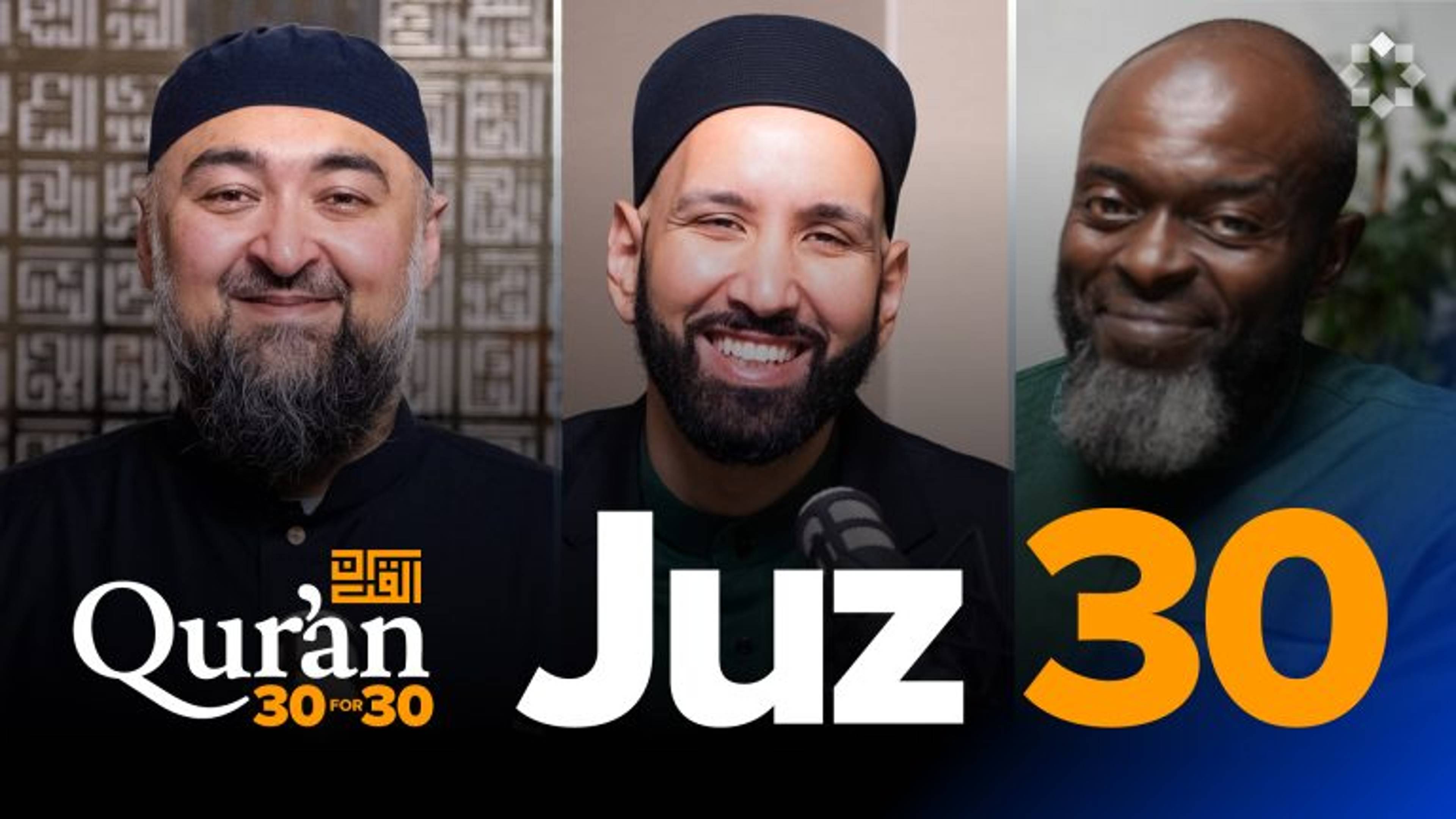
Qur’an 30 for 30 | Season 7
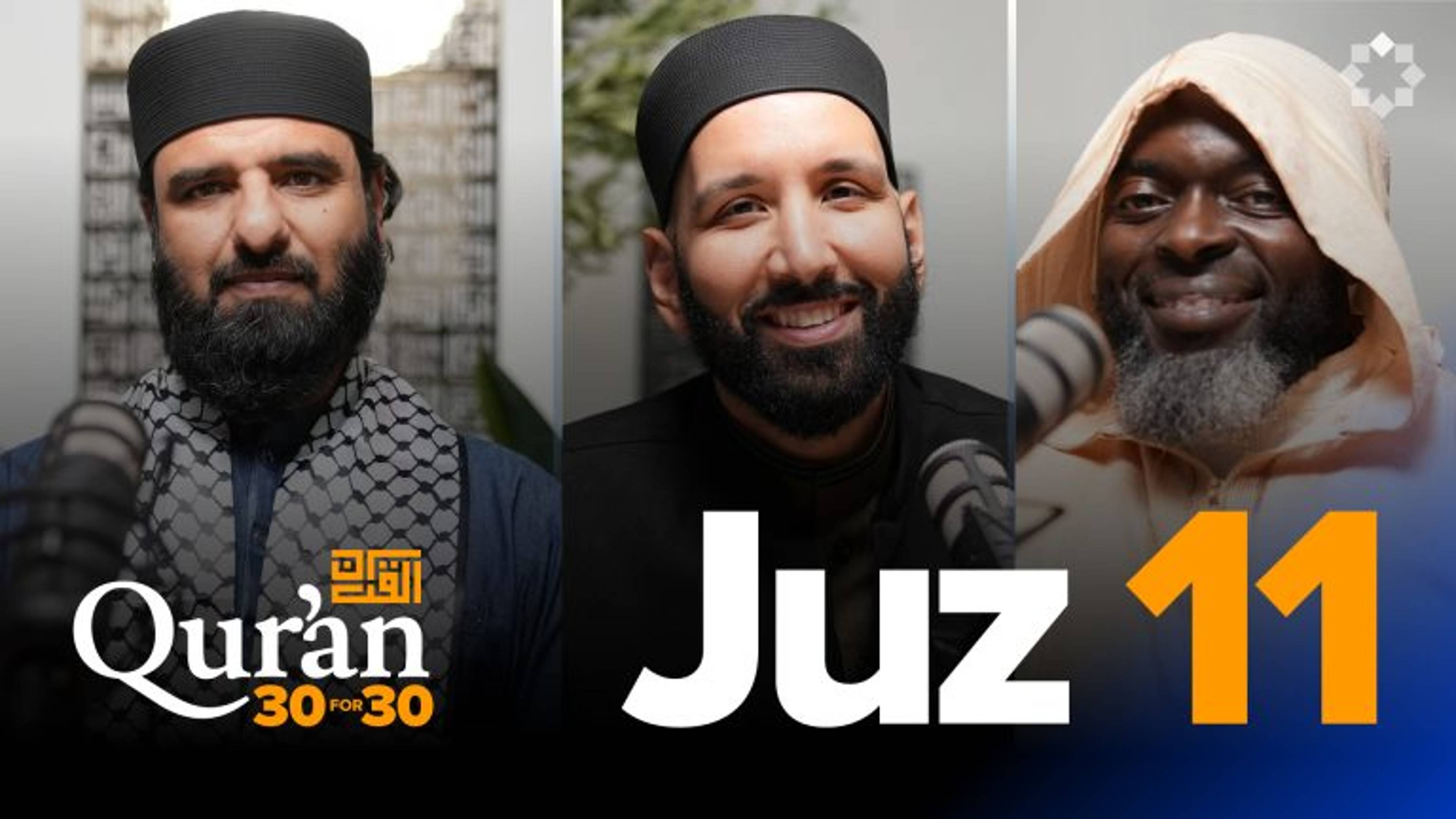
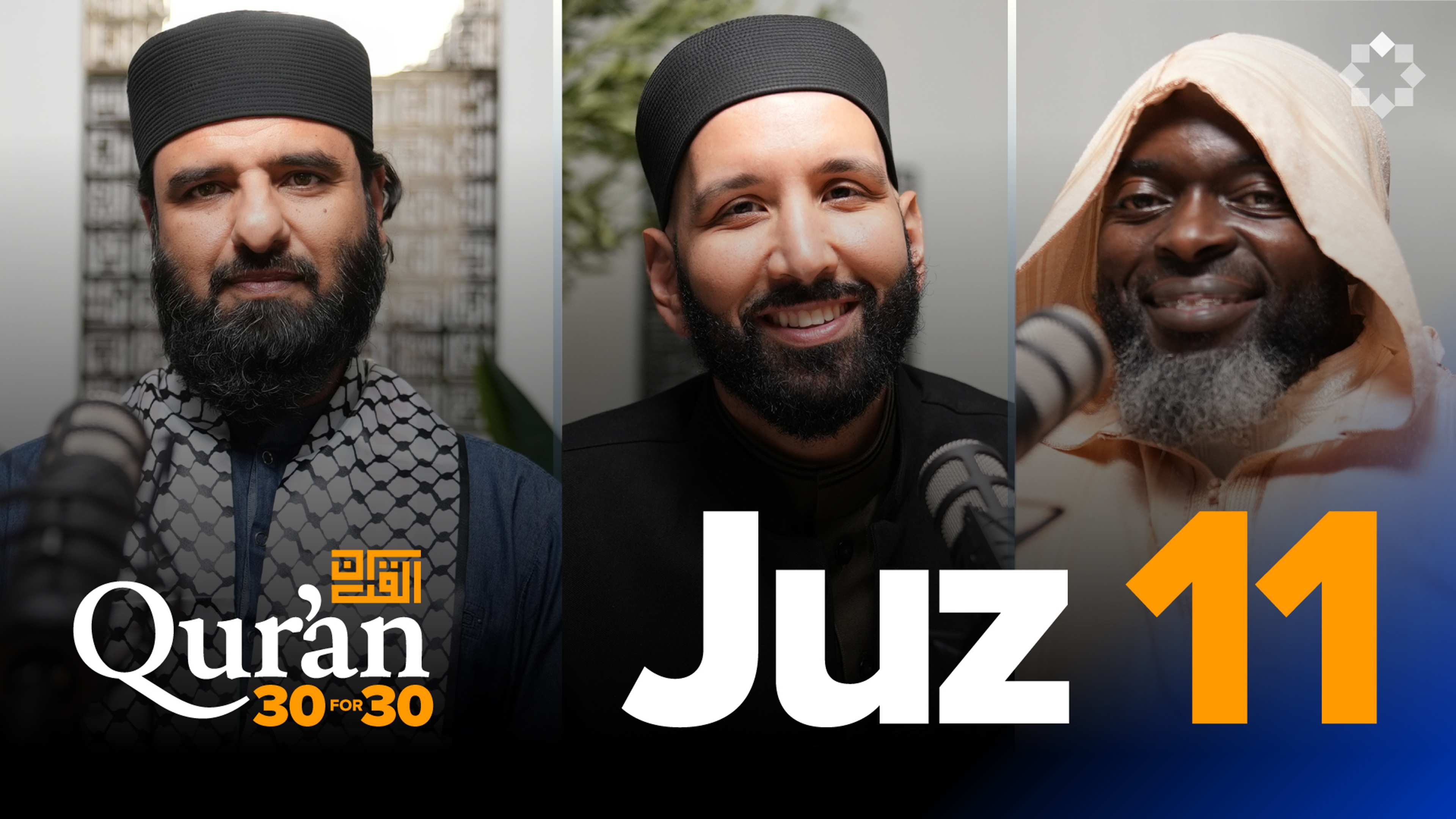
Juz 11: Stop Playing Games | Dr. Ovamir Anjum
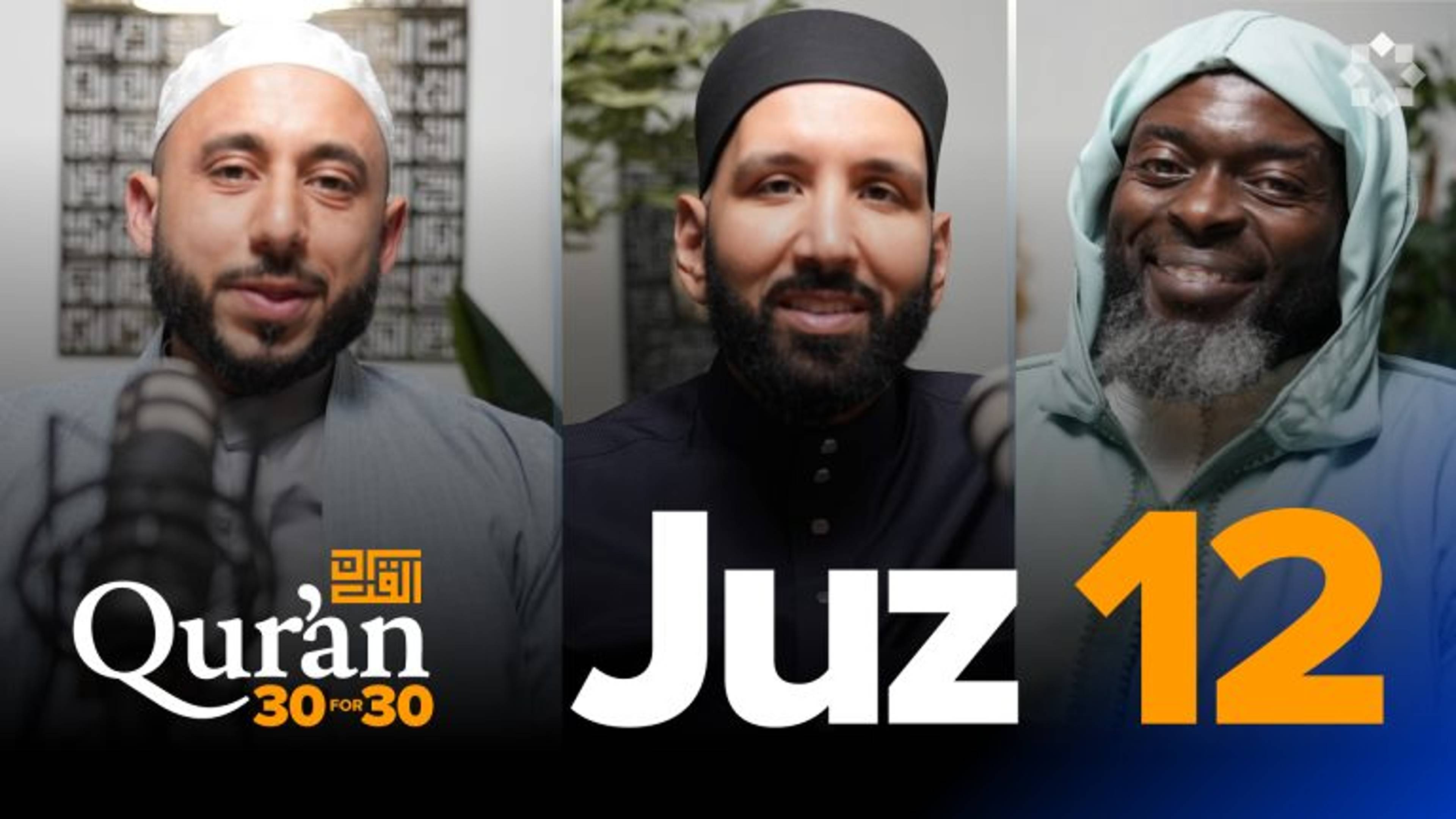
What is true repentance? Dr. Ovamir Anjum delves into the subtleties of repentance by reflecting on verses from Surah al-Tawbah and other passages from Juz 11, alongside Dr. Omar Suleiman and Sh. Abdullah Oduro.
They discuss repentance even after the gravest sins and how Allah continually keeps the door of repentance open.
Names of Allah discussed: Al-Qareeb, Al-Mujeeb, Al-Aleem, Al-Qadeer
This transcript was auto-generated using AI and may contain misspellings.
And Allah سبحانه وتعالى loves that tawbah where the person comes with a heart broken, even if it's the heart is broken because of a sin. Allah سبحانه وتعالى Ta'ala is prompting you and calling you to seek forgiveness from Allah سبحانه وتعالى and turn back to Him
individually from what you have done in this life. And that requires introspection. If you want to come to Allah عز وجل, there's a clear path back to Him. Stop playing games.
السلام عليكم ورحمة الله وبركاته everyone. Welcome back to Quran 30 for 30. الحمد لله رب العالمين. Just to remind you all, as we get into Juz 11, the middle 10 days بإذن الله تعالى to please do support the work of Yaqeen, follow along, and also be consistent. This
is where we usually see the drop-off in everything. So I just want to remind you all that, you know, this series gives you an opportunity بإذن الله تعالى to really keep up with your own Khatm, to make sure that you're reciting the whole Quran إن شاء الله تعالى.
And by watching these episodes every day, you get an overview of the juz and a very particular vantage point, which is how to connect to Allah سبحانه وتعالى through this particular juz of the Quran. So keep up with it إن شاء الله. Don't fall behind in these middle 10.
May Allah accept it from us all. اللهم آمين. We're blessed to have with us, الحمد لله رب العالمين, Dr. Ovamir Anjum. Alhamdulillah. How are you, doctor? الحمد لله. الحمد لله. الحمد لله رب العالمين, all the way from
Toledo, الحمد لله رب العالمين, a land of much greenery and trees. We're also blessed to have Shaykh Abdullah Oduro Al-Maghribi. He's officially like Moroccan. He's adopted the full Moroccan fit, you know. الله يبارك فيك. الحمد لله.
Dr. Ovamir, before we get started, if someone were to ask you, what's your favorite name of Allah right now, what is it? I was reflecting on these names of Allah, Qareeb and Mujeeb.
And then I thought that, subhanAllah, it is very hard right now for a lot of people to hold on to their Iman, seeing what they see in Gaza. And so I suggested to myself
the wird of إِنَّ رَبِّي قَرِيبٌ مُّجِيبٌ. إِنَّ رَبِّي قَرِيبٌ مُّجِيبٌ. That Allah is near and Allah sees and He answers and He hasn't forgotten. Beautiful answer, ماشاء الله, تبارك الله. الحمد لله رب العالمين, we are in
Juz 11 now. And it is the continuation of Surah At-Tawbah. It goes from verse 93 of At-Tawbah through Yunus into Surah Hud. And, you know, subhanAllah,
as I'm looking at the big picture of what this juz does, first of all, it's always remarkable to me that Surah At-Tawbah, which is this hard-hitting surah for the hypocrites, is still Surah At-Tawbah, right? Like it
is an opportunity, even in the midst of disavowal of the hypocrites, Allah Subhanahu wa Ta'ala calling people back to repentance. And it's similar to, you know, I remember reading Imam Hasan al-Basri rahimahullah Ta'ala as he comments on
إِنَّ الَّذِينَ فَتَنُوا الْمُؤْمِنِينَ وَالْمُؤْمِنَاتِ ثُمَّ لَمْ يَتُوبُوا, right? Those who test the believers, who torture the believers, who oppress the believers, and then they don't make tawbah. That even in the midst of something so horrific, Allah Subhanahu wa Ta'ala still offers tawbah, right? That there is
redemption and repentance. Of course, that is proportional to what has been committed, but that Allah Azza wa Jalla offers it, right? Even in the midst of these types of episodes. So Surah At-Tawbah is the most severe on
the hypocrites. It's the most comprehensive on the hypocrites. It's sort of the last surah, a final warning to the hypocrites, right? Surah Al-Munafiqun is actually mid-Madinah, right? Allah Subhanahu wa Ta'ala is showing their hypocrisy as it's becoming more
obvious at that point. But still, ثُمَّ لَمْ يَتُوبُوا, right? Do they come back? Do they return to Allah Subhanahu wa Ta'ala? And in this juz, very interestingly enough, as you go through Yunus and Hud, the last two examples that are
given, the people of Yunus, right, who turned back to Allah Subhanahu wa Ta'ala when it seemed too late, when they didn't seem to have any hope, they actually did turn back to Allah Subhanahu wa Ta'ala. And Allah Azza wa Jalla accepted them and He forgave
them and He turned towards them. And then after that, the very final example that we find in this juz is Fir'aun making his supposed tawbah. Verse 90 in Surah Yunus where he says,
آمنت أنه لا إله إلا الذي آمنت به بنو إسرائيل, that verily I believe in that there is no God except that in whom بنو إسرائيل believe. And I am now amongst those
who submit. So you have Fir'aun supposedly making tawbah, but his tawbah doesn't get accepted. So subhanAllah, you've got the people of Yunus alayhi as-salam who repent when it seems too late, and then Fir'aun who, you
know, verbalizes, but it is actually too late and it is a form of deception. Now, this actually highlights the way that Allah Subhanahu wa Ta'ala talks about how He is well acquainted with people's
intentions throughout this juz, right? And it's really just very obvious. It's like repentance, tawbah, is not some backdoor sneaky deal. Like you've got to come to Allah Subhanahu wa Ta'ala through the front door.
Like it's very obvious. Like you're not going to be able to weasel your way out of what you're doing. If you want to come to Allah Azza wa Jalla, there's a clear path back to Him. Stop playing games, right? This is a juz which is stop playing games. Allah
Subhanahu wa Ta'ala knows what you're doing. Stop playing games. And so you even have, for example, in this juz, Masjid Quba, where Allah Azza wa Jalla praises the intentions, right? People that love to purify
themselves, people that are building from hearts of piety a structure that is built upon piety, أُسِّسَ عَلَى التَّقْوَى, right? Allah is comparing
Masjid Quba to Masjid Dirar, which on the outside, right, the externals, it could look the same. In fact, you know, Masjid Dirar, which is being built by the hypocrites, could have more glamour to it, right? But at
the end of the day, it's not about what the structure looks like. It's about the hearts, the agendas, the intentions. And Allah is very well acquainted. And Allah is bringing that out in Surah At-Tawbah. Then look at this.
Allah Subhanahu wa Ta'ala says in verse 119, يَا أَيُّهَا الَّذِينَ آمَنُوا اتَّقُوا اللَّهَ وَكُونُوا مَعَ الصَّادِقِينَ, O you who believe, be mindful of Allah and be
amongst the truthful. And الصَّادِقِينَ here is, of course, referring to صِدْق in the most overwhelming and comprehensive sense, that your intentions are pure and truthful, your words are truthful, your actions are truthful,
that all of it is a testimony to this true covenant that you've taken with Allah Subhanahu wa Ta'ala. So Allah Azza wa Jalla is calling us to repentance no matter where we are, but don't be sneaky, right? Like Allah knows and Allah Subhanahu wa Ta'ala
is well acquainted. And the last verse in this juz ends with what? يَعْلَمُ مَا يُسِرُّونَ وَمَا يُعْلِنُونَ ۖ إِنَّهُ عَلِيمٌ بِذَاتِ الصُّدُورِ. Allah knows
what they conceal and what they reveal. Surely He knows best what is hidden in the hearts. At the end of the day, what they try to hide in their hearts, Allah Azza wa Jalla will bring it out. Allah Subhanahu wa Ta'ala is already exposing it in this juz,
what you were thinking, what you were intending. And, you know, of course, in the last juz, which leads into this, we were talking about إِنَّهُ هُوَ السَّمِيعُ الْعَلِيمُ, right? That Allah is all-hearing and all-knowing. So He sees it,
He hears it. And at the end of the day, come through the front door of tawbah. Don't try to sneak around the way that these people were sneaking around. And they had their exit plan that fails them, right?
Like Fir'aun. He probably knew all along, right? That, look, if push comes to shove, you know, I'll wait and I'll see how this all plays out and I'll figure it out then. And of course, by the way, just because it's important to actually
mention here that someone might say, well, why wasn't Fir'aun's repentance accepted? The Prophet (ﷺ) mentioned that Allah ﷻ will accept the tawbah of a person until they start foaming at the mouth, right? That there's a point where your tawbah at an
individual level no longer is acceptable, which is the initiation of death has already come. You're already dying at that point. And you're already at that point where it doesn't matter. That is for the individual. At the collective level, it's when the sun rises, as the Prophet
(ﷺ) mentioned, from the west. So there's the individual time in which the door of tawbah is closed. And that is a person that was sneaky, that waited until the very end, that tried to fool Allah ﷻ, deceive Allah عز وجل,
and they only deceived themselves. So may Allah Subhanahu wa Ta'ala make us sincere in our repentance. And verily Allah knows when we are sincere in seeking Him. And Allah ﷻ certainly can accept us despite what
He knows about us and our shortcomings. جزاك الله خيرا, as you were talking, it made me think, of course, even for people who built up Masjid Ad-Dirar in order
to destroy Islam and hurt Rasulullah صلى الله عليه وسلم, Allah Subhanahu wa Ta'ala gives in Surah At-Tawbah a condition of their tawbah. And this is the, you could
say, the highest condition for the people that are least deserving of it, which is إِلَّا أَنْ تَقَطَّعَ قُلُوبُهُمْ, just to emphasize your point. Allah Subhanahu wa Ta'ala describes the hearts that you need after having committed
such a great crime that you live with the Prophet صلى الله عليه وسلم, you see his Nur, you see his truth. Your hearts are so dark that after all of that, you are not only not open, but you are conspiring to kill him. Nothing. We cannot imagine
something worse than that. And then after that, Allah Subhanahu wa Ta'ala says Allah will not accept their tawbah, but even then there is a door, to emphasize your point, إِلَّا أَنْ تَقَطَّعَ قُلُوبُهُمْ, that their hearts
are broken to pieces. And so this is the highest kind of tawbah that we should aspire to. Beautiful. You have to go to Allah Subhanahu wa Ta'ala with a broken heart. And Allah Subhanahu wa Ta'ala loves that tawbah,
where the person comes with a heart broken, even if the heart is broken because of a sin, or the heart is broken because somebody broke their heart, some betrayal, or their heart is broken because they're sick.
Ibn al-Qayyim makes this point that sometimes people are most hopeless when they feel sick, when they have long illness. And Allah Subhanahu wa Ta'ala loves when someone turns to Him with brokenheartedness,
such that He will forgive even this sin. You know, it's interesting. Like, imagine the visual of Yunus alayhi as- salam coming back to his people and finding them as believers. He turned his back, walked away from them because he thought they were hopeless. Then he went through his
own tawbah and his own being brought back to Allah Subhanahu wa Ta'ala, and then he returns to Allah Subhanahu wa Ta'ala, continuing the mission as Allah commanded him. And then he comes back to his people, and the same people that turned him away are now embracing him and saying, "Come back."
And, you know, they're believers. And that's, I guess, that is that brokenheartedness. Imagine how regretful they were that they even drove Yunus alayhi as-salam to that point of walking away from them. And now
they get their Prophet back in their sincere tawbah. So Dr. Ovamir, I'll start with you, insha'Allah ta'ala, sort of continuing along the lines of Al-'Alim.
إنه عليم بذات الصدور, verse 115 in Surah At-Tawbah. Allah Subhanahu wa Ta'ala uses this name in a very specific context, which is
the opportunity of guidance, right? Allah is offering guidance, and in the perfection and comprehensiveness of His knowledge, He teaches people what they don't know. He makes it very clear that He
knows what benefits and what harms, sometimes beyond what we know. And that's part of the believers' trust in Allah Subhanahu wa Ta'ala. So how do you reflect on Al-'Alim in this context? JazakAllah khair.
Allah Subhanahu wa Ta'ala says, وَمَا كَانَ اللَّهُ لِيُضِلَّ قَوْمًا بَعْدَ إِذْ هَدَاهُمْ حَتَّىٰ يُبَيِّنَ لَهُم مَّا يَتَّقُونَ ۚ إِنَّ اللَّهَ بِكُلِّ شَيْءٍ عَلِيمٌ. Allah Subhanahu wa
Ta'ala, first of all, the way that verse begins, Allah is Al-Qadir, Allah is perfect in His complete control. He creates, right? But He is putting a restriction on Himself. وَمَا كَانَ
اللَّهُ لِيُضِلَّ قَوْمًا Allah promises that Allah will not misguide a people after He has chosen them for guidance. So this is the greatest gift that we have as guidance. So in a sense, this verse is speaking to the believers,
that you already have guidance. And in that sense, you have the gift. Not only do you have the gift of guidance, but you have an additional gift, which is in this ayah, which is وَمَا كَانَ اللَّهُ لِيُضِلَّ قَوْمًا بَعْدَ إِذْ
هَدَاهُمْ حَتَّىٰ يُبَيِّنَ لَهُمْ مَا يَتَّقُونَ. An additional gift is that Allah will not hold you accountable for errors that you may make. After He has given you the guidance of Islam, you will make errors.
But Allah will not hold you accountable for them. Imagine this is the mercy. This is a special added gift that Allah will not say, "I have given you guidance. I have shown the Nur. I have, you know the Tawhid.
You know the truth." You should be able to figure out life, how to obey and submit to Allah Subhanahu wa Ta'ala in everything. But you will not do that. You will make errors, errors of judgment, sometimes other kinds of errors of
heart, of intention. But Allah, when that happens, Allah will show you and explain to you مَا يَتَّقُونَ, what you should fear, what you should avoid specifically. Because Allah
Subhanahu wa Ta'ala knows everything. He knows your hearts. He knows human beings. He knows your weaknesses. And the context here is that Ibrahim alayhi as-salam makes du'a for his father, which is, of course, Allah Subhanahu wa Ta'ala shows His love and honor
for Ibrahim alayhi as-salam. He is the Muwahhid. He is the epitome of Tawhid, submission to Allah, the knowledge of Allah. And His knowledge is such that even when he is a child, you know, he is able to think
about the world and then explain to his people, even though he's born in the house of an idol maker. Despite that, Ibrahim alayhi as-salam loved his idolatrous father, right?
His mushrik father, and makes du'a for him. So in the verse before, Allah Subhanahu wa Ta'ala explains, gives an explanation that, "Oh, Ibrahim only did that until
he was told, 'Look, you cannot make du'a for someone who is 'aduw of Allah, enemy of Allah. You have to do tabarru'. You have to disavow. You have to separate yourself." So this is an error that Ibrahim
alayhi as-salam made. And look at the error. SubhanAllah, his error is better than our righteous deeds put together, that he is asking for du'a, forgiveness. But he was not supposed to do that. But Allah Subhanahu wa Ta'ala doesn't say to Ibrahim, "You
should have known this." But rather, Allah Subhanahu wa Ta'ala says, "We will not, you have been given guidance." And then Allah generalizes. This is not only Ibrahim. It's general. وَمَا كَانَ اللَّهُ لِيُضِلَّ قَوْمًا, Allah will
not misguide you. Allah will not cause you to lose guidance, lose iman, and lose your way to Jannah until He will specifically show you what you should actually avoid, even though you should have
known the rights of Allah Subhanahu wa Ta'ala, right? Because He knows everything. And this reminds me of another story when Ibn Abbas (رضي الله عنه), you know, he asks
his companions, "Tell me the most hope-giving ayah in the Qur'an, أَرْجَى آيَةٍ فِي الْقُرْآنِ." And so they guess verses of mercy, you know, and he says,
"No, أَرْجَى آيَةٍ فِي الْقُرْآنِ is: وَإِذْ قَالَ إِبْرَاهِيمُ," when Allah said, when Ibrahim said to Allah, أَرِنِي كَيْفَ تُحْيِي الْمَوْتَىٰ, "O Allah, show me how You give life to the dead." Allah says, "Do you not
believe?" He says, "Yes, but it will give اطمئنان to my heart." So Ibn Abbas (رضي الله عنه) says, "This is the most hopeful ayah because it is Ibrahim who
asks for more signs after Allah spoke to him." If Allah were to look at the mercy and hope that you get from this, that even Ibrahim alayhi as-salam,
if he could ask Allah for more signs for اطمئنان, "O Allah, show me one more sign," then Allah Subhanahu wa Ta'ala will forgive us when we need
more signs, right? And that is an ayah that gives hope. So this ayah is kind of connected to that. Allah Subhanahu wa Ta'ala looks at Ibrahim, looks at the error that he makes, quote unquote, and then He says,
"A general rule, you believers, you will make mistakes, but Allah Subhanahu wa Ta'ala knows what is in your hearts." You know what's amazing is that the questioning of the hypocrite and the questioning of the believer
can look identical to the eye that's not discerning. Mm-hmm. The hypocrites keep asking questions, Mm-hmm, but as deflection. They have no intention to follow guidance. And so they keep asking questions
to complicate, to evade, whereas the believer asks questions from the desire to learn more and to come closer to Allah Subhanahu wa Ta'ala. You find like these ahadith where the Prophet (ﷺ) condemns persistent questioning, but there are also
شفاء العي السؤال, right? The Prophet (ﷺ) teaches us that the cure of ignorance is asking. Yeah. So it's the, it's again, where is the question coming from? Exactly. Right? Are you, is it coming from a place of wanting to know so that you can follow?
Or is it like Bani Israil when they start asking all these questions about the cow, right? Because they have no intention to follow in the first place. No, it's beautiful how, and touching on the knowledge of Allah Subhanahu wa Ta'ala and the way that He, the way
that it's shown here, because, you know, Allah will not choose to misguide a people until He gives them the clarity, مَا يَتَّقُونَ, how those signs can come to you. It's another qa'ida, right? It's another qa'ida of
af'al Allah, like what He does and how it manifests. But the importance and responsibility for the Muslim to seek knowledge, right? To really seek knowledge of Allah Subhanahu wa Ta'ala. And there's the experiential knowledge within. There's a knowledge that's acquired by learning from the
people of knowledge. Mm-hmm. And that's what's very, very important, because the more that you learn about Allah, the more you'll have a relationship with Him, and the more it'll manifest in your actions because of the knowledge of that particular name, for example, like Al-Ghafur, you
know, understanding how He is Al-Ghafur. And that could be مَا يَتَّقُونَ, you know, بَيَانُ مَا يَتَّقُونَ, because of that effort you made. And within all of that effort you made and how you acted upon that knowledge, Allah knew that as
well. And this is where it goes to qadar, you know, the predestination of Allah Subhanahu wa Ta'ala. But it's so beautiful because, you know, within all of this is the effort where we still have a level of responsibility.
So Shaykh, on that note, Al-Qadir, but particularly, uh, we go to the end of verse four of Surah Hud, where Allah Subhanahu wa Ta'ala mentions that He is
القدير, right? All-powerful, but in a very particular, uh, context. We're all going to return to Allah Subhanahu wa Ta'ala. So tawbah is the voluntary
return, right? Repenting, turning back to Allah. And death is the involuntary return. You all get pulled back. And at that point, when death comes, it's too late. How does
this sort of complement the notion of Allah's knowledge of where you were, where you wanted to be, and how Allah Subhanahu wa Ta'ala's qudra, His power, is just so obvious
compared to our weakness and our vulnerabilities? And that should bring us back to Him, that knowledge of His strength and that knowledge of His power versus our own weaknesses and vulnerabilities. No, ماشاء الله, it's a great segue, ماشاء الله تبارك الله. I mean, it's
beautiful how you gave the النسبي and then العام, which could be contingent on the particular person, of them coming back to Allah Subhanahu wa Ta'ala before we all go back to Him. And as you mentioned earlier about when the sun rises, you know,
that's going to be for everyone. But when there's مَا لَمْ يُغَرْغِرْ, you know, before that the person, you know, the signs of death or the implementation of death is happening, you know, at that time, it's too late to try to turn back to Him. So when, you know, Allah Subhanahu
wa Ta'ala is talking about in the chapter of Hud in the very beginning, where He says, وَاسْتَغْفِرُوا رَبَّكُمْ ثُمَّ تُوبُوا إِلَيْهِ, you know, that He may, that you may seek forgiveness from your Lord and turn to Him in repentance. And the verse continues, but Allah Subhanahu wa Ta'ala is prompting you and calling you to seek
forgiveness from Allah Subhanahu wa Ta'ala and turn back to Him individually from what you have done in this life. And that requires introspection, to ponder over that, with the knowledge that Allah Subhanahu wa Ta'ala has
the ability to bring forth that communal, or you say, the general, when everything will end and we will all return to Him. But we don't know when that is. But what's most important that we know that He knows
and that He has the quwwah, that He has the strength, that He has the qudra, the ability. And that's why the next verse, He says, إِلَى اللَّهِ مَرْجِعُكُمْ جَمِيعًا, that to Him, إِلَى اللَّهِ مَرْجِعُكُمْ وَهُوَ عَلَى كُلِّ شَيْءٍ
قَدِيرٌ, unto Allah is your return, and He has the power to do everything. What's beautiful about this verse and the insight on this verse is that He says, firstly, إِلَى اللَّهِ مَرْجِعُكُمْ, and the scholars call this al-hasr. So He mentions the object of the verb
or what will take place. So here, it is to Allah you will return. It didn't say you will return to Allah, which in the Arabic language shows the importance, and it's designated only to Allah Subhanahu wa Ta'ala, the return of all of creation, that they will go back
to Allah Subhanahu wa Ta'ala. And when the Muslim remembers that, you know, at the time of the sin, in general, which is hoped, but at the time of making that mistake, at the time of istighfar, like while
you're seeking forgiveness from Allah, you're thinking about death. You're thinking about, I don't know when Allah Subhanahu wa Ta'ala will take me, but at this moment, I hope that He'll accept from me. You consistently do that outside of, you know, the last 10 nights of Ramadan
and the 27th night. It's that sixth month, six months after Ramadan, where you're thinking, Allah Subhanahu wa Ta'ala, I'm going to return to Him. When I wake up, I say, الحمد لله الذي أحيانا, I praise Allah that He has given me life. بعد ما أماتنا,
after He has caused us to leave, some would say the cousin of death, of our souls leaving our body. وإليه النشور, that I'm going to go back to Him. And this is, subhanAllah, as some of the scholars mention, as some of the mushrikun, they believe that Allah Subhanahu
wa Ta'ala is Mubdi', that He's the one that brings things into existence. Then in that case, it's important for you to believe in the Ba'th, because some of them, the resurrection, they didn't believe in the resurrection. But if you look at the fact and understand that if He can bring things into existence, He can easily
resurrect them, which is even of a lesser form, as some scholars mention here. So He said, وَهُوَ عَلَىٰ كُلِّ شَيْءٍ قَدِيرٌ, He has the qudra, He has the ability, He has the power, He has the strength, and He has the knowledge to resurrect you, hold you accountable,
which is the Ba'th, and the accountability is the jaza'. And also, even before that, is the Hashr, to gather you all together. And we look at, ماشاء الله, in your series of Al-Barzakh, when talking about all of these events
that we have not seen that will take place, that's from the 'ilm of Allah that He is telling us. And we sit and think about that. Allah is telling us about things that have happened in the past that we haven't seen, and things that will happen in the future
that we may see. But He's showing you that He has the qudra and the ability to make all of this happen, بناءً على علمه, that is founded or couched or seated in His knowledge, the knowledge of Allah Subhanahu wa Ta'ala that is endless. So when
one remembers this, the qudra of Allah, when they face anything in life and they realize, okay, what I see in front of me, Allah Subhanahu wa Ta'ala has power over it. That which may grieve me, Allah Subhanahu wa Ta'ala has power over it. Allah Subhanahu wa Ta'ala has control over it. But what is my responsibility?
As Shaykh Sulayman mentioned, you know, having that, you know, we may ask the why, but it's most important to ask, what's the what? What is my responsibility, particularly in aspects of my faith and my creed and my
connection to Allah Subhanahu wa Ta'ala? So knowing His ability and His strength, when we hear the adhan and we say, لا حول ولا قوة إلا بالله, that there is no power nor might except with Allah. And I'll
end here when, you know, when we say, لا حول, la hawla is like transitioning from one point to another. And that transition requires quwwah, it requires strength, it requires ability. So knowing that Allah
Subhanahu wa Ta'ala's ability is endless, and it is nothing that يغلب عليه, that can overpower it, that brings a sense of tranquility and ease to the Muslim, and security
to go back to Him at all times, knowing that He has the ability to forgive you for your sins. So may Allah Subhanahu wa Ta'ala make us of those that remember this pillar of Islam, this pillar of our iman, that there will be a day of resurrection.
And may Allah Subhanahu wa Ta'ala make us of those that consistently remember this to push us to do actions of seeking His forgiveness. إِنَّهُ وَلِيُّ ذَلِكَ. Ameen. JazakAllah Khair. SubhanAllah, from His qudra is that He could have made everyone a believer. He could
have forced repentance on everyone from His power. But He chose out of His knowledge and His wisdom to let things play out differently, right, with these different examples. Dr.
Ovamir, do you have a final reflection for us? Man, I was listening to you both, you know, um that uh ayah that you recited, كُونُوا مَعَ الصَّادِقِينَ, stuck with me. I'm still
thinking about it. That ayah in Surah At-Tawbah appears in the context of the three uh Sahaba who were believers, but they acted like munafiqin, right? And SubhanAllah, I feel that that is
the condition. That's my condition. Insha'Allah, we are believers. I am a believer. But we look at our actions. But Allah Subhanahu wa Ta'ala, the cure that Allah Subhanahu wa Ta'ala
has for them is كُونُوا مَعَ الصَّادِقِينَ, be with them. It's not كُونُوا مِنَ الصَّادِقِينَ, or كُونُوا صَادِقِينَ. It would be harder to be
the truthful, to be among them. Allah says Subhanahu wa Ta'ala, كُونُوا مَعَ الصَّادِقِينَ, choose their side, be. So Allah is telling these Sahaba who have iman that was weak
to be with the Sahaba who chose to go on Ghazwah Tabuk and who had that iman. So part of the condition of their tawbah is to choose
the right side, and that is what's going to bring them to fill up the part of the iman that was missing. So I feel that's such a mercy to me and to the Ummah right now,
when we are watching and we are falling short. الله المستعان. الله المستعان, JazakAllah Khair, Shaykh. May Allah Azza wa Jalla make us with them and amongst them. Ameen. JazakAllah Khair for joining us, Shaykh Omar.
Shaykh Abdullah, as always, insha'Allah ta'ala, we'll see you all tomorrow. والسلام عليكم ورحمة الله وبركاته.