
fbpixel
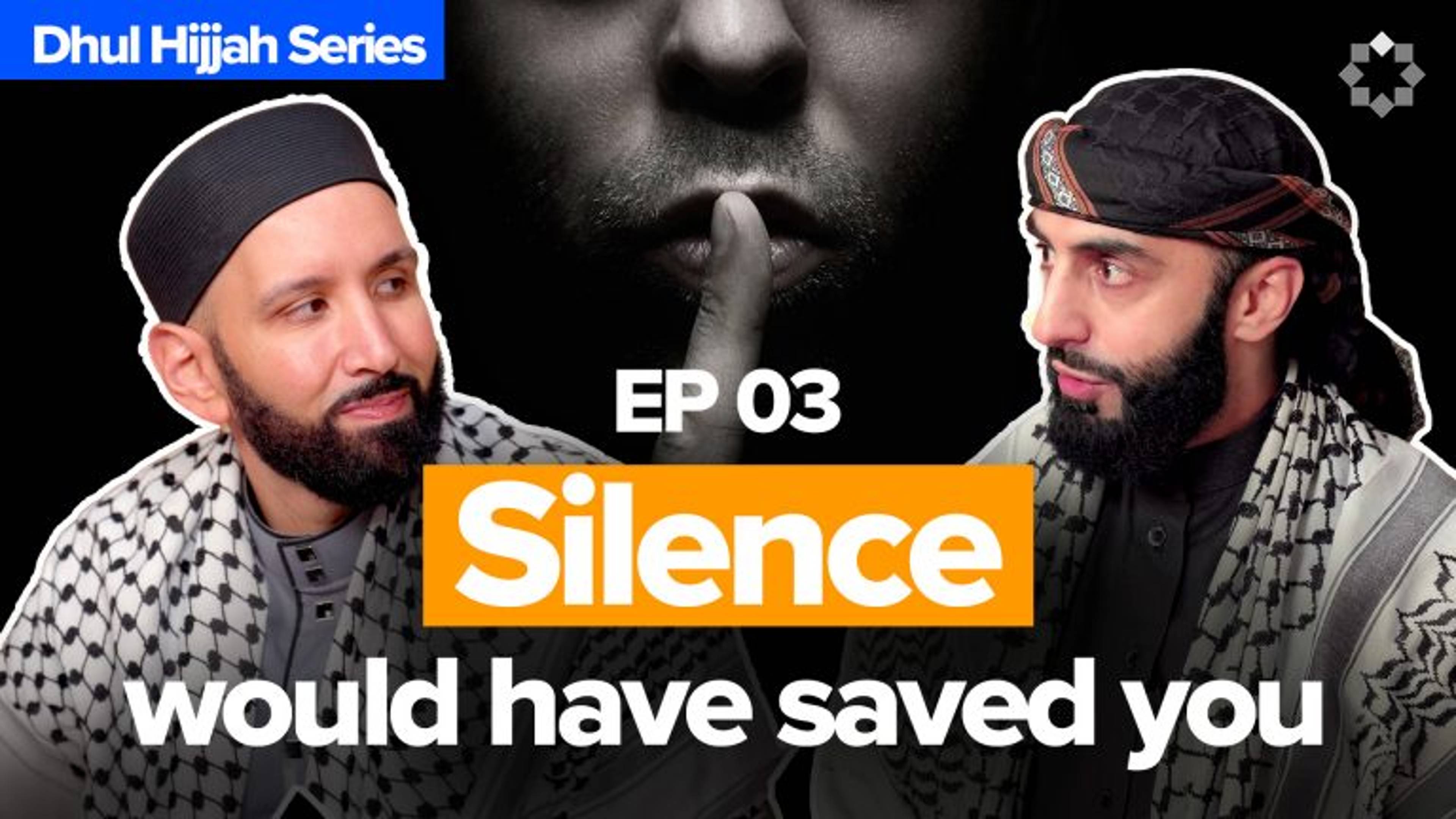
Ep.5 How You Will Be Resurrected | Dhul Hijjah Series | Dr. Omar Suleiman & Sh. Ali Hammuda

The Book of Heart Softeners Dhul Hijjah 2026

Ep.5 How You Will Be Resurrected | Dhul Hijjah Series | Dr. Omar Suleiman & Sh. Ali Hammuda
"Every soul will stand before Allah stripped of status and possessions, left only with their deeds.

The reality of resurrection comes into stark focus through the Prophet’s ﷺ description of humanity rising barefoot, naked, and overwhelmed by the severity of the Day of Judgment. As the illusion of worldly status fades away, the only garments that remain will be given to the people who clothed others, concealed faults, comforted the grieving, and chose sincerity over status.

Join Sh. Omar Suleiman and Sh. Ali Hammuda as they reflect on this moment of resurrection, the fear of standing before Allah, and how to keep Judgment Day in mind in our daily lives. " Special thanks to Heenat Salma Farm for hosting and supporting this series, and to Caravane Earth for collaborating with us on this journey.

This transcript was auto-generated using AI and may contain misspellings.
00:00Whose judgment do you fear more? Whose approval do you want more? And that is something that is supposed to exist while you're still here in this world.
00:13The same way that you are constructing a house of deeds, you are constructing a version of you on the Day of Judgment that you want to see.
00:20And that is what should be preoccupying you, not the distraction of everybody else who will die like you and who will be naked on that day just like you. And who will be just as vulnerable as you.
00:32Whenever there is an intense need, the greater the reward. So he said, food upon hunger and drink upon thirst and clothes upon nudity.
00:42 And it is upon us, insha'Allah, to start our independent search and research into the aspects that we can apply today earnestly, insha'Allah.
01:18'A'ishah, radiyaAllahu ta'ala 'anha, narrates that the Prophet ﷺ said that you will be resurrected on the Day of Judgment huffa, barefoot. 'Urra, which is naked.
01:30And ghurla, which is uncircumcised. 'A'ishah, radiyaAllahu ta'ala 'anha, says: قَالَتْ يَا رَسُولَ اللَّهِ الرِّجَالُ وَالنِّسَاءُ يَنْظُرُ بَعْضُهُمْ إِلَىٰ بَعْضٍ
01:41O Messenger of Allah, won't the men and the women be looking at each other if this is the situation? And the Prophet ﷺ responded and he said:
01:52الْأَمْرُ أَشَدُّ مِنْ أَنْ يُهِمَّهُمْ ذَاكُ He said ﷺ that the affair is too severe for them to be paying attention to that. SubhanAllah, Shaykh Ali, before we get into this,
02:06just a really human manifestation of this, especially in Dhul-Hijjah. If you go for Hajj or for 'Umrah, one thing I always notice is that in the beginning when the group first dons their ihram,
02:19there's an awkwardness, right? Like let's say you got a group of men and a group of women, friends, you take school trips, you take couples, and then suddenly the men are pretty exposed.
02:31In the beginning there's an awkwardness, right? But it only takes a few minutes. And especially once you're doing tawaf, no one's even paying attention anymore.
02:42Because at that point, they're all focused on the Ka'bah. The situation is too severe. And our mother 'A'ishah, radiyaAllahu ta'ala 'anha, just like the first hadith that we started off with, she asks the question that would be on the mind.
02:56The human interaction, the human response to the situation. But in this situation, as Allah subhanahu wa ta'ala says,
03:08that every single one of us will have too severe of an affair to be thinking about this situation, to be thinking about anyone else's burden, or to be thinking about how other people are looking at us,
03:20how other people are perceiving us. Could you go into detail, Shaykh Ali, with this hadith, what the Prophet ﷺ is specifying here, and what the deeper meaning is?
03:34So we have several descriptions of how people will emerge from their graves. We have huffa, and we heard they are barefooted. It's the peak of vulnerability. There's nothing even on your feet. 'Urra, completely nude.
03:48And then he goes to the detail, ﷺ, to say ghurla, which means uncircumcised. In other words, everything that you may have lost in this world, whether it's by way of surgery,
04:02or whether it's by way of an explosion, or a devastating accident, by design or otherwise, is restored to you. So a child who's lost his limb there in Gaza,
04:15his arm, his ear, his eyes, a part of his nose or her nose, everything is restored on Yawm al-Qiyamah. That land will not tilt in favor of anyone, even if it means to restore that bit of foreskin
04:29that a person had removed from the body. As Allah ﷻ said in the Qur'an: كَمَا بَدَأْنَا أَوَّلَ خَلْقٍ نُعِيدُهُ As we began the first creation,
04:42so shall we repeat it. وَعْدًا عَلَيْنَا This is a promise binding on us, Allah said, إِنَّا كُنَّا فَاعِلِينَ We shall do it. What is interesting is that the Prophet ﷺ
04:55then goes on to say in another narration: أَلَا وَإِنَّ أَوَّلَ الْخَلَائِقِ يُكْسَىٰ يَوْمَ الْقِيَامَةِ إِبْرَاهِيمُ He said the very first people or of people who will be clothed on the Day of Judgment
05:09will be Prophet Ibrahim ﷺ. So nudity is a common denominator between us all when we are resurrected. The hope is that through the decisions we make today
05:20and how we cover ourselves with piety through the right decisions we make in this world of ours, our nudity will quickly be erased, insha'Allah, on Yawm al-Qiyamah.
05:31The first of them, however, will be Ibrahim ﷺ. And Imam Ibn Hajar, he gives several reasons as for why it could be the case that Ibrahim ﷺ will be the first of creation to be clothed.
05:43Why him ﷺ? Let us perhaps identify some characteristics in his seerah, in his biography that perhaps we can adapt and reflect in our lives. Because the Lord who will clothe Ibrahim ﷺ is the Lord who we hope will clothe us as well
05:56on Yawm al-Qiyamah. One opinion is that Ibrahim ﷺ will be the first to be clothed because when he was cast into the fire, he was stripped bare of his clothes. And because he was persecuted in the path of Allah,
06:10Allah Almighty will compensate by giving him clothing on Yawm al-Qiyamah to give him security. This was al-Qurtubi's opinion. Others have said Ibrahim will be the first to be clothed on Yawm al-Qiyamah
06:22لأنه أول من سن التستر بالسراويل He was the first to start the tradition of clothing yourself, covering yourself with the lower garment with the intention of extra concealment or extra covering.
06:36So Allah will return that favor by covering him on Yawm al-Qiyamah as the first of creation. And some have said, and this was the opinion of al-Halimi, is that because Ibrahim was the most fearful of Allah Almighty on the Day of Judgment,
06:50so Allah Almighty will give him security as a thanks on Yawm al-Qiyamah by making him the first to be dressed. Sometimes, brothers, there is a shock in our lives
07:03that causes the heart to collapse whereby you completely disassociate from the world around you. This is perhaps what is being described here on Yawm al-Qiyamah. The sight of nudity that would usually capture our attention
07:17is no longer a matter of concern or interest on Yawm al-Qiyamah. Why? لِكُلِّ امْرِئٍ مِنْهُمْ يَوْمَئِذٍ شَأْنٌ يُغْنِيهِ Everybody will have a matter that will occupy him or her on Yawm al-Qiyamah. And allow me to mention here,
07:30Shaykh Omar, several examples of what it means to disassociate from the world around you because of trauma, because of shock, where something in the heart collapses.
07:43And in order to protect your mind, it's almost as though your mind almost temporarily checks out to protect the system from being further overwhelmed. So it's as though you disconnect from reality because it's too much to bear.
07:56So you're not there anymore. Somebody who can squat, say, 200 kilos of iron on his back, strong man, but then someone says to him, and all of a sudden, he can't carry his own body weight, which shows you that the strength
08:10was never his quads. It was something invisible inside, which gives meaning and which gives resolve and power. Shock caused him to collapse. We've heard of people who in the case of shock,
08:23they randomly start giving the Adhan, the call to prayer in public. It's Habibi, it's not the time for Salat. He's shocked. He doesn't know what he's saying. Or in a time of trauma, someone who starts calling out for someone who died many years ago.
08:35They're not there. I remember a friend of mine, a paramedic. I asked him, What was the strangest thing you've come across? He said to me, Subhan'Allah, once we came into a home to respond to the death
08:49of an elderly woman. We came into the room and she was in the living room and she clearly, all of the signs of death were there on her. And she was a woman, say, in her 70s or 80s. He said, What was more startling than that was her daughter,
09:03a middle-aged woman, sat by her side and she was combing her hair as though she was still alive. She's clinging onto any remnants of normalcy, refusing to accept that she has gone.
09:17Disconnect. You disassociate. Right? At war, sometimes a person will lose a limb or lose a leg and somehow he gets up and he tries to run. He's not there or someone who's even disemboweled and they continue fighting
09:31though they don't realize what's happened to them. Our Prophet ﷺ also experienced a portion of this when he went to At-Ta'if to invite them to Islam and he was treated
09:45in a very harsh way and he left and his ankles were bleeding. You know the story. What does he say? He said that, فَلَمْ أَسْتَفِقْ إِلَّا وَأَنَا بِقَرْنِ الثَّعَالِبِ I continued to walk
09:58and I only regained consciousness of where I was until I reached Qarn al-Tha'alib. Qarn al-Tha'alib is near Mina today. So he walked from At-Ta'if to near Mina.
10:10That's around 88 kilometers. That's almost the entire width of Qatar by the way. He said he walked that entire distance unaware of where he was. That's what happens to us. See?
10:23So it's not surprising that our mother Aisha, she receives this response from the Prophet ﷺ saying to her, No, no. الْأَمْرُ أَشَدُّ مِنْ أَنْ يُهِمَّهُمْ ذَٰلِكَ
10:35The matter is far greater than for them to realize this. Now I'll just say one thing, Shaykh, before I pass over, which is when I was delivering this hadith to some of my students in the UK,
10:47one of the students is a psychiatrist and he said to me, You know what is strange is that in psychiatry we call this dissociation. You disconnect from the world around you because of a sudden shock.
11:00And we have certain techniques to help a person come back to reality. And one of them is a grounding technique where we encourage them to take off any material on their feet and to stand on the earth. And he said, Subhan'Allah,
11:14you find on Yawm al-Qiyamah, people are walking barefooted as though to say to them, Yes, you are in shock, but you need to come back to reality because your accountability is about to start.
11:28So what is a person to do in this situation other than to prepare the essence of the garments of piety that is the best of all garments. Beautiful reflections.
11:42Subhan'Allah. I think when I connect this to the previous hadith, there's a lot that we've spoken about of the deeds that you present. And then there are the vulnerabilities that are created
11:56because of the securities that are no longer there, the external. And then there's the trepidation of the sins that you've put forward coming to light. Now you think about
12:10what your clothes represent. When you walk outside, you have a bare minimum that you want to be dressed to an acceptable level and appear, let's put appearance
12:24in the broader sense here, not just focus only on the clothes. But you want to be to an acceptable level because you fear their can anyone complete that sentence? You fear their judgments. You fear their judgment.
12:38So I can't go out with one sock. I can't go out with a hole in my clothes. I can't go out with this because I fear their judgment, right? They might perceive me in that way. So it's the first thing. I fear their judgment.
12:51But then you embellish yourself. You embellish your profile. You embellish your appearance. Your whole life you're constructing an image of yourself because you want their approval.
13:04Fear their judgment, want their approval. There's the disassociation from vanity here. What are you trying to construct? What appearance are you trying to construct?
13:16Who are you performing for? Who are you trying to look good for? Whose judgment do you fear more? Whose approval do you want more? And that is something that is supposed to exist while you're still here in this world. The same way
13:29that you are constructing a house of deeds, you are constructing a version of you on the Day of Judgment that you want to see. And that is what should be preoccupying you, not the distraction of
13:41everybody else who will die like you and who will be naked on that day just like you and who will be just as vulnerable as you, right? So it really is a powerful way to disassociate. SubhanAllah,
13:52I want you all to think about this. Like I can say that just sitting next to Shaykh Ali elaborating, hasn't the Day of Judgment become just that much more real to you just in the last five ahadith? There's an imagery.
14:06Imagine if we pondered on this every single day of our lives. And that was the state of the Prophet ﷺ and the Companions. They thought about this every single day when they prayed their Salah. Maliki Yawm al-Din.
14:20If they read no other ayah about the Day of Judgment, they pondered upon this every single day. Those images were fresh. And that's the point. That if you embrace that reality and then manifest a reality of yourself,
14:34in response to that reality, then you don't have to see it to act for it, right? So you think of yourself standing on that day. How do I want to be constructed on that day? How do I want to be brought forth?
14:47What occupies me now so that I don't worry about them today? Because I certainly won't be worrying about them on that day. Shaykh Ali, I'll pass it back to you with a very specific question. What are some actions that can adorn us on the Day of Judgment?
15:02So, Alhamdulillah, it wasn't just a problem that was identified. In this case, nudity. As you ask, Shaykh, there is also solutions offered in the prophetic Sunnah.
15:13And this is from the mercy of Allah ﷻ. So take note, brothers. There's a few simple actions that we can imbue in our day-to-day that can really be a game-changer on Yawm al-Qiyamah.
15:26The first of them is the idea of leaving expensive garments, at least occasionally, out of a sense of humility towards Allah ﷻ. The Prophet ﷺ said,
15:53Yeah, which means any person who leaves expensive clothes out of humility to Allah ﷻ, Allah will summon that person, invite him on Yawm al-Qiyamah in front of all of creation
16:06to allow him to choose which of the garments of Iman he wants to wear. So there are some people who open up their wardrobes in the morning and they're about to pull out the
16:15Louis Vuittons or the Guccis or whatever it may be, and then something in their hearts happens and they close the cupboard door. Only Allah knows of the conversation that happened internally.
16:27That made them turn down that clothing for one day. That's a cause of stitching your own clothes of Yawm al-Qiyamah. Another way is to be present for somebody who is bereaved.
16:38Something as simple as giving ta'ziyah, words of consolement and relief and support for someone who has gone through, say, death. The Prophet ﷺ said,
16:58Any person who consoles a bereaved person in the life of this world, Allah Almighty will adorn him with the clothing of honor on Yawm al-Qiyamah.
17:08What is the clothing of honor? What is the clothing of Iman? That's a surprise left for us, insha'Allah, for the Day of Judgment. A third easy one is well, brothers, وَمَنْ سَتَرَ مُسْلِمًا سَتَرَهُ اللَّهُ فِي الدُّنْيَا وَالْآخِرَةِ
17:22The Prophet ﷺ said, whoever covers the fault of a Muslim or whoever covers a Muslim, veils a Muslim, Allah will veil him in this world and in the Hereafter. What type of veil?
17:36It's left open to include every type of veil for every 'awrah, every flaw, every defect, physical or otherwise, that you would wish otherwise to be covered.
17:47Another quality is where the Prophet ﷺ said, listen to this hadith and link it to the famine that is rife in Sudan, in Gaza and in other parts of the Muslim and the non-Muslim world.
18:02The Prophet ﷺ said, three parts, أَيُّمَا مُؤْمِنٍ أَطْعَمَ مُؤْمِنًا عَلَى جُوعٍ أَطْعَمَهُ اللَّهُ مِن ثِمَارِ الْجَنَّةِ
18:12Sentence one, any believer who feeds another believer who is hungry, Allah will feed him from the fruits of Jannah. Sentence number two,
18:22وَأَيُّمَا مُؤْمِنٍ سَقَى مُؤْمِنًا عَلَى ظَمَئٍ إِلَّا سَقَاهُ اللَّهُ مِنَ الرَّحِيقِ الْمَخْتُومِ Any believer who gives a cup of drink to another person, another believer who is thirsty upon thirst,
18:34so there is need, Allah Almighty will give them to drink from the sealed nectar of Jannah. Listen to this third one, it relates to the idea of stitching your own clothes for tomorrow. He said, statement three,
18:48وَأَيُّمَا مُؤْمِنٍ كَسَا مُؤْمِنًا عَلَى عُرْيٍ إِلَّا كَسَاهُ اللَّهُ مِنْ خُضْرِ الْجَنَّةِ And any believer who clothes another believer who is nude, who has no clothes,
19:01Allah will clothe this person from the beautiful green garments of Jannah. The emphasis of the hadith here, as Dr. Abul Karim Al-Khudayr said, is that
19:13whenever there is an intense need, the greater the reward. So he said, upon hunger, and drink upon thirst, and clothes upon nudity,
19:24the greater the need, the greater the reward. And it's upon us, insha'Allah, to start our independent search and research into the aspects that we can apply today to earn us, insha'Allah,
19:37some clothing to cover our nudity on Yawm al-Qiyamah. JazakAllah khair. And there's a direct connection between not being so distracted by your own vanity, by the very real poverty that's out there today,
19:51and not being so distracted by the vanity of this world to where you forget your poverty tomorrow. And I think that's the beautiful connection that all of these ahadith keep on bringing us back to,
20:03that what are you trying to construct for yourself in the world that you will go to? And what are you trying to construct for others in this world that you are in right now?
20:14May Allah subhanahu wa ta'ala allow us to clothe ourselves with taqwa, with a beautiful appearance for Him. And may Allah subhanahu wa ta'ala allow us to clothe those who are in the poverty of sin, or in the poverty of suffering in this world. Allahumma ameen.
20:26Insha'Allah we'll take our two questions. Go ahead. How do we constantly remember and remind ourselves of the Day of Judgment so that we remember what state we'll be in on that day?
20:40How scared we'll be? How do we remember that in our daily lives? So the Prophet ﷺ said that Allah has said that, I do not combine for My servant two feelings of fear and two feelings of security.
20:54If he fears Me in this life, then I will make him feel secure in the next life. And if he feels safe from Me, in a way that's delusional, in a way that he's complacent and he overlooks, belittles,
21:07what Allah 'azza wa jall has made great, then I will cause him to fear Me on the Day of Judgment. And so there has to be a healthy fear. We started off with that. A healthy fear that there is a fear that runs you back to Allah subhanahu wa ta'ala.
21:22When it comes to the Day of Judgment, reading about it constantly, if you think about how much of the Qur'an is about the Day of Judgment, the scenes of the Day of Judgment, visualizing it, reading it constantly. If you read the Qur'an daily, you will visualize it. Thinking about its specific scenes.
21:36I remember when I did the Judgment Day series, and we went through many of these very refined points. I would see people about a month after, and they would say, you know, I was thinking about the Day of Judgment every day in Ramadan, but now a month later, it's disappearing.
21:50And I said, SubhanAllah, that's actually the hadith of the Prophet ﷺ. When he said to the Prophet ﷺ, you know, that I've become a hypocrite.
22:04Why? Because when we're with you, right? We're so connected. Like, we can visualize the hereafter. I'm paraphrasing, obviously, right? It's like, we are in such a state of iman, we're in such a state of faith, and then we go back and we get distracted by our families,
22:18and we get distracted by all these other things. And the Prophet صلى الله عليه وسلم explained that this is natural. Sā'ah wa sā'ah, an hour for this, an hour for that, a time for this, a time for that. If you were to be in the state that you are in with me, at all times, the angels would shake your hands in the streets.
22:32You can't. You can't possibly do it. So, to carve out a time of your day, where you're making du'a, the morning remembrances and the evening remembrances, there's mention of the Day of Judgment there, try to visualize it.
22:46Try to be more present in your prayer, when you read the verses about the Day of Judgment. And then try to have a daily reading of the Qur'an itself, where you are paying attention to those verses, and really living in those verses. Not thinking about how many pages you read,
23:00but how deeply you read the pages, every single day, and focus on those scenes. JazakAllah khair. JazakAllah khair. Another question? I have a question. So, I made the connection that
23:14the three ways that Allah سُبْحَانَهُ وَ تَعَالَى describes how we'll be raised is barefoot, nude, and uncircumcised. It's the same way that we were once brought into this dunya. Is there any wisdom behind the fact that the way we were
23:28brought into this dunya is the same way that we will once be brought back to life? Alhamdulillah. So, as you see from these hadith that we're covering, there is clearly a systematic
23:42undoing of everything that supposedly had meaning in the life of man, other than Allah سُبْحَانَهُ وَ تَعَالَى. So, first of all, the world was decked, razed, leveled
23:57and everything that we thought was familiar and was of worth disappears. That's the physical structure around you and the landscapes and landmarks, they disappear. But then the clothes that we wear,
24:11they are also then taken away from us. And we're gonna come across other hadith where we will realize that even the very air that we will be inhaling on the Day of Judgment for many people, when Allah has no mercy, will be a different
24:25type of air where people will be submerged in their own perspiration. So, it's almost as though there is a systematic dismantling of everything that we thought was real and was of worth and to realize that it was delusional,
24:39it was fake, it was not real. This is what, this is the only thing that ever held any type of weight. Also, it's the idea of all of us being put on an equal playing field.
24:53So, this is an earth that will not tilt in the favor of anybody. Nobody will have home court advantage. Nobody will be missing a limb or having an extra limb, rather all will be identical so that
25:07there is a physical manifestation of just how equal the justice of Allah Almighty will fall upon people. Wa'llahu a'lam.