
Jump to:
Qur'an 30 for 30 | Season 3
Juz' 1 with Dr. Tesneem Alkiek | Qur'an 30 for 30 Season 3
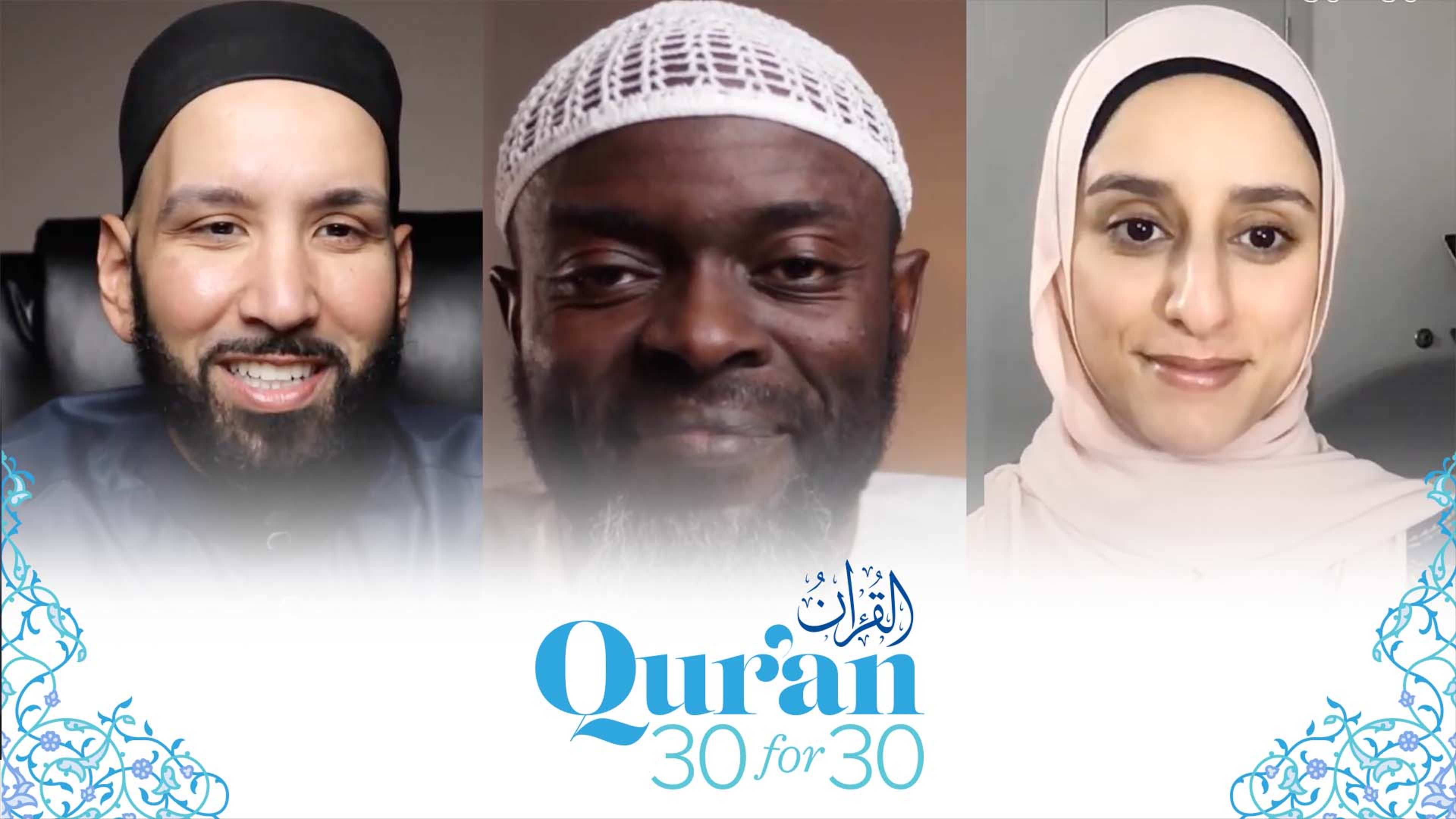
The opening verses of the Qur'an introduce five of Allah's names, including the Most Merciful, Master of the Day of Judgment. With the afterlife in mind, Dr. Omar Suleiman and Sh. Abdullah Oduro return this season with Dr. Tesneem Alkiek to dive into the beauty and wisdom behind Allah and the Unseen, khushu' in prayer, and practical tips that will inspire us to act for our akhirah.
Join Dr. Omar Suleiman, Sh. Abdullah Oduro and special guest Dr. Tesneem Alkiek as they explore gems from the first juz of the Holy Quran.
Download the new eBook "Qur’an 30for30: Seerah Edition" here.
This transcript was auto-generated using AI and may contain misspellings.
Ramadan Mubarak, Alhamdulillah, Salatu wasalamu ala Rasulullah wa ala alihi wa sahbihi wa man wala So we're back with Qur'an 30 for 30 and looking forward to spending this time with you InshaAllah ta'ala before we get started just to remind everyone
It's the season of Ramadan. So biidhnahi ta'ala as you are allocating the Donations towards the very worthy causes that are out there. We hope inshaAllah ta'ala that you'll consider Yaqeen once again I hope that you're enjoying already the launch of the Judgment Day series
And all of the other things that are coming out Alhamdulillah That is a direct testimony first and foremost of course to Allah subhanahu wa ta'ala We give praise and thanks and then to all of you for investing in Yaqeen
And I hope you've seen the growth inshaAllah ta'ala in everything that we have been able to do Since then Alhamdulillah rabbil Alameen So I want to remind you all to please donate and then go to the page
Yaqeeninstitute.org the webpage and you'll see there a bunch of resources that have accumulated over the years as well Our first Quran 30 for 30 e-book, last year's Seerah edition, Convert Resources with Shaykh Abdullah
Dr. Tasneem's Habits workbook, Shaykh Tahir Wais Du'a's e-book A lot of e-books, a lot of worksheets, a lot of videos, a lot of series and a lot of khair biidhnahi ta'ala
And Alhamdulillah because of your donations we were able to go sign Shaykh Abdullah Aduru Who we're introducing Alhamdulillah So it was like, you know, I don't know if Adam Schefter tweeted this out or not but like we got Shaykh Abdullah Alhamdulillah
Who has joined us this year once again He's about, you know, 30 pounds heavier, all muscle Alhamdulillah He's almost benching as much as I am now, almost doing as many jump ropes as I do
Superior scholar Alhamdulillah, inferior athlete but almost there, better human being Alhamdulillah Shaykh Abdullah, how's it going? Alhamdulillah, Alhamdulillah, just making du'a to be like you Shaykh, I'm waiting for that ping pong match coming up inshaAllah man
Ready to go It'll come man, it'll come inshaAllah InshaAllah I'm gonna use the first 20 days to practice, then I'll make du'a the 21st night
And if the sun comes out and it looks like Laylatul Qadr, I'll play you a ping pong inshaAllah We'll see how it goes We'll see, we'll see And we're gonna get your face palms back, lots of face palms inshaAllah
Those haven't changed but as much as you've been lifting, your face palm might like dent in your face If you come too hard at it Shaykh We'll see, we'll see Let's see how many we can get tonight Alright, let's see how many we can get
Dr. Tasneem Alqeek Alhamdulillah is back, first diyasat Alhamdulillah Rabbil Alamin MashaAllah, honestly the Habits workbook, and I forgot to mention, Convert Resources, we have that on the page as well inshaAllah
And the Habits workbook, Dr. Tasneem Alhamdulillah, fully doktorah Alhamdulillah, a yaqeen favorite now in Philadelphia Alhamdulillah How are you Dr. Tasneem?
Good Alhamdulillah, I'm ready, I can't believe it's Ramadan again, SubhanAllah time flies Alhamdulillah, it came quick, we asked Allah SubhanAllah to accept and to make this a fruitful and blessed Ramadan for everyone bi'l-Aliyul Ta'ala
So we'll get into it inshaAllah, and before I get into it, let me just sort of give the breakdown of the theme The first time we did Quran 30 for 30, we did the companion guide, and so that's why you'll just see overviews of the chapters
And that was in the first e-book that you'll find The second year, we did a seerah edition, matching with Meeting Muhammad Sallallahu Alaihi Wasallam last year And so there's a seerah focus, and that's in the e-book from last year
This year inshaAllah Ta'ala, it's a hereafter focus, because obviously the focus is the Akhira And so inshaAllah Ta'ala, we'll be looking at the brilliant way in which chapter by chapter the Akhira is discussed As well as covering other themes inshaAllah
So, Bismillah, I'll get started, bidunAllahi Ta'ala Alhamdulillah rabbil alameen, wa salatu wasalamu ala rasoolillahi wa ala alihi wa sahbihi wa man wala
So obviously, we begin with none other than surat al-Fatiha and surat al-Baqarah And subhanAllah, what I want to actually impress upon you with the few minutes that I have inshaAllah just introducing this
Obviously al-Fatiha is the first surah, and I know that Shaykh Abdullah inshaAllah is going to be sharing some insights on that
But surat al-Baqarah, if you remember, surat al-Baqarah is the first major surah of al-Madinah And so it really is there for us because it sets the constitution for a community
For an individual and how we approach life And subhanAllah, it's almost the answer to al-Fatiha It reads like an answer to the dua of al-Fatiha
Now what I wanted to focus on is this idea of the seen and the unseen And how there's this perfect, beautiful coherence between the way that al-Fatiha approaches it and then al-Baqarah approaches it
So first and foremost, alhamdulillah rabbil alameen When we praise Allah subhanahu wa ta'ala, the Lord of the worlds Al-alameen includes the seen and the unseen
Ar-Rahman, ar-Raheem, the most compassionate, the most merciful Or you would say the especially merciful, the exclusively merciful
Why? Because Ibn Abbas radiAllahu ta'ala anhuma and some of the sahaba mention Rahmanun fi dunya, raheemun fi al-akhirah He is Rahman, he is merciful to everyone in this world
And raheem, especially merciful, exclusively merciful to the believers on the day of judgment Wa kana bil mu'mineena raheema So you have again the observable and the hereafter
And then we say Maliki yaum al-deen What does this all lead up to? Master of the day of judgment And we just alhamdulillah rabbil alameen published this beautiful paper on Maliki yaum al-deen That you can read inshaAllah ta'ala
That talks about the implications of master of the day of judgment So again you have al-alameen, the worlds, the seen and the unseen
Rahman, more so for the dunya, raheem for the akhirah, for this life and then the next And then you ask Allah subhanahu wa ta'ala for what? Hidayah, guidance
Your main ask in al-fatiha is that Allah give you guidance The most precious ask How does Allah subhanahu wa ta'ala respond to that? Alif laam meem, thalika al-kitabu la rayba feeh hudan lilmuttaqeen
This is a guidance for the people of taqwa, the people of God consciousness And of course fasting was prescribed upon us la'allakum tattaqoon so that we could attain taqwa
Now again look at the dichotomy here Hudah, when you're asking Allah for guidance in al-fatiha You are asking Allah subhanahu wa ta'ala for guidance in regards to the affairs of the seen
And in regards to the unseen Meaning what? As the scholars say, hudah means that what is in front of you You are guided in regards to your perspective and your perception And what is in front of you, what is seen
And with the unseen, with the things that you cannot see The decree of Allah subhanahu wa ta'ala and what you pursue from Allah subhanahu wa ta'ala So you're asking Allah for guidance where many people are lost
Many people have earned either the anger, al-maghdoobi alayhim or al-dhaleen or they're completely astray So you ask Allah for guidance in the seen and the unseen And the scholars subhanAllah point to what?
Taqwa is to abandon seen sins even in the unseen So let me unpack that really quickly Taqwa, God consciousness is tarqul ma'asi, is to abandon sin
It is holding yourself from the thorns, from the bushes, the disobedience of Allah subhanahu wa ta'ala And these are tangible things, things that you see and you hold yourself These are not invisible thorns, you hold yourself
And you abandon those seen sins even in the unseen Even when no one sees you because you fear Allah subhanahu wa ta'ala You are more aware of the sight of Allah subhanahu wa ta'ala than the sight of anyone or anything upon you
Now here's where it gets really really really beautiful subhanAllah Allah says, allatheena ya'minoona bilghayb Who are the believers? What are the qualities of these people? They are the people who believe in the unseen
And as Ibn Mas'ud radiAllahu ta'ala Anhu said, he said Amalghayb famaghabaAAanilAAibad min amriljanna wa amrilnaar wa maa thukira filquran
He said that the ghayb, the unseen refers to all of the unseen What has been hidden from the believers of the affairs of paradise and hellfire And all that is mentioned in the Quran
So it's a very general term, but you have to believe in the unseen And so the believer does not need to see it to believe it But on top of that, Allah subhanahu wa ta'ala mentions
allatheena ya'minoona bilghayb wayuqeemoonas saraa That they pray, they establish the prayer wamimmaa razaqnaahum yunfiqoon And they spend of what we have provided to them
And so not only do you not need to see it to believe it You don't need to see it to work for it You don't need to see it to work for it So this is not just some belief that remains in the realm of philosophy or thought
This is a belief that pushes you to do for the sake of Allah subhanahu wa ta'ala To spend for the sake of Allah subhanahu wa ta'ala To pray for the sake of Allah subhanahu wa ta'ala To actively detach yourself from this world through prayer
And to actively deposit your deeds in the hereafter through sadaqa Now Allah subhanahu wa ta'ala says allatheena ya'minoona bimaa unzila ilayka wa maa unzila min qablik wabil aakhirati hum yuqinoon
And Allah subhanahu wa ta'ala says that they are the ones that believe in what was revealed to you and that which was revealed to those that came before you And they have complete certainty in the hereafter They have yaqeen in the aakhirah Certainty in the hereafter
Now if you notice here alghayb is general, all of the affairs of the unseen al aakhirah is a khas, it's specific, the hereafter Why? Because as the scholars mention
if your certainty in the hereafter weakens you are more likely to sell it for something of this dunya If your certainty in the hereafter weakens you're more likely to sell it for something of this dunya
Whereas if your certainty in the hereafter is strong then you will be always motivated towards the good deeds that better your affairs in the hereafter Whether people are watching or not whether there's a worldly benefit or not
you will be activated towards the affairs of the hereafter because you have a stronger belief in it Allah azawajal says olaika ala hudam min rabbihim wa olaika hum al-muflihoon Those people have guidance So what they asked for from Allah
they get their guidance and they are successful They are successful SubhanAllah, compare this to what and this is where it's so powerful the coherence and the beauty of the Qur'an If you fast forward to verse 16
when Allah talks about the hypocrites Allah says olaika allatheena ishtarawat dhalalata bilhuda fama rabihat tijaratuhum wa ma kanu muhtadeen These are the people who purchased misguidance with guidance
meaning the currency that Allah gave them to be guided by they used it and instead they went and they purchased misguidance Right? So they used the deeds that could have gotten them success and goodness in the hereafter for worldly things
and they pretended and all that got them was misguidance whereas they could have been amongst those that are guided fama rabihat tijaratuhum wa ma kanu muhtadeen and so they were not successful their trade did not pay off
nor were they amongst the guided Compare that to olaika ala hudam min rabbihim wa olaika hum al-muflihoon Right? So people that are guided and that are successful Now, write down these verses inshaAllah ta'ala because it's very important That's verse 16
ishtarawat dhalalata bilhuda they purchased misguidance with guidance al-baqara same surah verse 86 Allah says olaika allatheena ishtarawul hayatad dunya bil-akhirah fala yukhaffafu AAanhumulAAadhaab wala hum yunsaroon
These are people that purchased this world with the hereafter SubhanAllah imagine you buy dunya with jannah That's what Allah is saying that these hypocrites are essentially doing You purchased this world with the hereafter
Right? So dhalalah huda Right? You used guidance to purchase misguidance and then you used dunya I'm sorry you used akhira the hereafter to purchase dunya So what is the end result? Verse 175 in surah al-baqara
Allah azawajal says wala olaika allatheena ishtarawat dhalalata bilhuda walAAadhaabah min maakhira They purchased the punishment of Allah with the forgiveness of Allah subhanahu wa ta'ala Like this is the end result of it all
They could have had forgiveness from Allah They had what they needed to have forgiveness from Allah subhanahu wa ta'ala Allah gave them guidance They purchased misguidance with it Allah gave them an opportunity at the hereafter They purchased this dunya with it
So at the end of the day Allah gave you opportunities for forgiveness And notice this is of course the last part of the sequence here That Allah azawajal was welcoming Allah talks about these people that fell, right? Adam alayhis salam
But Adam alayhis salam turned back So he got makhira from Allah He got his forgiveness, right? And he talks about the people of Musa alayhis salam And he goes, you know, through all of these examples Allah was giving them an opportunity Some took forgiveness
Others took that forgiveness, that amnesty that Allah offered And instead they went and they purchased his aadhaab They went and they purchased his punishment So why would you turn away from a merciful Lord? So this is the message that you see with the hereafter
The way Allah azawajal lays it out for us Just like you're not going to get from Allah subhanahu wa ta'ala What you want from Allah subhanahu wa ta'ala You're not going to get from this message Except what you want from this message If what you want from this message is something worldly
If that's what religion is to you Another tool for material gain Then you'll get that But at the expense of what? True guidance, at the expense of the hereafter And at the expense of the forgiveness and mercy From Allah subhanahu wa ta'ala
May Allah azawajal grant it to us Allahumma ameen So again those were verses 86 and 175 that of course follow 16, 86 and 175 in al-Baqarah And Sheikh Abdullah inshaAllah will hand it over to you
Jazakum Allah khairan Bismillah wa salatu wa salamu ala rasool Allah wa ala alihi wa sahbihi wa man wala amma ba'du MashaAllah, tibariq Allah As you see Sheikh Omar he mentioned the chapter of al-Fatiha earlier
And it's important when we take a step back And look at the shari'ah Look at the religion of Islam The blueprints and the format that Islam The structure that Allah subhanahu wa ta'ala has revealed to us And the way that we practice our religion
The way that we believe and the way that we exemplify that belief within our actions You see that subhanAllah Allah legislates things on a daily basis On a weekly basis, on a monthly basis
And on a yearly basis And subhanAllah, once in a lifetime such as hajj But we see that primarily a lot of these actions within the shari'ah Within the deen of Islam, the religion of Islam Is something that is consistent
And we understand that all of us may, may need a level of motivation in the beginning As we see with this 30 for 30, mashaAllah And many other lessons within the Quran Many other lessons that people are performing and they're teaching in different places
May Allah subhanahu wa ta'ala reward you all For teaching the people the remembrance of Allah subhanahu wa ta'ala It's a level of consistency that is needed after the motivation You need that level of discipline
And when Allah subhanahu wa ta'ala mentions to the Prophet وَأْمُرْ أَهْلَكَ بِالصَّلَاةِ وَالصَّبِرْ عَلَيْهَا And order your family, your people Either your immediate family or the people in your area بِالصَّلَاةِ With prayer
وَالصَّبِرْ عَلَيْهَا And have perseverance upon it When we talk about patience A subtitle under that is perseverance You are consistent upon that patience As many of us that have family members that we live with
Children, etc. It is not a matter of being patient one time It is a matter of having perseverance And continuing that level of patience Why is this important in regards to al-Fatiha? We recite this chapter every unit of prayer
As soon as we get up from our prostration We recite it every single unit of prayer It's important to be conscious of that which you are consistent upon Because that will have the most everlasting effect upon you
Think of everything that you do Even what we eat It's important that we eat something that is beneficial for our bodies For our mind, body, and even soul Because it is something that we It is used that Allah Subhanu Wa Ta'ala has provided for us
That sustains us on a daily basis So to be consistent and to be conscious of that which you are consistent upon The chapter of al-Fatiha is the opening of the Quran And to understand that al-Fatiha literally
As we see with a lot of apps nowadays Talking about meditation The Quran al-Karim in this particular chapter Is something that is calling you to detach To detach
Nowadays people understand the importance of detaching To close their eyes And to just go blank, go empty But in Islam we see that there is a heavenly A godly connection
That Allah has prescribed for every single human being That believes in Him Allah Subhanu Wa Ta'ala starts out with the Quran In this beautiful chapter by saying Alhamdulillah All of you right now Just say Alhamdulillah
Just say Alhamdulillah Think of where Allah has brought you How you are here today Listening to the remembrance of Allah Alhamdulillah that you made the choice to click on this site And on this gathering
That inshaAllah Allah Subhanu Wa Ta'ala will accept it from you For making that small effort to listen to some type of remembrance Alhamdulillah All types of Hamd, of praise are for Allah Subhanu Wa Ta'ala Why? Because He is the Rabbul Alameen
This first portion of Al-Fatiha is to acknowledge Verses 1 through 4 Allah is just telling you His names Allah Alhamdulillahi Rabb, Ar-Rabb, The Lord The One that brings you from one state to another
Think of where you were before And look at where you are now Things that you can't even control How old you are, you have grown up And you have grown up strong and healthy Rabb, He is the Rabb of Al-Alameen And as Shaykh Omar mentioned
That which you can see and which we cannot Everything acknowledges that there is a Creator Ar-Rahman, Ar-Rahim That He is the entirely and especially merciful Whether it is an intense form of mercy at one time Or something that is consistent over a long period of time
Maliki, Yawm al-Deen That He is the owner of the Day of Judgment He is the Malik of the Yawm al-Deen Of the day that we will stand in front of Allah Here, one thinking about these beautiful names What does that mean in my life?
The mercy that Allah has had upon me Where Allah has brought me And that is a form of mercy But there will be a day Have I recognized this mercy? Because there will be a day that all of this will end And I will stand in front of Allah
You see when you detach from the dunya When you detach, you say Allahu Akbar And you think of the beautiful names You think of what you've done in your life And you attribute these names to that which happens in your life How Allah has saved you from certain things
Psychologically, even spiritually from doubts Because you made the effort to read the Quran You made the effort to have good friends You made the effort by forgiving someone
And then Allah Subhanahu wa ta'ala tells you that there is a day Where you will be rewarded for that You will be rewarded for your intention, for your efforts After that acknowledgement, which is the first category The second of them is that we admit Al-I'tiraaf
That we say, Iyaka na'budu wa iyaka nasta'een It is you we worship and you we seek help Some of the scholars mention that this Iyaka na'budu Where Allah says it is you that we worship
In the Arabic language, when you put the object before the verb, it shows a level of what they call Inhisar Or what they call, to specify and to make great that object
So Allah Subhanahu wa ta'ala is the object of worship And in Islam, He is the only object of worship Which is the exact epitome of Tawheed Of the oneness of Allah Subhanahu wa ta'ala Which is the reason the prophets came
Which is the reason that we exist on this earth Allah wants you to just acknowledge that And to admit that He is the one that deserves to be worshipped Worship can be done through any aspect of our life
As long as the intention is there when you do an action that He wants you to do And you do your best And that's why the next one is Takhsees It is a certain category or aspect of worship
Is seeking help from Allah Iyaka nasta'een, to you we seek help Look at how it's structured You acknowledge, you think of the names of Allah It is setting you up by thinking of who you are dealing with
When you detach, when you detach to come closer When you reflect to connect to Allah Subhanahu wa ta'ala That He is the one that I am seeking help He is the only one that I seek ultimate help from
If I'm let down from everybody, I turn to Allah If someone is promising me something and they've forgotten, I turn to Allah If I have let myself down, I turn to Allah After this acknowledgement of worship of Allah
And what you as a human being do, what's next? Dinus siratul ma'idah And this is so beautiful because we mentioned acknowledge We mentioned admit And now it's time to act
You are acting because you are calling on Allah Hadha li abdi wa li abdi ma sa'al As Allah Subhanahu wa ta'ala mentions in a hadith in the Prophet Sallallahu Alaihi Wasallam Where Allah mentions that he has separated the salat qasamtu bayna salati bayna abdi nisfayn or shatrayn
That I have separated this chapter into two different parts One of them is where he is praising Allah majidani abdi as we see in the beginning And then after this, he said, and this is from my slave And from my slave what he asked of me We say, ihdina siratul mustaqim We ask Allah to guide us
And we see that the scholars mention That the one that says, ihdina siratul mustaqim We don't say, ihdina ila sirat Because when we say, ihdina, guide us to the straight path To the straight path can either mean In English, it's a little different
To the straight path can mean, show us what it is We don't even know what it is But here particularly the scholars mention That now that we know what it is Keep us on the straight path
thabbitna wazidna wa'idna ala hadhil huda Some scholars mention that it is keep us strong Keep us firm, keep us steadfast ya muqallib al-qulub thabbit qalbi ala deenik As the Prophet ﷺ would say
O the one who flips the hearts Make my heart firm in the religion Or increase us in this guidance Or give us the guidance that you have given us from before Thinking of what Allah has done for you You see the process When one thinks about the actions of Allah upon them
This without a doubt With the intention that is pure At least five times a day What will it do to the soul of a human being? What will it do to the discipline of a human being? What will it do to the success of a human being?
So may Allah ﷻ make this chapter of the Fatiha Something that every single time we hear it Or we recite it We think of the beautiful names of acknowledging Him We think and we admit who we are as creation deficient human beings That Allah has created
And we need Him And then lastly we act upon it by making du'a That is why some of the scholars mention this is the best du'a One of the greatest du'as that can be answered Or implemented And also the mannerism of du'a When we call on Allah
We mention His beautiful names We acknowledge what we should or what we do And then we ask Him May Allah ﷻ make us of those that call upon Him on times of ease And on times of hardship And may make us of those that adhere to the beautiful words of the Quran
JazakAllah khairan JazakAllah khair Sh. Abdullah I think SubhanAllah The beautiful point that Like everything starts with Allah ﷻ And the ayah could easily be the opposite Right But like not
Yaumuddin and then Al Malik Malik Yaumuddin So it's you You are the master of the day of judgment Ihdina al sirat al mustaqeem Guide us Iyaka na'budu You alone we worship
Not we worship you alone You, you we worship You we seek help from Like SubhanAllah even the language could easily be flipped Almost all the ayahs could be flipped But seeing the day of judgment Seeing mercy through the most merciful
Seeing the day of judgment Through the master of the day of judgment Seeing assistance, aid, guidance All through first and foremost The names and attributes of Allah And then channeling that into our And I think that's what it is right You gotta trust
If you don't trust Him Nothing in the book is gonna make sense to you You're not gonna be satisfied Your life will not be satisfactory Nor will the revelation be satisfactory So how can you be satisfied with what He tells you about the hereafter
Right, so you have to start with that trust And that's, if you're asking Allah for guidance Then you better make yourself vulnerable to that guidance SubhanAllah There's one beautiful statement that one mentor always tells me SubhanAllah, and it reminds me all the time And I always mention it
We believe in Allah but do we believe Allah? We believe in Him but do we believe Especially in issues of the unseen Do we believe Him and do we have certainty That it has, is or will take place? It's a constant test
Okay, beautiful Dr. Tasneem, Bismillah, Tafalani Bismillahirrahmanirrahim, Salam Alaikum I think this is a perfect transition Because the verses that I wanna talk about today Are verses 45 and 46 of Surah Al-Baqarah
And essentially, I mean, Sheikh Abdullah You kind of set that up perfectly Because you talk about the strength that you get from Salah The strength that you get from that connection with Allah Subhanu Wa Ta'ala And in these verses Allah Subhanu Wa Ta'ala says Wasda'eenu bis sabri wa salat
He says, you know, take advantage of As-sabr and as-salat, patience and prayer But not just take advantage Find help, find relief, find that contentment
Through patience and prayer And interesting enough, I find these verses Extra applicable for the case of Ramadan Because some commentators of the Quran say That sabr here, that patience here
Is actually referring specifically to fasting That when you're praying, when you're fasting That is something that is supposed to be A source of relief for you That that is something that You're going to get this sense of contentment
This sense of happiness and really resolve That you can't find anywhere else So you might be thinking to yourself Well, that's not really what happens to me When I'm fasting, I'm just hungry and angry And you know, it's just something I do
Because I know I have to do Same thing maybe for Salah That Salah is something that I'm trying my best to do I'm trying to do it because I have to I wouldn't necessarily say that I find relief Or contentment from it
But Allah Subh'anaHu Wa Ta-A'la doesn't leave us hanging there That immediately after this command really To enjoy your prayer, enjoy your fasting That take advantage of these things Allah Subh'anaHu Wa Ta-A'la has given us He says
وَإِنَّهَا لَكَبِيرَةٌ إِلَّا عَلَى الْخَاشِعِينَ Well, As-Safiyyah really understands I mean his creation, right? That he acknowledges that you know what? You're not just going to wake up one day
And suddenly find that Salah is the most relaxing thing in the world for you That fasting or being patient during tribulations is going to be easy But he says وَإِنَّهَا لَكَبِيرَةٌ It's a big deal It's something difficult, it's challenging
It's not going to come naturally for most people That really, he just acknowledges that this is a reality Which is so comforting because you might be thinking to yourself
Well like this is not me, this is not applicable Allah Subh'anaHu Wa Ta-A'la hears you and he responds and he says وَإِنَّهَا لَكَبِيرَةٌ But again, doesn't leave us hanging there It's really really challenging
It's a big deal except for those who are من الخاشعين Except those type of people who have unlocked this thing called khushu'a That there's this type of humility, this connection with Allah Subh'anaHu Wa Ta-A'la
That they really understand what it means to be speaking to Allah Subh'anaHu Wa Ta-A'la What it means to be connecting to Allah Subh'anaHu Wa Ta-A'la And again, you might be thinking to yourself Well I don't really have that either, so now what?
And in the very next ayah Allah Subh'anaHu Wa Ta-A'la says What exactly is it that gives people that khushu'a? What exactly makes you of the khash'een?
And he says in the very next ayah, الَّذِينَ يَظُنُّونَ أَنَّهُمُ لَقُوا رَبِّهِمْ وَأَنَّهُمْ إِلَيْهِ رَاجِعُونَ That the people who can really connect with me The people who can really enjoy fasting and praying
And can just really handle tribulations Are those people that يَظُنُّونَ In this context that there's a certain that they are going to Not just أنهم إليه راجعون Not that they're just going to go back
You know after death they're going to go back to Allah Subh'anaHu Wa Ta-A'la That أنهم مُلاقوا رَبِّهِمْ That they are going to essentially come face to face with Allah Subh'anaHu Wa Ta-A'la That they are going to be held accountable for everything
Everything that they've experienced and everything that they've engaged in When you have this level of connection This understanding that you're going to meet Allah Subh'anaHu Wa Ta-A'la It really changes the playing field altogether
And the way that I like to think about it is that Think of your life as sort of this reality TV show That there is constantly someone in the corner In every corner almost Recording your second by second
But not just what's happening outside But what's happening also inside What you're thinking, how you're reacting And there's someone there every single second of the day And this person is always there And we know that this is the case
That the angels are constantly recording every single action that we're doing But for me it helps to imagine just someone in the corner As if I'm arguing with someone Or if I'm really just angry Or if I'm doing something good Or any action that I'm carrying out
But especially when I'm doing something that I know I need to be working on And I think to myself, I see someone just recording Thinking of how that reality TV show That movie, I'm going to have to watch that
With Allah Subh'anaHu Wa Ta-A'la Scene by scene, moment by moment Really hits home And I genuinely just imagine my life unfolding In one of those old movie scenes
Where the film is just constantly rolling And I'm either going to be sitting there mortified Oh my God, how could I possibly react to this? Or I'm going to be thinking to myself You know, it was all worth it It was worth the patience
That's the law, that connection, that everything It's this constant remembrance That Allah Subh'anaHu Wa Ta-A'la is always there He's witness to every moment you're patient He's witness to everything that you've sucked up Or you've handled, or you've dealt with And all the good you've done
That it gives us a sense of purpose That everything that I do, my day to day I'm going to wake up and I'm going to get things done For the sake of Allah Subh'anaHu Wa Ta-A'la Because you know what? That movie scene is constantly going There's no breaks in between There's no intermission
And you have this mentality Again, what happens is that You have, you're constantly You understand sort of the wisdom Behind things, when things don't go your way That if things are really difficult If your dua is not being answered in the way
That you asked, specifically the way you wanted It's knowing that Allah Subh'anaHu Wa Ta-A'la It's like Allah Subh'anaHu Wa Ta-A'la is going to reward me for this Or he's going to answer it in a different way But with that constant connection That constant reminder that I'm going to stand before Allah Subh'anaHu Wa Ta-A'la
And we're going to watch this movie together That is going to give you It's going to unlock that level of khushu' That is going to allow you to enjoy your fast Enjoy your salah
And that's something that I think is extremely helpful Going into Ramadan That when things get tough Keeping that connection in mind That this is why I do what I do Because I know, no matter what This is something that Allah Subh'anaHu Wa Ta-A'la Is going to reward me for
And as insha'Allah the month goes on And we, you know The Day of Judgment series is playing with yaqeen Keep that in mind That when Sheikh Omar is going through All of the different actions that are going to Either before you or against you
Think of how that's going to play in your movie scene In those reels, right? Think about, you know what? I just made this connection Because I said this, because I did that This is how it's going to unfold In front of Allah Subh'anaHu Wa Ta-A'la And that's really going to be able
When you really live your day to day When you experience, you know, hardships Or you experience good You can actively see That image, what is going to happen So keep that in mind as you watch the series
And really try to make that intimate connection Because the stronger you can build that connection The more relief you're going to get out of it Ironically The more you think about death The more you think about accountability before God
The more enjoyable life begins The irony is incredible And one last thing I want to point out Which I find is so incredible about these ayat Is that Allah Subh'anaHu Wa Ta-A'la Uses of all the words, He says
الَّذِينَ يَظُنُّونَ أَنَّهُمُ لَا قُرَبِّهِمْ That in the case of the Qur'an Most of the time when Allah Subh'anaHu Wa Ta-A'la Uses the word dhan It means certain, right? They're certain they're going to meet their Lord
But that word also has a double connotation That it also means you're not certain Ironically, right? That you know, you understand But there's some level of like
Well, it's not really here It hasn't really hit me And so I can't really wrap my head around it And it's that type of understanding And what I think is so beautiful about using that word Is that we might not all be there
We might not be at the level where we're confident That you know what? I'm going to stand before Allah Subh'anaHu Wa Ta-A'la Allah Subh'anaHu Wa Ta-A'la says You know what? You can still reach that level of khushu'a You can still enjoy that level of contentment
In your patience, in your prayer, in your fasting With even just a basic understanding That you're going to meet your Lord And that's something that you're constantly striving to better So don't feel left out by any means
But use this as an opportunity Use the Day of Judgment series Use your time this Ramadan Of really building that connection And know that Allah Subh'anaHu Wa Ta-A'la hears you He sees you He acknowledges it's not easy He acknowledges that you might not have that 100% certainty
But work on building that connection And everything becomes beautiful after that All of the challenges that you experience All of the prayer that you feel like you have to engage in That suddenly becomes sweet and enjoyable
And when Allah Subh'anaHu Wa Ta-A'la says Ist'a'ino, take advantage, find relief Find aid in these things You'll really be able to enjoy it And inshaAllah we'll really enrich your Ramadan And really all of your worship after that inshaAllah
InshaAllah Ta'ala The religion is relief You know, you said the greatest irony It's like people would think I don't want to know Ignorance is bliss I don't want to think about accountability I don't want to think about it
But all that does is Leaves a loneliness and a constriction Because you're ignoring what you know is inevitable And in the case of the believer
Even though the day gives a sense of anxiety It also gives a sense of relief That I have a road map And so long as I apply that road map
I'll be okay bi-idhnina ta'ala And that's husn ad-dhan Husn ad-dhan in Allah Ibn Mas'ud radiAllahu anhu said Do not die The greatest deed that you can prepare when you die Is husn ad-dhan To expect well of Allah Husn ad-dhan in Allah
So ad-dhan here definitely has some significant connotations May Allah bless you SubhanAllah the connection You know it's really beautiful Every year Imam Al-Shafi'i rahim Allah said Every time you read the Quran You can take something different
Like when you're reading it with a theme in mind It just gives a whole nother level of just beauty And unravels that to you So like your ayat here that you covered Which verses were they by the way? 42?
45 45 isti'ino bisabri was-salaw wa inna ana kabiratun inna ala al-khashi'een So Allah mentions that the prayer and the fasting are heavy For those that don't have humility Right?
And directly said al-khashi'een are those who have that belief in the hereafter And in the very beginning Right? yuqimoon as-salah Right? These are people that establish the prayer Why? Because bil-akhirati hum yuqinoon There's certain hereafter right?
So prayer is an event for them Prayer is a part of their lives And it's a part of their regimen Because they know that they're praying for something real And praying more importantly to someone that is real And for a reward that is real
Shaykh Abdullah any final thoughts? Dr. Tasneem You're all free to give your last thought You mentioned something This is going to be one minute You mentioned something how Shaykh Omar It was
Off of what Dr. Tasneem mentioned Is how SubhanAllah This is How this is something that is very important How someone can really really
Doesn't want to perform the evil deeds But they go ahead and do it And you think to yourself Man I don't want to perform this But you go ahead and do it And you say to yourself Man if I go into religion I'm going to have to stop doing these habits
So it's really fighting yourself and being responsible And that's what I wanted to talk about Even before me becoming Muslim It was that That was a thing I used to say to myself Man if I become Muslim I have to stop all this stuff So am I ready to go and do this? So just really being responsible for our soul
Because you never know when Allah is going to take you Dr. Tasneem Your 15 seconds of wisdom Honestly the one thing that has been running through my mind This past year is just Really remember death And I think that again
The way that I visualize it Is visualizing myself Either leaving this world Or others around me leaving this world And I think that it's just that Putting yourself and having that play out in front of you It just makes it so real And just like I
I try to play out that moment That I'm going to be standing before those Hanta'ara I think of that moment I'm going to die And really I think that just brings everything to life And really just Will get you past the hard
But also bring so much good into your life BarakAllahu feekum ShazakumAllahu khayran Reminder to everyone Yaqeeninstitute.org Just go to the main website You'll find all the resources The e-books Take notes Benefit from the notes
Donate inshaAllah Keep up with us Every morning at Suhoor Watch the Judgment Day series Every evening at Iftar InshaAllah join us for 30 for 30 We'll be here every night, midnight, and nighttime ShazakumAllahu khayran Wassalamualaikum warahmatullahi wabarakatuh
Waalikumussalam Truly is a blessing How far Yaqeen has come over the past five years This is a dua come true Due to the generosity of Allah Then thousands of donors like yourself
And as we see the need for Yaqeen's work in the world I'm proud of the legacy we're leaving behind For our future Ummah inshaAllah
As we remind everyone And we remind ourselves that our life in this world Determines our life in the hereafter We push ourselves to do our very best To properly educate our youth To support our Imams To impart beneficial knowledge
To instill conviction in the hearts and minds of our community To inspire change makers To foster spirituality in our homes To spread a true understanding of Allah's message
To deepen our love for the Messenger salallahu alayhi wasalam To show people how faith is relevant in their everyday lives Yaqeen's team is trying to accomplish a lot But none of it is possible without your support
Be a part of this mission to dismantle doubt Nurture conviction and inspire contribution So that you too can build that legacy of a Sadaqa Jariyya for your hereafter Act for your Akhira
Donate to Yaqeen