Signs of the Hour
How Time Is Shrinking | Signs of the Hour Ep. 17
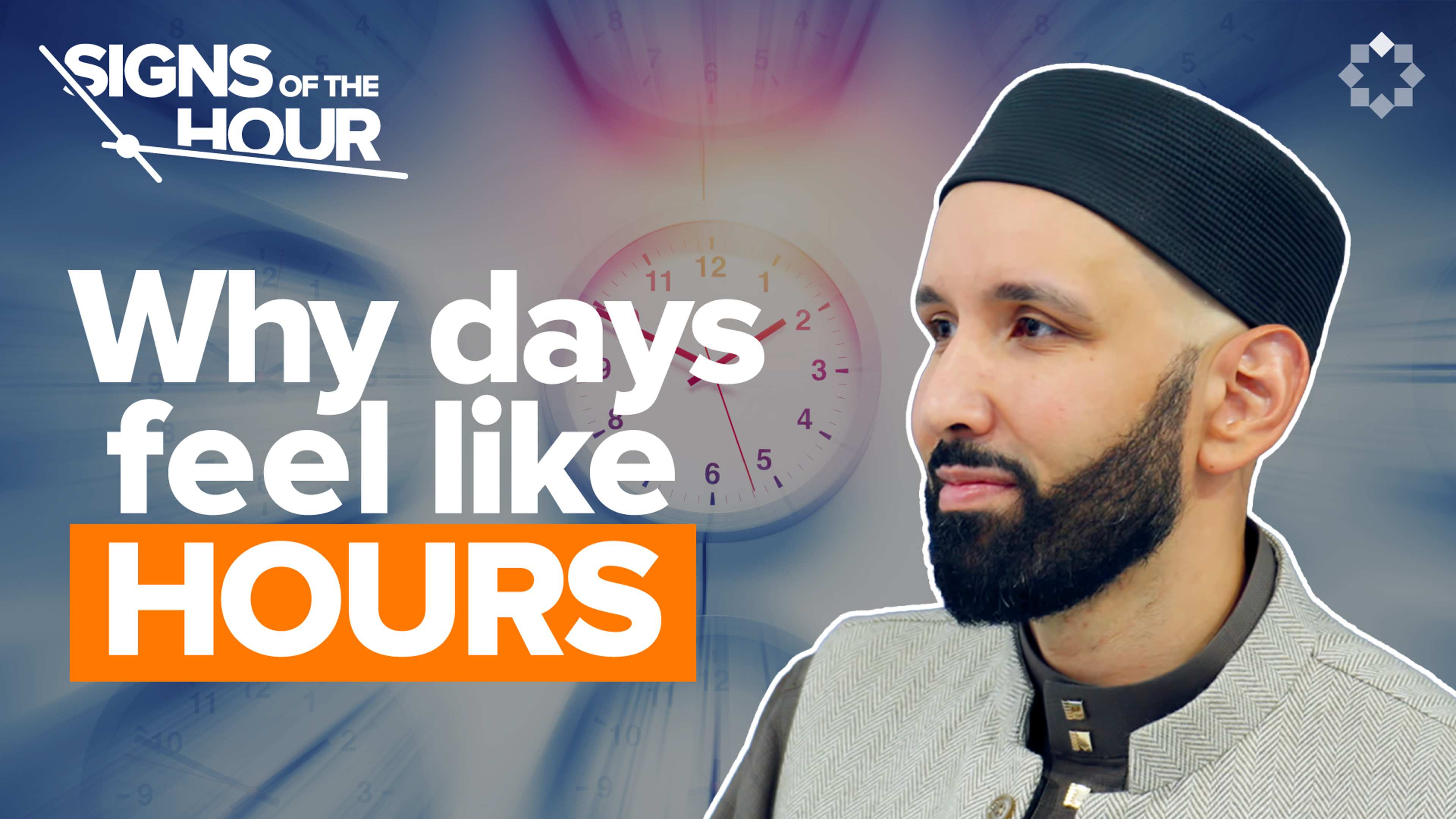
A narration says that before the Hour a year will pass like a month, a month like a week, a week like a day, and an hour like a burning leaf. Ibn Hajar (rh) gave three reasons for it, and the first was that the barakah of time had been removed.
Dr. Omar Suleiman on what disappears first when time stops being blessed. Find out what he says the first casualty actually is, and the one thing he guarantees will give time back.
This transcript was auto-generated using AI and may contain misspellings.
00:00You blink your eyes and then look how old you are. Suddenly it pops up a memory and you're like, 5 years ago? 3 years ago? What happened? How did this entire day pass and I didn't read one page of the Qur'an?
00:11How did it pass so quickly and I have no good deeds to show for myself? Look at your screen time. How did it pass? Where's the barakah in that time? The abundance of distractions. That's what makes time move quicker.
00:23Do not become slaves of the hustle culture, productivity culture, efficiency at the expense of your deen. Somehow the things that are supposed to make us more productive are making us less productive, making us feel more stuck, more frozen. Speed without sakinah.
00:36Fast has no tranquility. There's no barakah in it. He said, sallallahu alayhi wa sallam, that the Hour will not come until a year will be like a month. A month will be like a week. A week will be like a day. A day will be like an hour. An hour will be like a burning piece of grass.
00:50We can't conquer speed and distance and then lose presence.
00:59Now, we have a little bit of time, but I ask Allah to put barakah in this part about time. When we talk about barakah in time, Allahumma ameen. When the Prophet sallallahu alayhi wa sallam talks about time itself losing barakah.
01:14So distance collapses, the markets are collapsing into one another, communication is becoming instant, right? We're becoming busier. Somehow the things that are supposed to make us more productive are making us less productive,
01:27making us feel more stuck, more frozen. So let's call this speed without sakinah. Fast has no tranquility. There's no barakah in it. So we already mentioned one hadith from the Prophet sallallahu alayhi wa sallam,
01:42where he mentioned that time gets closer along with the markets getting closer. And he mentioned that deeds become less, that deeds become less.
01:53And so while fitna are increasing, trials and tribulations are increasing, killing is increasing. When time loses barakah, what's the first casualty of time losing barakah? Is it that you didn't finish your work tasks? Is it that you didn't earn your money for the day?
02:08Or is it that you did not perform enough good deeds? That's the first casualty of your time. Time losing barakah, that I did not perform enough good deeds, right?
02:20How did this entire day pass and I didn't read one page of the Qur'an? How did this entire day pass and I couldn't find in this entire day, the time to say Subhan'Allah wa bihamdihi, Subhan'Allah al-'Aleem a hundred times? How did it pass so quickly?
02:34And I have no good deeds to show for myself. Look at your screen time. How did it pass? Where's the barakah in that time? And so then you have the more famous narration.
02:48But again, it bases on this idea of time drawing close. When the 'ulama talked about time drawing close, they had multiple interpretations. They said that time can be close because the day is shortened.
03:00It can be close because barakah is removed. But at the end of the day, the idea of time being close is that you have shorter,
03:09you know, or you have smaller portfolios of good accomplished with longer spans of time. The generations that came before you. They had shorter time, but they did much more good within that period of a day,
03:22within that period of a month, within that period of a week. So the more famous narration is the hadith of Anas ibn Malik, radiAllahu ta'ala 'anhu that the Prophet sallallahu alayhi wa sallam said, "La takumu sa'atu hatta yataqarrabu az-zamanu
03:35fatakunu assanatu kashshahri wayakunu shahru kaljumu'ati watakunu aljumu'atu kalyawmi wayakunu alyawmu kassaa'ati" So he said, sallallahu alayhi wa sallam, that the Hour will not come until a year will be like a month.
03:48A month will be like a week. A week will be like a day. A day will be like an hour. An hour will be like a burning piece of grass or a burning leaf. I want you to think of the visual here.
04:01If you took grass and you lit it on fire, how quickly the fire burns through it. So what's the imagery that the Prophet sallallahu alayhi wa sallam is giving to us here? It's accelerating. It's just moving too fast.
04:15You blink your eyes and then look how old you are. Look what happens. Where did time go? Where did all those years go? Subhan'Allah, one of the most humbling things in the world that these phones that are manufactured through means of exploitation,
04:29may Allah forgive us, do is they show you a memory. Suddenly it pops up a memory and you're like, five years ago? Three years ago? What happened? Okay? So, number one, again, the 'ulama mentioned,
04:42it's the lack of deeds that the Prophet sallallahu alayhi wa sallam is talking about. Imam Ibn Hajar, rahimahu Allah, said three things that this is referring to. Number one, dhihab al-barakah. The Prophet sallallahu alayhi wa sallam is saying the barakah of time is lost.
04:55So what one used to be able to do in a month, you can't even do in a year. What one used to be able to do in a week, you can't do in a month. What one used to be able to do in a day, you can't do in a week.
05:07And that's why when you read narrations of the salaf and how much Qur'an they read, you're like, no way. You're skeptical. A whole khatm in a day, whatever. Right? No, no, there are people that did that.
05:21By the way, there are people that do that today. Okay? I know of people that finish the Qur'an every day in Ramadan. Right? But it just seems so inconceivable to us, so impossible to us. How?
05:35Because the barakah of our time, the blessing of our time has shrunk. So he says that's number one. So number two, the second meaning, and it's not contradicting, is that there is a literal shortening of the day. Right?
05:47So if you look in the era of al-Masih ad-Dajjal, when we talk about it, right? Time actually becomes different. Some days pass faster. Some days linger longer. Right?
06:01So one day becomes like a year in the time of ad-Dajjal. And that's physical. Like the Sahabah asked, how do we pray when that happens? When a day becomes like a year? And then a day becomes like a month? The Prophet said what? Estimate it.
06:16Right? So that Allah 'azza wa jall, indeed, through His decree, could shrink time or make it linger longer. So it feels a certain way to you. 50,000 years, 1,000 years, one day, Allah controls time.
06:28The third one he mentions is distractions. The abundance of distractions. That's what makes time move quicker. So he specified that.
06:42So the first one is the loss of barakah, meaning the loss of good deeds. The second one is actual shrinking or lingering of time. The third one is the loss of your attention. Right? Distractions. Right? So you doom scroll.
06:57You get a notification. You go through this. There was just an article today in a scientific journal about the cognitive function of the brain shutting off because of short-form videos and reels. Like it actually shuts off a part of the brain. Right? So you lose because of distraction. You get immersed in entertainment.
07:11You get immersed in distraction in the process. The time slips away without you even paying attention. May Allah 'azza wa jall protect us. Another element of this is faster communication. Right? May Allah 'azza wa jall protect us. Another element of this is faster communication actually being a problem.
07:25Why? Why is faster communication a problem? Can anybody tell me? It would be nice to tell people that 'Isha is slightly delayed. That would be good faster communication. But why would faster communication be a problem? The spread of fitna.
07:39The lack of verification. Things spread fast. By the time you posted it. By the time you re-shared it. By the time you sent it. It's too late. It's already gone halfway across the world.
07:54And so wisdom. Which is restraint. Wisdom is restraint. And verification. And then you carry the sin of that. May Allah protect us. So speed of communication to the person.
08:08How quickly. Before you even get home and you could let your anger dissipate. So we could talk about this. I'm going to send you this text message. While I'm angry. And then I can't take it back. So that's the speed of it.
08:22Lack of wisdom and lack of verification as well. So lack of restraint. An element of this that the 'ulama mention as well. Is the speed of transport. This is one of those interesting ahadith. That you wonder when they read it at the time. Or when they heard it at the time.
08:36What did they mean? When the Prophet said. That there will come at the end of my ummah. Rijalun yarkabun 'ala surujin kashbah al-rihal. Rijalun yarkabun 'ala surujin kashbah al-rihal. Yanzilun 'ala abwab al-masajid. The Prophet said that there will come a time.
08:51Towards the end of the ummah. Where people will ride on large saddles. And they will place them. Right in front of the masjid. i.e. my parking spot. Jazakum Allah khair. For not violating it for many many months now.
09:05Alright. But what does this mean? Now when they heard that before. Some of the scholars said. And it's not either or. It's end to end. Some of them said extravagance.
09:19That the saddles themselves. The houses themselves are not about function. They're about form. You think about the variation we have in our means of transport now. How much variation can you really have on a horse or a camel? Right. So the saddles themselves get decorated.
09:33And become very luxurious. And things of that sort. So there's a competition over the saddles. So some of them spoke about it. In terms of riyal. But then you'll see contemporary scholars saying. Well actually.
09:48Perhaps the Prophet is talking about the saddles themselves. Replacing the need of the animal altogether. Like the Prophet is specifying that. Think about someone. 1400 years ago. Seeing our transport. Seeing our airplanes and our cars.
10:02And the things that we just take as normal. Right. Imagine them looking at our world. And the speed of it. Right. We are living that speed of transport. That speed of our vehicles.
10:16Some of the scholars also mentioned. That when you combine the hadith of. The coming close of the marketplace. Right. The taqarrub of the aswaq. And the taqarrub of az-zaman. The coming close of the marketplace.
10:30And the coming close of the time. It's really interesting. Some of the scholars talk about it in terms of congestion. On the roads. Traffic. It's a recipe for traffic. Everybody is out there trying to earn.
10:45And in the process, what happens? Right. What's the imagery of the modern city? Congestion. Traffic. What's supposed to make us faster? And it's really interesting when you're in one of those societies.
10:59I'm telling you. I was in a country not too long ago. And I'm in the car and you're stuck in traffic. And you see this guy just riding his camel on the side of the road. Just relaxing. And he's getting ahead of everybody. And you're like, I should have had a camel.
11:13Not a car. Then I would have got ahead. Or how many times do you just want to ditch your car and walk out in traffic? That's why half of you move from New York to Dallas. Right? It's just too much. But it's the imagery of a modern city.
11:27That transport. That these new means of transportation were supposed to save time. And get you places quicker. But the abundance of the marketplaces. And the abundance of the vehicles. Even though the cars got faster. And the roads keep getting wider.
11:42And the opportunities are there. At the end of the day, we're just getting more stuck. Congested. More traffic. And so I'll say this. And I'll conclude with this. Because of time.
11:56And I ask Allah to put barakah in our time. That we have to be careful. With becoming slaves to mechanical efficiency. I'm serious. We want to maintain our humanity and maintain our Islam. Becoming slaves to mechanical efficiency.
12:10That has an AI component. That has a tech component. That has a market component. We have to be very careful. To not become slaves of efficiency. And productivity. But to maintain spiritual capacity.
12:24To maintain what Allah gave to us. Of what actually broadens. And builds into time. Right? That's number one. Becoming slaves of the hustle culture. Productivity culture.
12:39Efficiency. At the expense of your deen. At the expense of your spiritual capacity. Number two. This is perhaps the most important one. I guarantee you. That acts of 'ibadah will increase your time.
12:53Start memorizing the Qur'an. Watch what happens to your time. Start giving a portion of the day. Start taking advantage of the morning after Fajr with your dhikr. Watch what happens to your time. Watch how much barakah you have in your time as a result of that. And you're going to start wondering.
13:07How am I able to do this much? In such a short span of time. Allah infuses your time with barakah. With good deeds. Because Allah is the one who controls time. And so when you please the controller of time. Then Allah Subhanahu wa Ta'ala controls your time differently for you.
13:21The last thing here. Rush. Compete over good deeds. Be quick to tawbah. Be quick to opportunities to please Allah Subhanahu wa Ta'ala. Be quick to as-salah. Be quick to all of these things that are pleasing to Allah Subhanahu wa Ta'ala.
13:36Right? The last thing here, dear brothers and sisters. Be very slow. With anything that possibly has 'ithm in it. With anything that possibly has sin in it. Be very slow. Be very slow.
13:50Be very slow. With anything that possibly has sin in it. That means I need to investigate this opportunity. And see if it's worth it. Maybe I don't need to jump on this one. I need to investigate what's being said. If it's even worth being investigated.
14:04If it's being said about someone else. I need to be careful about sending something quickly. Because maybe I'm going to say something. That's going to be displeasing to Allah Subhanahu wa Ta'ala. Intentionally. Slowing down. Is such an important part of.
14:18Gaining that speed towards Allah. Again, dear brothers and sisters. We can't conquer speed and distance. And then lose presence. Allah taught us how to be present. In everything that we do. And barakah.
14:33Is not about how much you can fit in your day. It's about how much. That which is fit into that day. Is pleasing to Allah Subhanahu wa Ta'ala. So may Allah Subhanahu wa Ta'ala make us a people. That as time shrinks. Our good deeds do not shrink.
14:47And that as productivity and efficiency. In the mechanical sense increase. That our sins do not increase. May Allah Subhanahu wa Ta'ala put barakah in our health. Put barakah in our wealth. Put barakah in our time. May Allah Subhanahu wa Ta'ala allow us to use all of that.
15:01In ways that are pleasing to Him. Allahumma ameen. Wa alaikum assalam wa rahmatullahi wa barakatuh. Allahumma ameen. Wasalamu alaikum warahmatullahi wabarakatuh.