In the Name of Allah, the Most Merciful, the Most Compassionate.
Among the most pressing questions faced by Muslims today is the relationship between the Islamic legal schools (madhhabs) and the two primary sources of the religion: the Qur'an and the Sunnah. This tension surfaced vividly in a widely circulated exchange between Sheikh Ahmed al-Tayyeb, the grand imam of Al-Azhar, and Mohamed Othman al-Khosht, President of Cairo University. Khosht argued that Islam requires renewal by returning directly to the Qur'an and authentic Sunnah, blaming tradition for the stagnation of the Muslim world, and suggesting that even Imam al-Shāfiʿī (d. 204/820) would have sought renewal were he alive today. Tayyeb responded by defending the tradition, noting that the very concept of religious renewal arises from within the tradition itself, not from outside it. He likened Khosht to a man who, rather than repairing his father's house, chooses to abandon it and purchase a new one. This debate reflects a broader current among certain reformers of the eighteenth to twentieth centuries who have called for bypassing the madhhabs altogether, a stance that often stems from a perceived inferiority of Islamic law compared to Western legal systems.
A common misunderstanding must be corrected at the outset: many suppose that the madhhabs are merely the personal opinions of a few jurists, disconnected from scripture, and thus declare that they follow "the Qur'an and Sunnah" rather than a madhhab. This assumption is mistaken, for the legal schools always ground their rulings in scripture. A madhhab is not a theological sect but a shared methodology of interpretation; the word itself linguistically means "a way." The four surviving Sunni schools—the Ḥanafī, Mālikī, Shāfiʿī, and Ḥanbalī—do not differ in the foundations of faith such as the Oneness of God, the truth of the Qur'an, or the messengership of the Prophet ﷺ. Rather, they permit a plurality of opinion in secondary matters. This difference of opinion must be distinguished from division, for the partisanship and conflict that split a community are condemned by the Qur'an and Sunnah, whereas measured juristic difference is not. Moreover, following a madhhab does not mean following only the opinion of its eponym; scholars such as Abū Yūsuf (d. 182/798) and al-Shaybānī (d. 189/805) among the Ḥanafīs, and al-Nawawī (d. 676/1277) and al-Rāfiʿī (d. 623/1226) among the Shāfiʿīs, differed with the founders of their own schools while remaining within their methodology. What carries the greatest legal weight in a school is the muʿtamad, or relied-upon position.
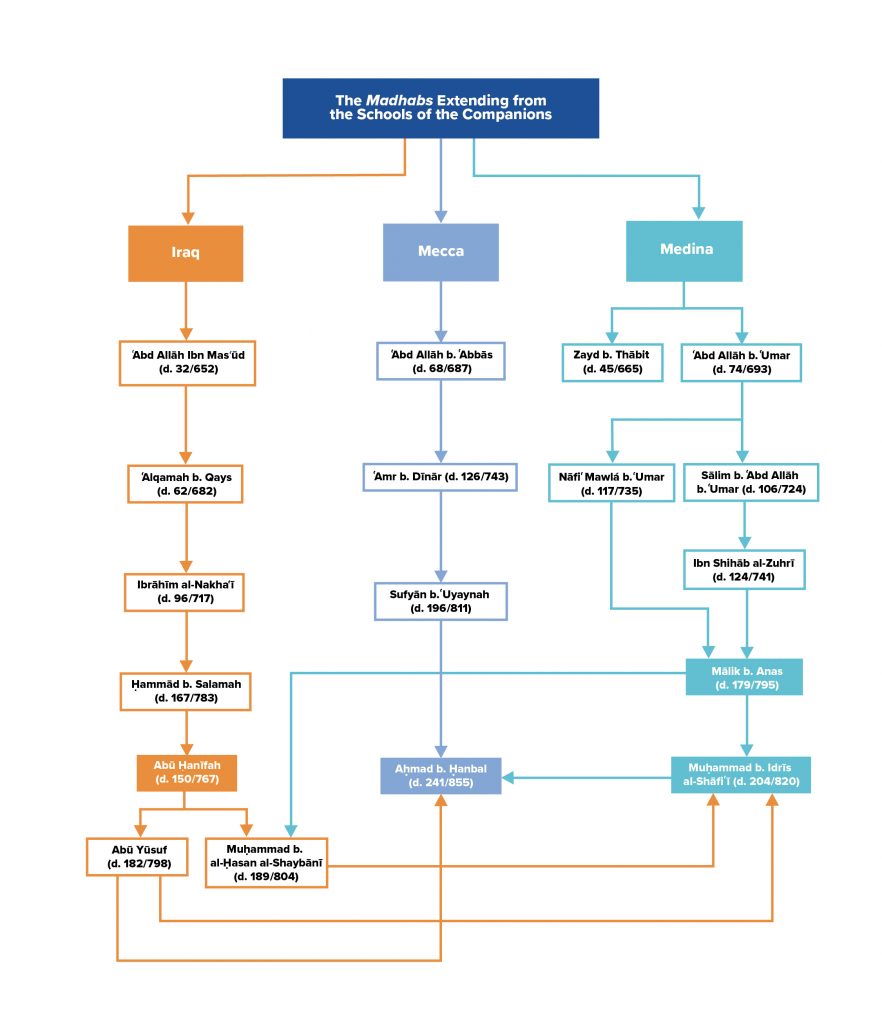
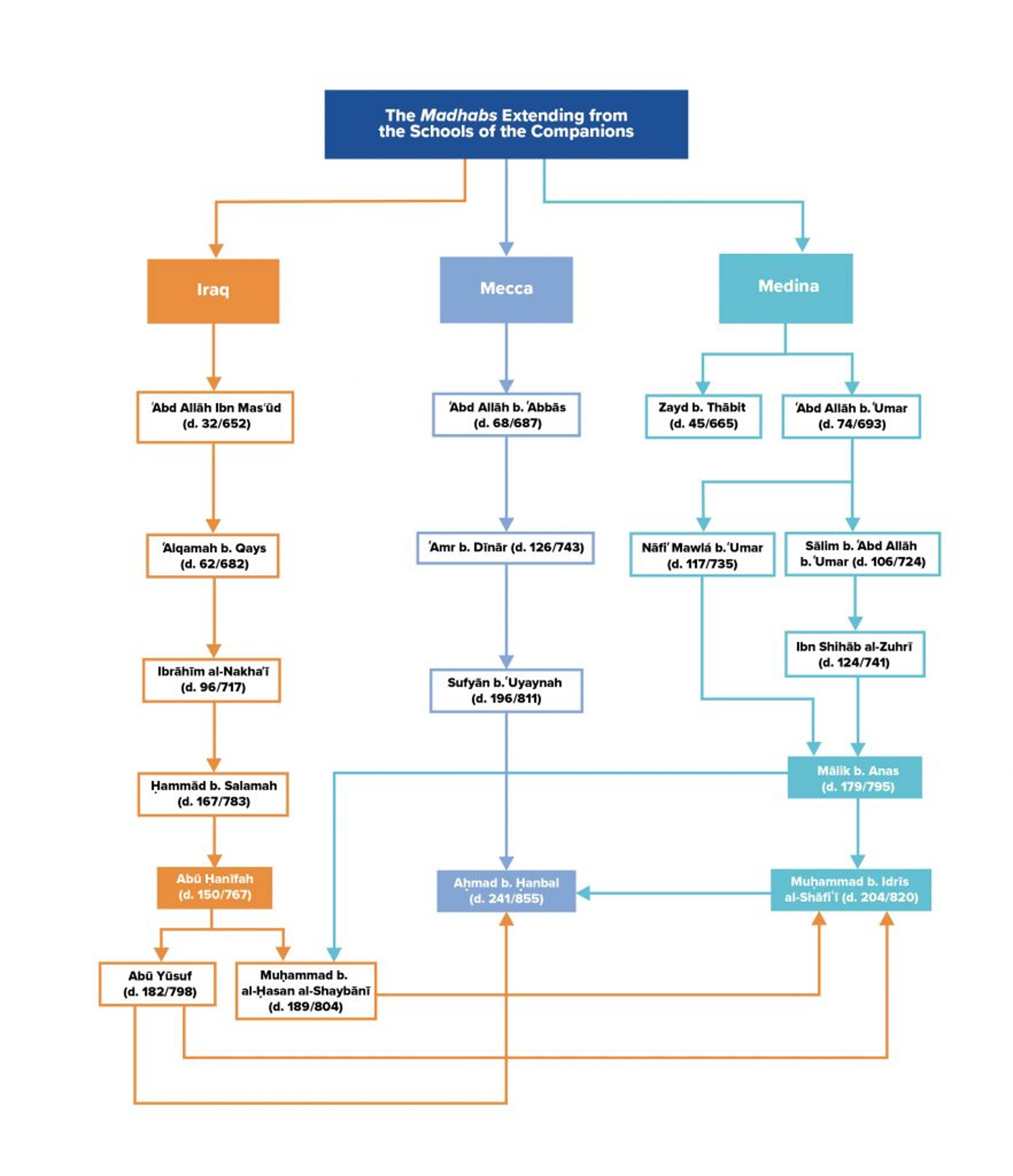
The emergence of the madhhabs was gradual and natural, tracing back to the Companions. During the Prophet's lifetime, differences were resolved by referring to him ﷺ, yet even then some Companions gave fatwas and were recognized for their legal expertise. When faced with matters not addressed by revelation, they exercised ijtihād—drawing upon knowledge of scripture, mastery of Arabic, analogical reasoning (qiyās), consensus (ijmāʿ), and subsidiary principles such as istiḥsān and maṣlaḥah. An example is ʿAmr b. al-ʿĀṣ, who, finding only bitterly cold water while travelling, performed tayammum, and upon returning had his judgment confirmed by the Prophet ﷺ. After the Prophet's passing, revelation ceased, and Companions renowned in law such as ʿĀʾishah, Ibn Masʿūd, Zayd b. Thābit, and Ibn ʿAbbās (may Allah be pleased with them) instructed students who carried forward their teachings. As Islam spread to lands with differing customs, the application of the law adapted to new circumstances. Thus when ʿUmar (may Allah be pleased with him) suspended the share of zakāh allotted to "those whose hearts need winning over" (Qur'an 9:60), reasoning that the effective cause (ʿillah)—the need to strengthen a small Muslim population—no longer existed, he was not disregarding the law but applying it, for a ruling operates only in the presence of its cause.
That legitimate difference of opinion is woven into the fabric of the religion is illustrated by the report of Abū Saʿīd al-Khudrī (may Allah be pleased with him), in which two men prayed with tayammum for lack of water; one later repeated his prayer upon finding water and one did not. The Prophet ﷺ told the one who did not repeat, "You have followed the Sunnah correctly and your prayer will be rewarded," and told the other, "You will have a double reward." The concept of following a qualified expert, sometimes termed taqlīd, thus existed among the Companions themselves. Their students became teachers, and numerous schools of interpretation arose, most of which did not survive for want of dedicated students to preserve them, until the four well-known schools spread throughout the Muslim world. These schools were never the product of a single mind; Abū Ḥanīfah, for instance, would present issues to his circle of scholars—experts in language, hadith, and judgeship—who debated and refined each ruling before it was adopted. In this sense, the madhhabs represent a communal preservation of the law, developing gradually just as the compilation of the Qur'an and the sciences of hadith developed after the Prophet's time as the community's needs grew. Imam al-Shāfiʿī was the first to compose a work on the principles of jurisprudence (uṣūl al-fiqh), not by inventing a method but by extracting it from the way the Companions interpreted scripture, providing, as it were, a guiding stick for those who lacked their direct experience.
The necessity of interpretation is not unique to Islam; every legal system requires qualified interpreters, for texts do not speak for themselves. Muslims agree upon the obligation of following the Qur'an and Sunnah, yet these are the sources of law, not the finished body of law itself. Extracting rulings requires ijtihād, and the Prophet ﷺ indicated that a judge who strives to reach a ruling receives a double reward if correct and a single reward if mistaken. The Qur'an itself distinguishes between scholars and non-scholars, an acknowledgment that its verses require study and analysis, for had everything been decisive (qaṭʿī), no such distinction would be needed. Sherman Jackson notes that tradition is not the mere passing down of ideas but a process of evaluation, refinement, and assessment, while the Syrian scholar ʿAbd al-Fattāḥ Abū Ghuddah (d. 1997) observed that what makes the madhhabs unparalleled is that they have been examined and refined thousands of times, representing the collective ijtihād of nearly the entire body of Islamic scholarship rather than the view of four individuals alone. Taqlīd, better rendered as "deference to precedent" than "blind following," safeguards the stability of the legal system and ensures that ijtihād proceeds within established boundaries rather than in chaos.
One may ask why God did not make everything explicit. The answer lies in the nature of language and divine wisdom. The Qur'an declares: "It is He who has sent this Scripture down to you [Prophet]. Some of its verses are definite in meaning—these are the cornerstone of the scripture—and others are not entirely clear" (Qur'an 3:7). The decisive verses concern the foundations of faith, and as al-Juwaynī (d. 478/1085) explains, these are not open to interpretation, for the principle holds that "there is no scope for ijtihād in the presence of a definitive text." Yet most legal matters rest upon probabilistic (ẓannī) texts, and al-Shāṭibī (d. 790/1388) explains that basing rulings upon preponderant probability (ghalabat al-ẓann) is the norm in law. A jurist works with a dalīl—an indication pointing toward a ruling—not a definitive proof, and as Muḥammad ʿAwwāma notes, following a recognized mujtahid is the layperson's means of following scripture, since the scholar's opinion rests upon careful study rather than personal preference, much as one trusts a physician's expertise. This deliberate ambiguity is not a defect but a mercy, for it allows the law to accommodate different times, places, and needs, and thereby to remove hardship rather than cause division.
It might be proposed that the schools should simply follow authentic hadith, and indeed the founders are reported to have said, "If the hadith is authentic, it is my madhhab." Yet Imam al-Nawawī clarified that this statement was directed to those who have attained the rank of ijtihād within the school, and only after ascertaining that the imam was unaware of the hadith or its authenticity—a condition met by very few, since the imams often set aside the apparent meaning of hadith they knew due to abrogation, specification, or interpretation. The question of whether physical contact with the opposite gender nullifies ablution illustrates this well. The Qur'an mentions those who have had "contact with women" (lāmastum), a word bearing both the meaning of physical touch and of intercourse. The Shāfiʿīs held to the literal sense, while the Ḥanafīs, relying upon the authentic report of ʿĀʾishah in Ṣaḥīḥ al-Bukhārī that the Prophet ﷺ touched her foot during prayer, understood it as intercourse; the Shāfiʿīs answered that he touched her clothing, not her skin. Both parties reason from a verse and an authentic hadith, so the disagreement cannot be resolved merely by appealing to authenticity. Not every interpretation, however, is valid. Since most jurists hold the truth to be singular, they cannot all be correct, yet certainty is unattainable; therefore the schools made sound methodology, not the result, the measure of a valid opinion, lest the Qur'an be treated as empty words into which anyone may pour his own meaning.
Concerning reform, the vast majority of Muslims reject the notion that Islam is inherently flawed and in need of overhaul, particularly when such calls issue from outside the faith or from governments, and the analogy of a Muslim "Martin Luther" imports Christian and Western assumptions foreign to Islam. Islamic law does, however, permit adapting the application of rulings to changed circumstances, and the world has transformed with unprecedented speed through industrialization, technology, and globalization—the printing press alone reshaped religious learning, replacing the laborious hand-copying by which Ibn al-Khāḍibah (d. 489/1095) transcribed Ṣaḥīḥ Muslim seven times in a single year. Reforming the very principles of jurisprudence is dangerous, for altering a single maxim such as "a command necessitates obligation" would unravel established obligations like prayer and fasting. For genuinely new issues, Muṣṭafá al-Zarqāʾ (d. 1999) held that collective ijtihād by qualified scholars is the best course, ensuring fidelity to tradition while curbing the chaos of unregulated fatwas. As Tayyeb's parable conveys, a house missing a brick or grown rusty is repaired, not demolished. In sum, the Qur'an and Sunnah are the sources of law rather than the law itself; because most texts are probabilistic, the madhhabs offer a disciplined methodology that yields the most likely correct interpretation, providing both the stability that prevents interpretive anarchy and the flexibility to meet the changing conditions of Muslim life.