Living under the dominion of secular power exacts a heavy toll upon the human being, and most especially upon the Muslim who has been made to imbibe its assumptions unknowingly. Our age has become one that worships at the altar of the autonomous self, echoing slogans such as “you do you” and “my body, my choice.” Charles Taylor named this an “age of authenticity,” wherein the individual is commanded to “find yourself, realize yourself, and release your true self.” The liberal state elevates this morally autonomous self as an uncontested good and assigns it inherent worth. Yet, far from ennobling the human being, this project in truth reduces the individual to a mockery of himself.
The self that modernity celebrates is not a natural creation but an invention traceable to the Enlightenment, secured through the doctrine of secularism. Secularism here is understood not merely as a separation of religion and state, but as a political doctrine that grants the state power to determine what counts as religion, which beliefs and actions are deemed religious or secular, and which of those are tolerated. Emerging from Western Europe’s trauma between the sixteenth and eighteenth centuries in the struggle between Church and State, secularism never truly delineated the boundaries of either. Instead, it recreated religion into a docile subject of the state, a feature of the state’s expanding regulatory power. This was then exported to the rest of the world upon the back of Western imperial expansion, aiming to produce a new self marked by moral autonomy. Immanuel Kant is credited with placing autonomy at the heart of moral authority, seating the individual and God in the same moral community and thereby rendering God, in his framing, “morally superfluous.” The consequence is that revelation is displaced by individual impulse, feelings are exalted over principles, and morality itself is made subjective and unstable—like a feather tossed about by the winds of one’s whims.
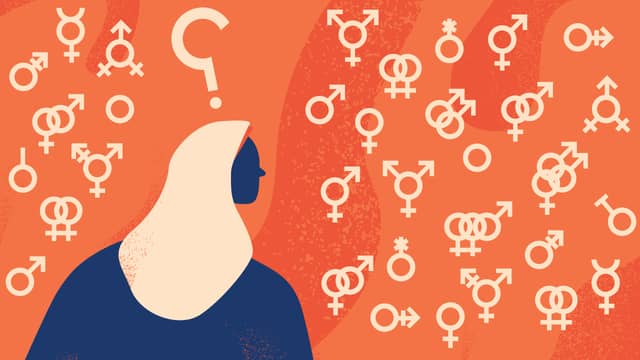
The bitter fruits of this may be seen in the phenomenon of transgenderism, where feelings of being trapped in the wrong body are treated as inherently valid and actionable through irreversible surgeries and hormones, all celebrated under the banner of choice—until one who detransitions discovers that these so-called “inner truths” were in fact inner lies bearing lasting harm. When morality is privatized, it is declared both subjective and equal in all its expressions, enslaving the person to the fragility of his shifting framework and producing a “cult of authenticity.” This vacuum, created by excluding Allah from any real sovereignty, is filled by man’s own sanctioned creative power. Yet the human being cannot be stripped of his innate disposition (fiṭrah) to seek a higher power, which is why secular society witnesses the rise of those who call themselves “spiritual but not religious,” resorting to affirmations, healing crystals, and mindfulness. Such secular spirituality merely shifts one’s servitude from Allah to the self.
This same disease infects many Muslims who justify abandoning Islamic principles through the phrase “only God can judge me,” whether in rationalizing interest-based dealings or redefining the norms of hijab. Such a mentality privatizes religious commitment and makes the Muslim a religious consumer rather than a follower, producing the secularized Muslim who prioritizes the experience of a feeling over the validity of creed itself—one who abandons prayer because he no longer feels its “benefits.” Secular power does not directly expel Allah from consciousness; rather, it strips Him of sovereignty and grants it to mankind, reducing religion to a form of deism where Allah is permitted to exist but assigned no role in society. Thus the “freedom” such Muslims imagine they possess is no true freedom at all, for the shape of their practice is dictated by, and remains at the mercy of, the state.
Indeed, the very production of the “individual” is what denied the self genuine individuality, for modern individuality can only be achieved through the state that defines, trains, and disciplines the self through its institutions. The case of the Jehovah’s Witnesses, expelled from public schools after Minersville School District v. Gobitis (1940) for refusing the Pledge of Allegiance, laid bare the fragility of religious freedom under a secular order: the state can crush freedom precisely because it is the sole guarantor of it. As Talal Asad observed, John Locke’s appeal to natural right was linked to a desire to stabilize the self through a legal concept of the person. One is therefore only as free as the state permits. Rousseau had already argued in the eighteenth century that the autonomous self flourishes only when citizens act uniformly upon a single general will. State-sanctioned norms masquerade as individual leanings, as seen in the celebration of women in the workforce over women as custodians of the family through “girlboss” culture, and in the acceptance of hijab only when framed as personal choice rather than theological obligation. Ironically, then, it is through the prescribed agency of the self that its subjugation is achieved.
No thought exists in absolute freedom, for as it has been noted, everyone remains dependent on conventions and on things he did not create, such as language. The word “terrorism,” once denoting state violence in the French Revolution, became an arbitrary label wielded by the state’s propagandists. Language belongs to a system, and this is how coloniality—a dimension of “soft power”—operates, prescribing values under the guise of universality and neutrality in order to intellectually gut a people and recreate them in the state’s image. This is visible in Muslim discourse on Palestine that favors the language of “human rights” over anything overtly Islamic, an assumption that denies Islam any capacity for the universal while exalting secular humanity as free of particular commitments. To funnel our convictions through secular vocabulary is to risk muddying them beyond coherence.
The secular Muslim, then, is not an organic product of liberation but the creation of a legal regime that treats one who lives by Islam as no different from one who merely claims belonging to it—a stance that violates Islam’s call to couple belief with action and reduces religion to identity politics. The state advances this through the “racialization” of the Muslim, inventing a Muslim phenotype through such measures as the Patriot Act and the 2017 “Muslim Ban,” measuring one’s “Muslimness” by skin, name, dress, and tongue. But Islam is not a race, and internalizing this framework traps the Muslim in a minority mindset and an inferiority complex. As Saba Mahmood noted, a minority drawing attention to its plight must highlight its difference and thereby deepen its exclusion. This is seen in American Muslim political engagement, which too often reacts within secular parameters, waiting for genocide before abandoning its leaders and dabbling in representation politics as though it were the means rather than a means. The RAND proposal for building the “moderate Muslim,” the International Religious Freedom Act, and Homeland Security’s Countering Violent Extremism initiative all reveal how the nation-state appoints itself a “de facto theologian,” dividing Muslims into the “Good” who secularize their faith and the “Bad” who recognize Islam’s authority over public and private life alike.
Against all of this stands the Islamic self, founded upon lā ilāha illā Allāh—a declaration that begins with negation and rejection of every competing sovereignty and worldview. Allah ﷻ affirms Islam’s monopoly on truth: “The true religion with Allah is Islam” (Āl ʿImrān 3:19), and, “Whoever seeks a way other than Islam, it will never be accepted from them, and in the Hereafter they will be among the losers” (Āl ʿImrān 3:85). The Islamic self is grounded in obedience (ṭāʿah) and refuses to make its desires its god, for Allah ﷻ warns, “Have you seen those who have taken their own desires as their god?” (al-Jāthiyah 45:23), and asks, “Who is rightly guided: the one who crawls facedown or the one who walks upright on the Straight Path?” (al-Mulk 67:22). Unlike the secular self that assumes its own sincerity, the Islamic self interrogates its intentions and celebrates submission to Allah and His Sharīʿah. Living Islam is no confinement of religion to the private sphere; it is the recognition that Islam permeates every aspect of the human experience, individual and collective, political and economic. Selectivity in the dīn is alien to the awakened Muslim consciousness.
Safeguarding this self demands more than what Dr. Ihsan Bagby described as the tendency of American Muslims to “insulate,” for true insulation requires the awareness that one is even in a stream before attempting to swim upstream. It requires engaging soft power, reclaiming the narrative, and reorienting one’s worldview through Islam, for Allah ﷻ says, “Are those who know equal to those who do not know?” (al-Zumar 39:9). It demands fulfilling our web of responsibilities, as the Prophet ﷺ said, “Every one of you is a shepherd and is responsible for his flock,” and, “He is not a believer whose stomach is full while the neighbor to his side is starving,” and likened the believers to a single body that reacts wholly when one limb aches. This entails building Muslim institutions, think tanks, media, and schools, and rekindling belonging to a transnational ummah that transcends the secular order. The Muslim who adopts Islam as the basis of his worldview poses a real challenge to the colonial project, traversing life as a truth-seeker who disentangles truth from falsehood, heeding the command of Allah ﷻ: “Indeed, this is My Path—perfectly straight. So follow it and do not follow other ways, for they will lead you away from His Way” (al-Anʿām 6:153).