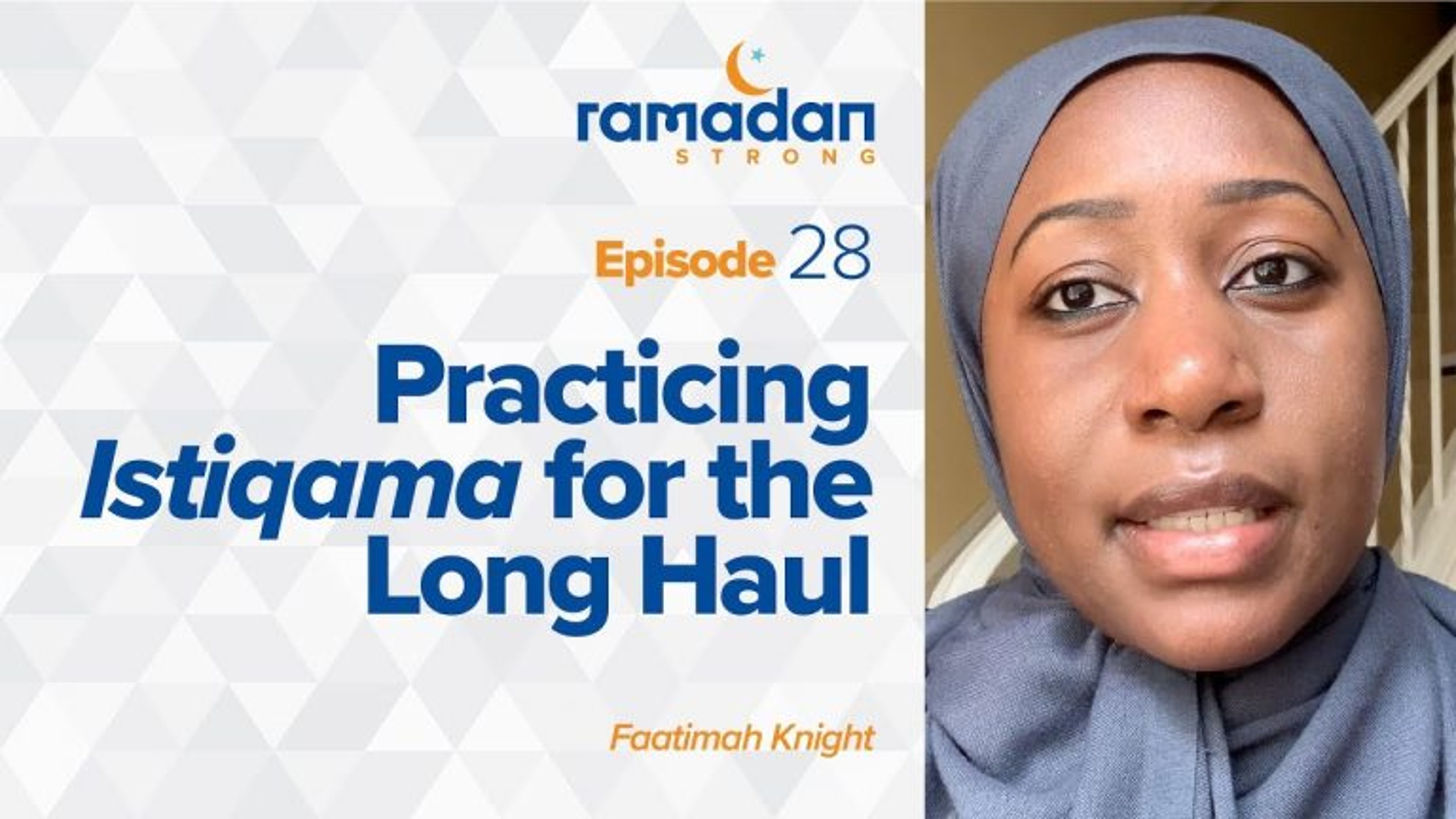
As-salamu alaikum, this is Fatima Naye of Yaqeen Institute. My Ramadan reminder for myself and
for anyone listening is to remember the value of istiqamah. Istiqamah is of course something that we're reminded of often in our lives, in our masajid, in our community centers, among ourselves
as Muslims when we gather. And I think the reason that it comes up so often is because of how true
the core message of it is. There is a hadith in which one of the sahabi asks the Prophet
to advise him, to give him moral guidance on something that he can't get from anybody else. Right, so something that particularly comes from the wisdom from the heart of the Prophet.
And the Prophet says to him, believe in God and then be steadfast.
Amantu billah thumma istaqim. Believe in God and then be steadfast.
On the topic of istiqamah, one of the sahabi said that the most difficult ayah on the Prophet
was the ayah in the Quran about istiqamah, repentance, and transgression. So there's an ayah in the Quran that brings all three of those heavy topics together. Istiqamah, repentance,
istiqfar, and transgression. And that was heavy on him for a number of reasons. One of them being how difficult it is to have istiqamah in one's life. Much easier for the
Prophet to accomplish, very difficult for the average person to accomplish. We can translate or think of istiqamah in two ways. One is constancy or consistency and the other is reliability.
And I think both of these help us to understand the fullness of the term istiqamah. One of the things that makes istiqamah so challenging is because it's so difficult
to remain consistent in an action. To do something every day or every week or every year, whatever the frequency is that that thing requires, it's very difficult for us to be
consistent. It's a human problem, right? It impacts all of us. And it's difficult to be consistent because typically the things that we need to be consistent in do not gain for us an
instant gratification, right? They're usually things that benefit us in the long term over a long while. And so when we're doing something, when we have our head down and we're just getting it
done, right? We don't see the benefits immediately or even over a course of a few days or a few weeks because they're so incremental. We only see those benefits when they add up to something that
is substantial enough for us to gaze. But the truth is that they're building up so small, so incrementally, and that we just can't see it. But if we don't continue to feed into it,
to give it life each and every day or each time that it needs to be accomplished, we'll never see that cumulative effect. So we need to remember that istiqamah, yes,
the benefits are not seen immediately, but they need to be, the action needs to be done with consistency in order for those benefits to begin to accrue. And so another way to think of
istiqamah is in terms of reliability, right? Think of someone that you can rely on. That when you need them, whether it's for advice or for some kind of tangible need,
or you just need them as someone that you can relax with, right? Think of someone that's
reliable in that way and think about how the order that they have in their own life, the steadiness that they have in their own life, allows them to benefit you in your life, right? It's something
that flows over from them because they've ordered their life, right? Because they've been consistent in some kind of practice, right? Because they are steady and grounded in some way,
they're able to benefit you in a way that someone who their life is chaotic is not able to benefit you, right? And the closer that person is to you, so the closer that person is who's reliable,
whether they're a spouse or a friend, right? The closer they are to you, the more you feel the benefits of the order they have in their life. Likewise, the closer they are to you, but the
more chaotic their life is, the more you feel that, right? It overflows and eventually it impacts you, even though it's just in their life, it impacts you because of how close they are to you.
And so if we think even further about being reliable in and of ourselves, right? That if we can count on ourselves, if we know that we have a plan, if we know that we want to remain grounded
in something, that we want to be consistent in something, and if we've shown and proven to ourselves that we can be consistent and grounded, right? Then we can rely on ourselves to take on
new tasks, to take on new challenges, to take on new challenges, to take on new challenges. To take on new challenges, we can trust ourselves to develop, to do new things, to take on
new adventures. And so again, my reminder to myself, first and foremost, and to anyone listening, is the benefit of istiqamah, and we hear it so much because it's so necessary and so crucial.
And remember that when you have your head down and you're making the progress, but you don't see it, the progress is real nonetheless. As-salamu alaykum wa rahmatullahi wa barakatuh.