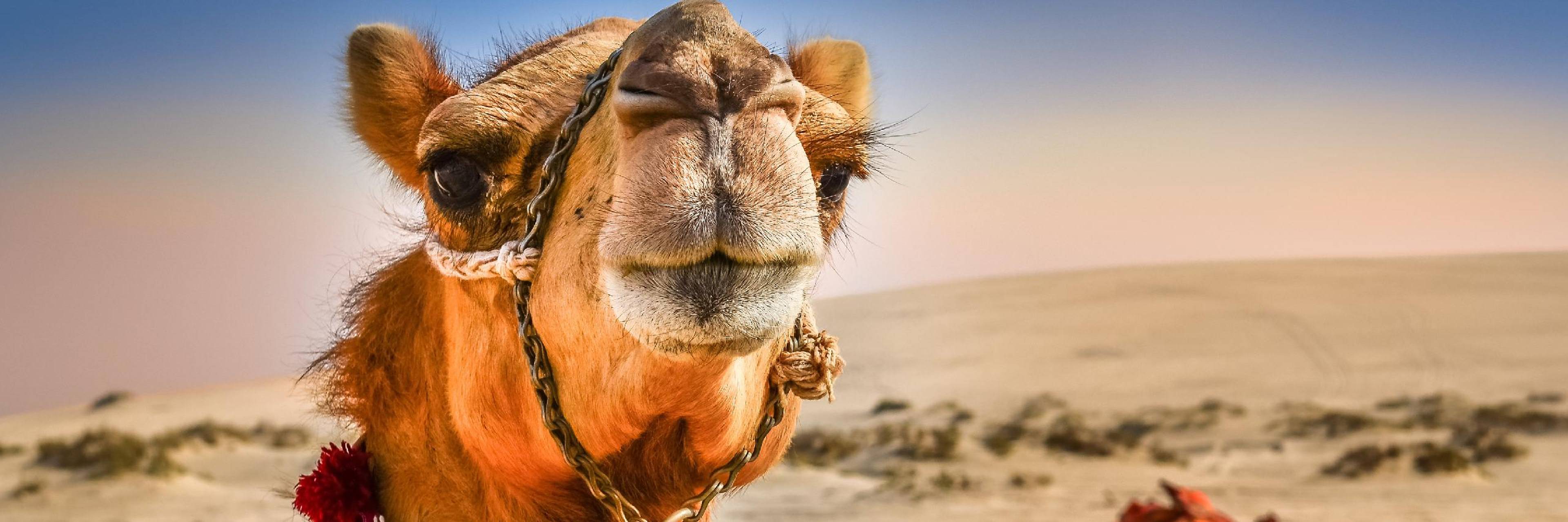
Trusting in Allah while taking the means He has provided is beautifully captured in the well-known counsel of the Prophet ﷺ, who instructed a man to "tie your camel and trust in Allah." This tradition serves as an ideal expression of the relationship between the Creator and His creation. A skeptic might pose a dilemma: if Allah keeps the camel in place, then the rope is superfluous; but if the rope keeps it in place, then trust in Allah was misplaced. This reasoning rests upon a false dilemma. The believer must affirm both that Allah keeps the camel in place and that there is genuine rational sense in tying it. The Prophet ﷺ did not say "trust in Allah and cross your fingers," precisely because tying the camel—unlike crossing one's fingers—is genuinely effective in keeping it secured, all things being equal.
Significantly, that tying one's camel keeps it in place is not something learned through revelation. This is knowledge already possessed through empirical experience of the created world. The purpose of the tradition is therefore not to inform us of the effectiveness of ropes, but to enjoin reliance upon our empirical knowledge of creation in our dealings with it, while affirming that such reliance is not opposed to trust in Allah, but rather connected to it. Taking this maxim seriously means acknowledging that the effectiveness of tying can be known through natural means—by which is meant means independent of revelation, though never independent of Allah Himself. In this way, the tradition affirms a proper scope for what may be termed "methodological naturalism," and the pressing question becomes: what is its scope, and what precisely renders it "naturalistic"?
Two further postulates, axiomatic to the Muslim viewpoint, clarify the boundaries of this methodological naturalism. First, if Allah does not keep the camel in place, the rope will not; and second, if Allah does keep it in place, it will remain so with or without the rope. Reflection reveals that, for the believer, the proposition that Allah keeps the camel in place is unfalsifiable. Should the camel stray, the believer affirms that Allah made it stray. No possible outcome could count against the proposition that whatever occurs is Allah's will. This proposition is therefore not "scientific" in the sense in which falsifiability is taken as a necessary condition for being scientific—a point which may be readily conceded. Yet the skeptic's claim that a straying camel proves trust in Allah was misplaced must be firmly rejected, for the purpose of trusting in Allah is not, in fact, to keep the camel in place. Whether the camel stays or strays is thus no fitting test of the soundness of trust in Him. By contrast, the proposition that tying the camel keeps it in place is falsifiable, and therefore a proper subject for experimentation. The rope can be tested, but not Allah.
There remains the question of what the rope contributes if Allah's will is both necessary and sufficient for the camel's staying. Here recourse is made to the classical distinction between the "primary cause," which in every case is Allah, and the "secondary cause," which is creation. Al-Ghazali, in the seventeenth discussion of his Incoherence of the Philosophers, famously argued that "existence with" a thing does not constitute "existence by" it, thereby reserving primary causation—as "existence by"—to Allah alone, and consigning creation to secondary causation as "existence with." This distinction suffices for the theological position taken by itself. Yet doing science effectively requires recognizing that not every "existence with" is equal, for mere correlation is not causation. A viable Islamic philosophy of science therefore requires not only the distinction between primary and secondary causation, but also an analysis distinguishing secondary causation from non-causal forms of correlation. Of these two tasks, the focus here remains upon defining methodological naturalism.
Turning to Nidhal Guessoum's paper, "Kalam's Necessary Engagement with Modern Science," Guessoum regards methodological naturalism as the fundamental characteristic of modern science, defining it as the insistence that science admit only explanations relying solely on natural causes, leaving out any appeal to supernatural agents—"be they spirits, angels, demons, or indeed God." He carefully distinguishes this from philosophical naturalism, which is the outright denial of any supernatural existence including Allah. Methodological naturalism, he maintains, is only a provisional, hypothetical assumption for the purpose of research. Yet despite this care, Guessoum raises problems—such as how to reconcile a naturalistic study of the world with belief in a present and personal God who acts within it—that can only arise by equivocating upon his own distinction. If modern science truly commits us only to a provisional assumption for limited purposes, such a problem should not arise. It emerges only when one wrongly adopts the position that the methods of natural science are fit to determine whether and how Allah acts in the world. This is to tie down Allah, and creation as a whole, with a rope suited only for camels.
A deeper difficulty lies in Guessoum's undefined distinction between the "natural" and the "supernatural." He names "spirits, angels, demons, or God," yet offers no principled account of what these share, such that one might wonder whether Santa Claus, elves, and phlogiston belong among them. From a classical Muslim perspective, one might identify the natural with creation and the supernatural with the Creator; or, more philosophically, the natural as that which is bound by space and time and subject to change, and the supernatural as that which is not. Yet neither clarifies Guessoum's intent, for angels, spirits, and jinn are all created, and the jinn at least are bound by space and time—provided we take Islamic ontology seriously in engaging modern science.
Guessoum's more illuminating point is his explanation of why methodological naturalism became a pillar of modern science: appeal to supernatural factors was identified as a "science stopper," halting the explanatory process. This suggests that "natural" should be defined not ontologically but by whether an explanation contributes to discovering further truths and devising useful applications. Guessoum's own example illustrates this: a physician who explains mental disorder as the work of demons will grasp neither the underlying brain processes nor discover any medication. But if this is so, Guessoum's definition proceeds backwards, for the "natural" would be defined by the requirements of the scientific method's aims, rendering the natural–supernatural distinction highly contingent upon those aims.
Consider the jinn—Guessoum's "demons"—as being like germs: causing illness yet undetectable under controlled conditions. On this account, appeal to them is "supernatural" only insofar as it fails to yield treatments we might devise ourselves, though it may yet permit treatments we learn of by other means. But were we one day able to study them systematically and confirm that some illness is indeed possession, no principled reason would remain to call this "supernatural"—it would be no more so than explaining a crime scene by human agency. Since the objectives of the social sciences differ from those of physics and biology, what counts as "natural"—in the sense of methodologically correct—will differ from discipline to discipline. To hold otherwise would absurdly consign the social sciences to "supernatural," and thus "pre-modern," explanation. Moreover, since the objectives within any discipline develop historically, fixing methodological naturalism to a specific set of requirements would force us either to deny future development or to admit that science might one day outgrow "methodological naturalism" altogether. Certain fundamental objectives are indeed universal—science seeks truth, technology seeks the achievement of our goals—but these belong to the "pre-modern" no less than the "modern," and therefore cannot alone distinguish the modern.
The clearest path forward is to define "natural," in this context, as that sort of explanatory factor which lends itself to the purposes of science, while insisting upon enough specificity and stability that a general methodological prescription remains applicable across disciplines and open to development. Returning to the ontology of Creator and creation, and the heuristic of tying the camel, the purpose is to understand creation in terms of itself insofar as possible. Here emerges an important point from the classical encounter between kalam and falsafa: were creation not sufficiently ordered, it would be naturally unintelligible, and action within it futile—for if there were no telling what Allah will bring about whether or not one ties the camel, action would be pointless. The problem of induction shows that we can never know how orderly things truly are; yet knowledge of the world cannot be rationally pursued except under the assumption that things are sufficiently ordered, and this holds however our scientific aims may develop.
Scott Tanona has proposed defining the natural in terms of intersubjectivity and predictability: "A phenomenon is natural if it involves regularities between intersubjectively definable aspects of the world," where those regularities constrain possible values so as to allow predictions, including under interventions. An intersubjectively definable aspect is simply one described and measured accessibly to more than one observer. The supernatural, by contrast, is "beyond any such intersubjective predictability"—not merely contrary to current theory but beyond incorporation into any future testable law. Tanona, like Guessoum, affirms that methodological naturalism does not entail ontological naturalism, and indeed seeks to defend this distinction from charges of unsustainability, framing it as "internal" versus "external" naturalism—the former applying naturalism within science alone, the latter universally. Internal methodological naturalism requires only that a scientific account make specified contact with intersubjective data and thereby make predictive claims about further such data; it neither promises success everywhere nor claims exclusivity. This formulation is preferable, both for its clarity and for maintaining the distinction between methodological and ontological naturalism. It is perfectly consistent with the awareness that some things, whether contingently or in principle, do not lend themselves to such predictability, and that nothing hitherto discovered can eliminate the real possibility that in the next moment the established order might be radically altered—for as the Prophet ﷺ advised, if the Day of Judgment arrives while you are planting a tree, then continue planting.