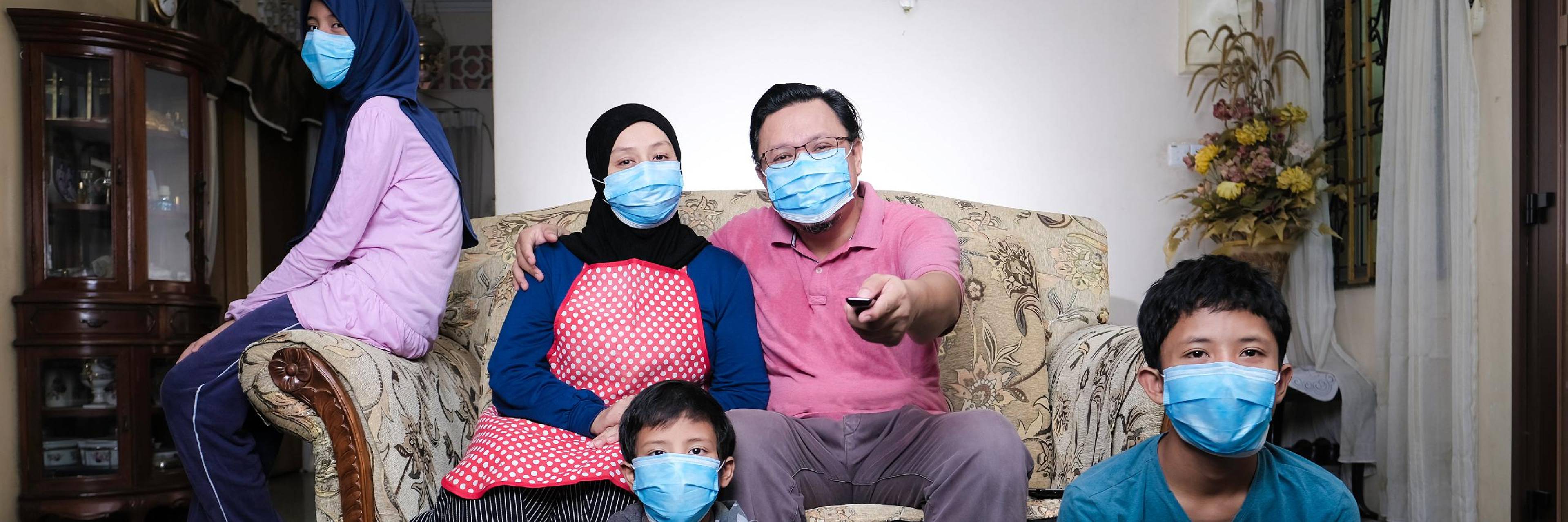
During times of hardship and confinement, families are drawn closer together and may discover things about one another that had previously gone unnoticed. Such discoveries can be a source of joy, as when we learn that a relative has excelled in some worldly or personal endeavor, but they can also stir up the darker inclinations of the soul. The story of Prophet Yūsuf, upon him be peace, offers a sobering example: his brothers, rather than rejoicing in the blessings Allah had bestowed upon him, were consumed by envy and cast him into the well. Prophet Yaʿqūb, upon him be peace, had perceived this danger and warned his sons in his cryptic caution against their consuming one another. This teaches us that envy often finds its most fertile ground among those closest to us, for we imagine that our familiarity with a person's faults renders them undeserving of the favors Allah has granted them.
Yet a moment of honest reflection exposes the injustice of such thinking. When we ourselves are praised, given opportunities, or blessed, we rarely pause to declare ourselves unworthy—even though no one is more aware of our shortcomings than we are. The principle of reciprocity should therefore govern our hearts: if it would wound us to be judged undeserving of our blessings, we must not visit such judgment upon others. However well we know our loved ones, we do not know them as Allah knows them. To pry into how and to whom Allah apportions His mercy is a losing endeavor, for His provision is vast and His wisdom in its distribution is finer than our own. Allah, Most High, declares, "All bounty is in the hand of Allah. He grants it to whom He wills. And Allah is All-Encompassing, Wise. He selects for His mercy whom He wills. And Allah is the possessor of great bounty" (Qur'an 3:73–74). Knowing this, our posture should be one of contentment with Allah's decree, hope in Him, and constant supplication.
Alongside envy, we must guard against the daily irritations that quietly erode the affection between family members. We often assume that others know their conduct upsets us, and we read hidden hostility into a glance, a furrowed brow, or a sigh, imagining that some small act or omission is a deliberate slight against us. But this is a double standard, for each of us has felt the sting of being accused of ill intent while wholly innocent. Rūmī reminds us of this when he said, "If you are irritated by every rub, how will your mirror ever be polished?"—the mirror here standing for the heart, which cannot be purified and made pleasing to Allah so long as it is perpetually disturbed by its surroundings. We ought therefore to recognize how improbable our suspicions usually are, and to extend to others the benefit of the doubt and a good opinion before surrendering to negative thoughts. The Messenger ﷺ warned us plainly: "Beware of suspicion, for suspicion is the worst of false tales; and do not look for the faults of others and do not spy, and do not be jealous of one another, and do not desert one another, and do not have enmity for one another. O servants of Allah, be brothers" (Bukhārī).
Living together well is itself a discipline, and it has been said that the greatest of the arts is the art of learning to live together. When we share a home for long enough, habits of mutual annoyance inevitably accumulate, and no amount of inner work will make us cherish every quirk of another person. Rather than despairing at this, we may take it as a reminder that perfection belongs to Allah alone. The Prophet ﷺ cautioned against holding others to an impossible standard, counselling a husband who dislikes one trait in his wife to turn his attention instead to another quality that pleases him—counsel that applies equally to wives. Since Allah calls us to be good to one another, mending our relationships becomes a duty, whether by cultivating a better opinion so that our hearts soften, or by all parties consenting to small changes for the sake of tranquility in the home. In a time of transition, the needs of every member of the household, young and old alike, deserve consideration, for the Prophet ﷺ said, "Whoever does not show mercy to our young ones, or acknowledge the rights of our elders, is not one of us" (Musnad Aḥmad).
When physical closeness becomes strained, we may be tempted to withdraw into ourselves and to turn to prayer as a means of repair. This is commendable, but our supplications must not become an instrument for the ego or for Shayṭān to claim their share. If we find ourselves praying merely that another person abandon some habit we find irritating, we should reconsider, for such a prayer may only rehearse their faults in our minds and rekindle our resentment. We should ask whether the behavior is objectively harmful—such as smoking, lying, or the neglect of responsibilities—or whether it is simply a source of friction. If it is not truly harmful, it is better to beseech Allah for the easing of tension and the renewal of compassion in whatever manner He knows to be best, while remembering that the other person may not be the sole cause of the difficulty. Nor should we neglect to pray for the burdens that may be weighing upon them, whether sickness, heartbreak, financial hardship, or the strain of their duties. In this the words of the Prophet ﷺ guide us: "The merciful will be shown mercy by the Most Merciful. Be merciful to those on the earth and the One in the heavens will have mercy upon you" (Tirmidhī).
Finally, we may find ourselves unaccustomed to spending so much time within our homes, feeling almost like strangers within our own walls. We would do well to treat our home as we would an honored guest, showing gratitude for the shelter Allah has given us through the care we take of it and the way we perceive it. In busy households it may help to set a modest standard of cleanliness—low enough to spare us needless frustration, yet not so low that dwelling there becomes harder. Above all, we should look upon our home with the eye of gratitude, dwelling upon what we possess rather than what we lack, and enlivening our space with worship so that it feels expansive rather than confining. The Arabs have a proverb, "Dayyiq fī al-qalb," meaning that constriction is often a product of perception rather than reality. Let us then take stock of whatever makes us feel confined, whether by adjusting our circumstances or our attitude, and remind ourselves—whether in earnest or in jest—how easily things could be worse: the house smaller, the water never warm, the internet severed. Returning to our situation with such awareness, we come to appreciate all that we have and how readily it might have been otherwise. Let us never allow our circumstances to become a wedge between ourselves and Allah when they might instead serve as a bridge to Him.