Jump to:
Imam Tom Live
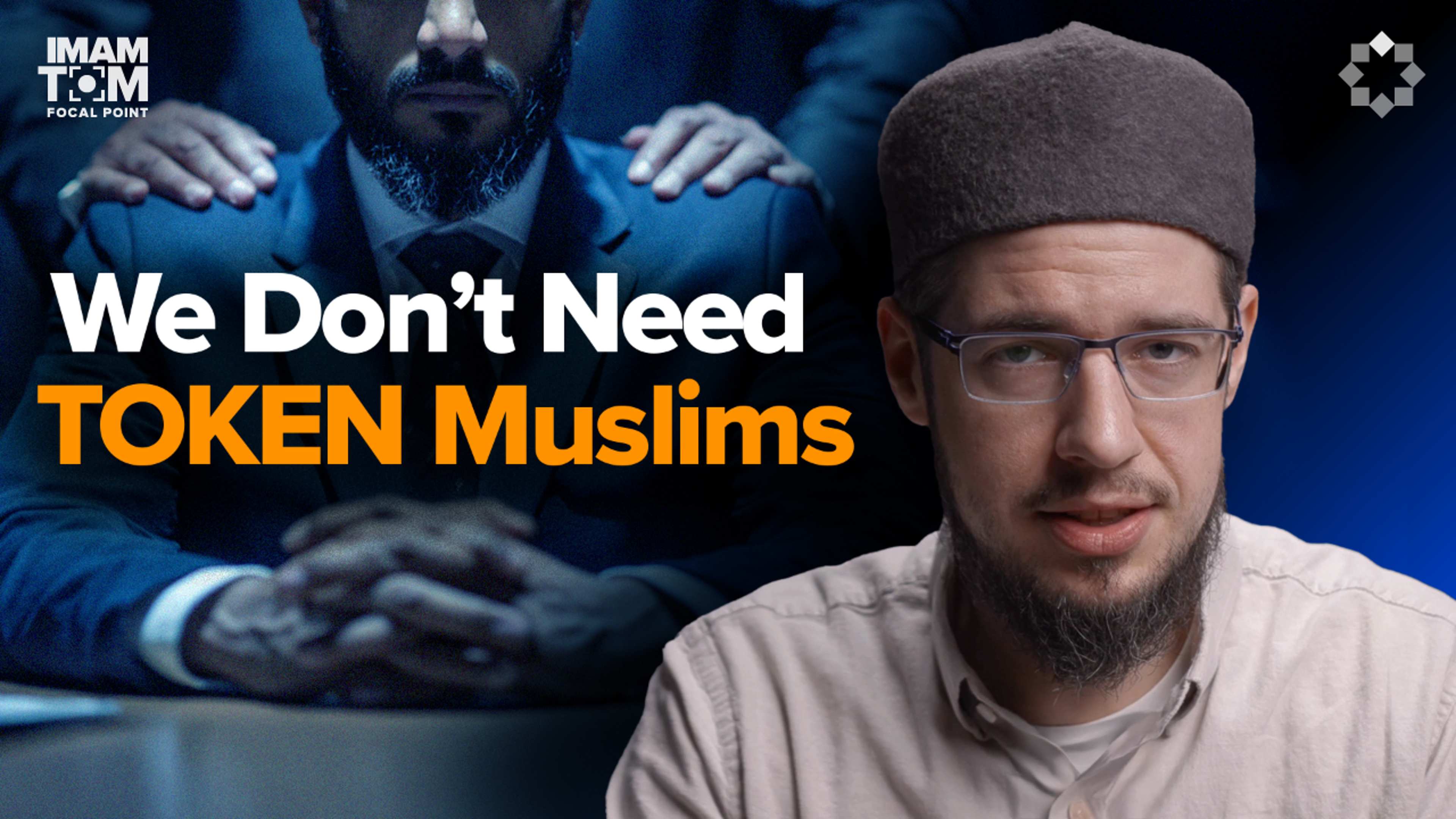
Representation Isn’t Working. Here’s Why. | Focal Point with Imam Tom Facchine
What if the Muslim representation we’ve been fighting for is actually working against us?
In this Focal Point episode, Imam Tom Facchine explores the rise of Muslim representation in media, politics, and pop culture, and why it might be more harmful than helpful. From tokenism to identity politics, we unpack how visibility without values can betray the very communities it claims to uplift.
Before we celebrate inclusion, we need to ask: At what cost?
This transcript was auto-generated using AI and may contain misspellings.
Hadith from the Prophet Muhammad (ﷺ). Many of us, unfortunately, are fooled. We talk about tokenization.
Okay, nobody likes tokenization. Is every movie just going to start having a token Muslim character?
People who are supposedly representing us, they look like us, they claim to be us, they might have a few token sort of similarities with us, but down deep their entire paradigm, their entire worldview is completely not only un-Islamic, but anti-Islamic.
Representation has gotten a lot of play in the Muslim community lately. We see that Muslim actors, celebrities, politicians seem to achieve certain status. We've got more cultural force, you could say, or cultural soft power.
Certainly, in the UFC, you've got Khabib and the whole team from Dagestan. There seems to be an argument or a default assumption that representation is only a good thing.
I want to pause that conversation to show some ways in which representation is not always good. And this is not a comment on any of the phenomenon that I've just mentioned.
But in a 2025 world where we've heard so much about how important it is to have a seat at the table, I want us to pull back and question what table we're trying to sit at in the first place.
Are we sure that our representation matters or how can we ensure that our representation matters? And when we're talking about smashing glass ceilings, we want to be sure that those glass ceilings need to be broken at all.
Because not all representation, let's be honest, not all representation uplifts and benefits our community. Some representation is just not good. Would we want Muslim representation among drug dealers or among prostitutes?
The answer is no. We do not want Muslim representation there. Okay, then we need to extend that logic to less dramatic examples. If we see people who are a social media influencer, maybe they're a celebrity.
But if they're known for a lot of public sin and they say things even that's like, wow, they scratch your head and like, is that blasphemy? Is that something that Allah is going to be okay with? We have to seriously ask ourselves whether the juice is worth the squeeze.
Is it worth having someone in that role with the limelight on them that is a Muslim or insha'Allah claims to be Muslim? But the type of representation that they're offering doesn't really do much for us. That's the first way.
The second way is that there's no guarantee that representation will be authentic. Okay, there's no guarantee that you have a Muslim. You grab any token Muslim. We talk about tokenization. Okay, nobody likes tokenization. Great.
Well, how are you going to ensure that tokenization won't happen? Do we have any mechanisms to prevent tokenization from happening? Or is every movie just going to start having a token Muslim character and every politician is going to have a token Muslim staffer?
We wouldn't even like that. I don't think. The establishment tries to recruit and conscript token Muslims as almost like a PSYOP against us, right? To get us to renounce our faith or to have doubts in our faith or to think that something's wrong with us.
Now, that's just one of the ways in which it happens. The other way is with the recruitment of people that are close to the establishment, that are actual Muslims, that are actual people of faith. They probably pray. They probably fast Ramadan.
And they probably are convinced or deluded in thinking that they're doing da'wah, right? And so they cozy up to power and they're given some kickbacks or they're given access.
But as a shaykh once told me, and this is very, very deep, what he said, he said, access is not power. We might say we might feel good. We might feel seen. We might feel visible.
But at the same time, it not only doesn't serve the community, it also might be an obstacle to serving the community better.
And that brings us to the third point, which is really, really difficult, which is that symbol and symbolic victories can easily turn into lip service.
And the sad state of affairs is that politicians and corporations have figured this out.
The politics of representation, the representation game, they have figured out how to use it to pacify us and tokenize us without giving us anything of substance whatsoever.
We saw how many people within, let's say, the Harris campaign that was supposed to be the liaison or the special liaison to the Muslim community or the special person, the special staffer that's appointed.
We don't need somebody who's a Muslim to be, you know, wiping the boots of the person in power or running and getting coffee. We just want substance. We want change. We want justice.
And that's really the two things that we're talking about here today. That representation, I'm going to give you a quote from Sana Saeed. She mentioned in a Twitter thread, representation is not liberation. Representation is not liberation and not sovereignty.
That they are willing to make you feel seen and heard, but they are not necessarily willing to set you free. And if you want concrete examples, let's go to Palestine. Let's go to the PA, the Palestinian Authority.
Let's go to Mahmoud Abbas, who's largely discredited among Palestinians for the things that he's done. We're not going to rehearse them here.
As they say, not all skin folk are kinfolk or that just because somebody has the right name or they look like someone who's going to represent your values does not mean that they represent your values whatsoever.
The colonial administrations of the European powers also use this tactic very, very well.
When it came to putting down rebellions or administering over the taxation or the theft of resources and land, they would much rather conscript a Muslim to do it to another Muslim than them get their hands dirty themselves.
That is what complicates the issue. We can even find an example of this in the Quran. And we say even, not to say that we're surprised to find the Quran. The Quran, as Allah subhanahu wa ta'ala said, is tibyan li-kulli shay'. It clarifies everything.
But even in the sense that this indicates that this is a perennial phenomenon. This goes cross history. This goes in every culture. You could even say it's universal. It's not something limited to this new era in which we live.
The powers that be, the tyrants have always attempted to use one of our own against us. So we find in Surah Al-Qasas the story of Qarun. And we know the story of Qarun. The story of Qarun are known as Korah in the Bible.
Qarun was someone who had so much money that Allah says that it took several men to carry just the keys to his treasures. Now you wonder, how did Qarun get this much money?
And if you go into the tafsir, Ibn Kathir rahimahullah, he says that Qarun was the first cousin of Musa 'alayhi salam. A lot of people don't know that. That he was part of Bani Israel.
He was part of the children of Israel. And then it starts to make sense. That's why he has so much money. Because Fir'aun, the tyrant, he doesn't want to oppress Bani Israel by himself. He doesn't want to get his hands dirty.
He needs someone from Bani Israel to do the dirty work. He wants someone close to, related to Musa, if possible, in order to do the dirty work. That way he can say, hey, this isn't a tribal thing.
This isn't a nationalistic thing or an ethnicity thing or a racial thing. Look, I've got one of your own guys hired and he's my right hand man.
So we see that this is a time honored tactic that people in power and tyrants have always used.
The tokenization game and the politics of representation in order to avoid accountability and avoid any accusations of wrongdoing.
Now, we see, unfortunately, when we get that token representation, many of us, unfortunately, are fooled. And many of us are content with little so that we look at somebody and we have maybe hopes for them.
And then they finally, they've been telling us all along, just wait until I get a little bit higher. Wait until I get a little bit higher. Then I'm going to flip the switch. Then I'm going to really represent the community and I'm going to speak truth to power and I'm going to bring the benefits. But what do we find?
They reach the highest echelons and then they're still tap dancing. They're still playing by the rules of the game. They're still playing within the bounds of acceptability, whether it's the major media outlets, whether it's the movies, whether it's political office.
We don't ever get the payoff that we were promised in exchange for the support of these figures in the first place. All that to say, the long and short of it, we want substance. We want substance. We want autonomy. We want dignity.
These things, they come from Allah subhanahu wa ta'ala first and then from having a community that is led by values, not necessarily identity. Identity, sometimes it's right and sometimes it's wrong.
You'll find someone who checks all the identity boxes that's going to sell you out and betray you. And then you'll find other people that are different from you, from a different race or ethnicity or heritage or religion.
Sometimes espouses your values and advocates for your values more than some of the people who check all the identity boxes.
So what we can do as a community, we have to lead with our values first and we have to be with whoever supports and lives and advocates for those values.
Not with anybody who just comes to us and tries to leverage their identity in order to get us to support them.
We also have to, from a young age, build individuals who won't sell out their values in order to advance their career or to gain status or to gain validation from broader society.
That being a values led community or a values first community starts at home and it starts young. We need to teach that to our children. And then the last thing is we need to do our own thing and be comfortable doing our own thing.
That means that when we look sometimes at Hollywood or we look at the music industry, right? We don't want a Muslim diddy, right? Hasha.
That we think about inserting somebody into these structures without realizing that these structures change you and they buy you and they tempt you and they do all these things to you. Maybe we need a new structure.
Maybe we need to do our own thing. Maybe we need to make our own system of funding film. Maybe we need our own film industry. Maybe we need Nasheed or auditory industry.
Maybe we need other industries that are going to not ask us to compromise our values and not attempt to tokenize us in the process.