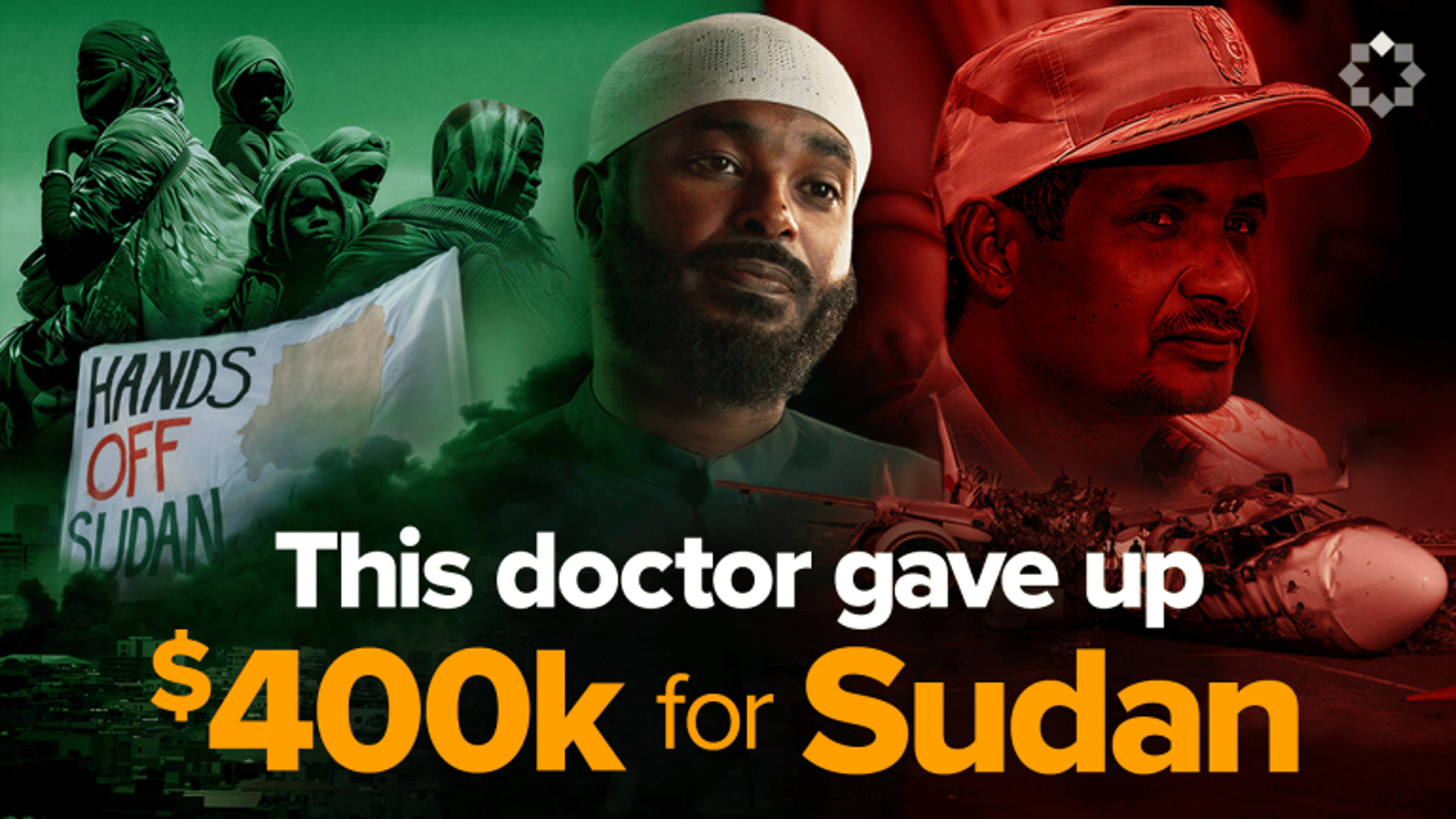
I had a chance to go to Sudan this past January and just touching down in Sudan after three years and not being able to go because of the war left me in tears. Sudan is filled with resilient heroes.
I met Dr. Yasir Jabra, a man who'd be making a salary of $400,000 if he was working in America as an ER doctor and he gave that up to earn just $200 a month serving patients in Sudan
for three years. A country facing what the World Health Organization calls the world's worst humanitarian crisis on earth where a child dies every three hours from starvation in a land
that is rich with agricultural resources while preventable diseases like cholera, the measles, malaria and dengue fever spread across displaced tent-dwelling families where doctors treat young
girls who've gone through unspeakable sexual violence without anesthesia, without proper tools, under the threat of armed groups. Almost 34 million need humanitarian aid. More than a third
of health care facilities are non-functional. Over 150,000 are estimated to be dead. April 15th marks three years since the war in Sudan began. For three years we didn't return to our homeland.
For three years we didn't get to see our families. In these three years 13.6 million people have been displaced making Sudan the largest displacement crisis in the world. How did we get here?
To understand this war you have to go back. In 2019 a revolution overthrew the dictator Umar al-Bashir after 30 years in power. The world watched as thousands gathered in Khartoum calling
for freedom. There was real hope that Sudan could finally build something better. But on June 3rd 2019 that hope was shattered. In Ramadan the rapid support forces, the RSF, massacred over 100
protesters. A friend told me that day the sky doesn't look the same anymore. It was the first time such violence would happen in the capital. Khartoum was no longer safe. A transitional
council was formed but in October 2021 the military overthrew the civilian prime minister and for 18 months the army and the RSF wrestled for power. The RSF is led by Mohamed Hamdan Dagalo
a man who rose through the Janjaweed militias during the Darfur genocide of 20 years ago and now controls gold mines worth billions. By April 2023 negotiations collapsed. Khartoum woke up to
heavy artillery and gunfire. This didn't happen in a vacuum. Negative state actors in the region have been taking advantage of the fragility of the Sudanese state to launch a proxy war that
will allow for them to usurp Sudan's resources. Call things by their proper names. This is not a civil war. This is genocide enabled by those profiting from Sudan's resources. When the ground
met my feet after three long years I couldn't help but break down. Another hero I met was Dr. Safat Yousif who runs the largest maternity hospital in Sudan delivering 130 babies a day.
When the RSF shells hospitals it belies their claim that they're seeking to rule over Sudan because why would you destroy the infrastructure of the society you're actually trying to govern? She refused to leave and stayed in the care of her patients throughout the occupation.
There is incredible resilience and hope in Sudan. We attended the opening of Bahri hospital. Bahri hospital was shelled by the RSF. By early 2026 Bahri hospital had reopened after extensive
reconstruction and renovation efforts spearheaded by Muslim-led organizations in the United States. When we did the reopening the community was incredibly happy. People were saying that now
that they have health care again our families will be able to return, our neighborhoods will be able to return. The hospital brings life back to the community. Not only that, people were saying the
hospital now looks even better and is more equipped than it was before the war. The Sudanese people are not passive victims. They are people of incredible courage, of sabr, of sacrifice, of zuhd
and belief in Allah. There's a real sense of hope that Sudan can come back stronger and maybe even better than it was before. But they can't do it alone. We can't do it alone. Three years in,
international attention has faded while the crisis deepens. You see it on your feed and keep scrolling, swallowing the guilt, the tents, the rib cages of children, the violence against girls,
the fall of al-Fashir last October when blood could be seen from satellite images in space. So what will you do about it? First, amplify Sudanese voices. Share their stories. Follow
Sudanese journalists reporting from the ground at great personal risk. Pressure media outlets to cover this. We forced the world to pay attention to Palestine. We can do the same for Sudan. Not
the same crisis but the same tool, attention. Second, support humanitarian organizations delivering food, medicine and safe passage. Every dollar can be the difference between life and death.
Giving your wealth will only increase your rizq. Third, demand political accountability. Contact your representatives and demand sanctions on those arming the RSF. Call out US complicity. Fourth,
use your economic weight. Where you spend is where you stand. Refuse to finance systems that sustain this violence. Boycott goods. Change travel plans. And fifth, make du'a. Du'a is the weapon of the
believer. Your tahajjud has a power you can't see because that power belongs to Allah subhanahu wa ta'ala. But remember, du'a though is of the greatest of actions, we also roll up our sleeves and go to
work. Three years of war, the world's worst humanitarian crisis, but also three years of unbreakable resilience from the Sudanese people. So don't forget about Sudan. Don't let the world