




fbpixel
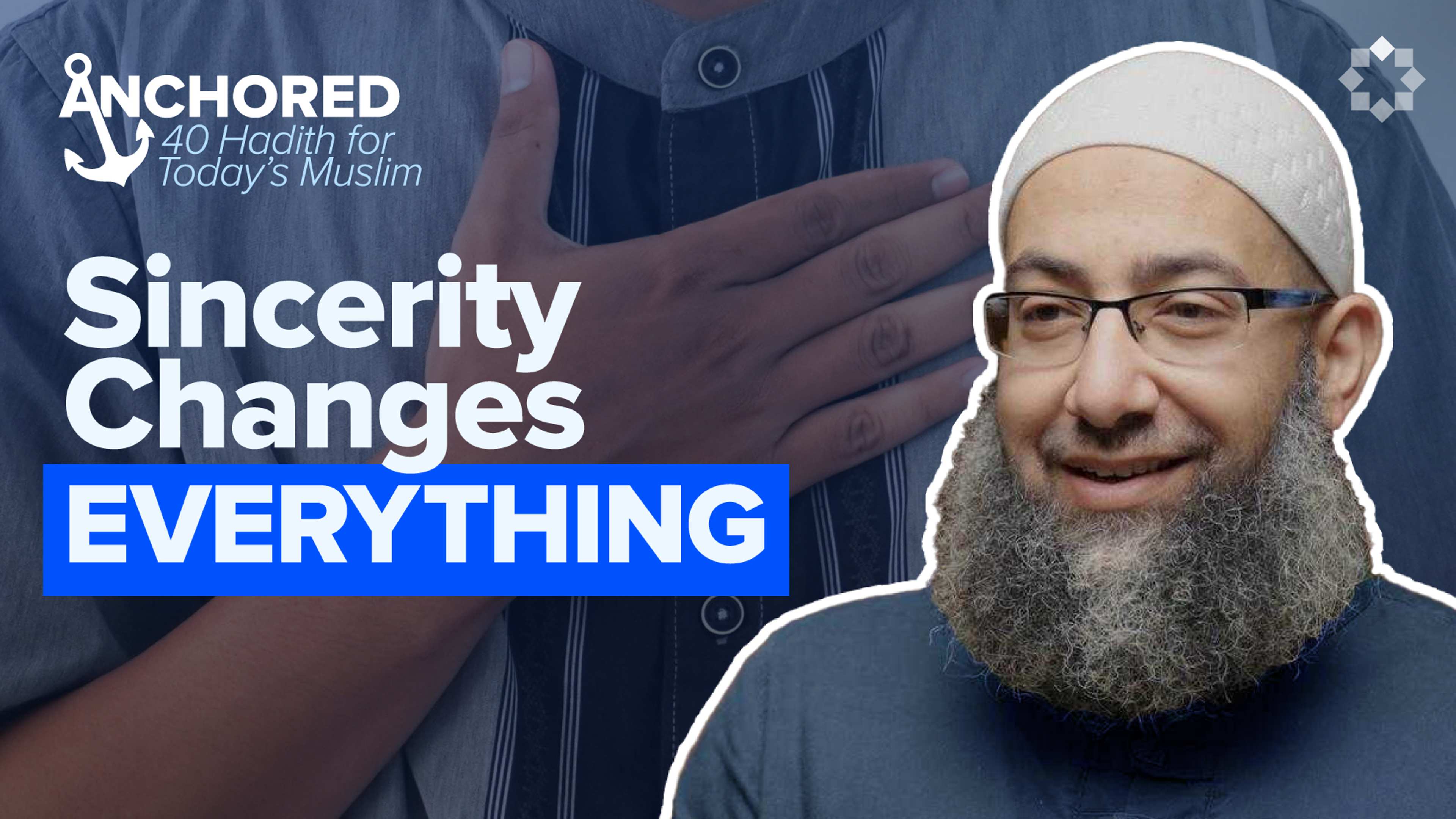
Should You Work for Big Tech? | Anchored Ep. 1

Anchored

Should You Work for Big Tech? | Anchored Ep. 1

Should you seek Islamic knowledge? Work for Big Tech? Get involved in politics? Make hijrah? Use AI?

These are some of the complicated questions that shape the decisions Muslims have to make every day, as students, professionals, parents, community members, and even in their personal worship.

And answering them starts with reflecting on the foundation of everything we do in life: intention (niyyah).

After introducing us to the great scholar Imam an-Nawawi (rh), Sh. Mohammad Elshinawy explains what every Muslim must know about intention.

“Anchored: 40 Hadith for Today’s Muslim” is a new series by Sh. Mohammad Elshinawy which draws insights from Imam an-Nawawi (rh)’s collection of 40 hadith and applies them to some of the most pressing questions Muslims face today.

Tune in every Saturday at 9 AM CST/3 PM GMT for a new episode of Anchored!

This transcript was auto-generated using AI and may contain misspellings.
00:00How could it be that Yusuf A.S. works in a disbelieving government in Egypt? I never had to wrestle with anything more difficult on me than my intentions, because they're constantly flipping on me.
00:11How many small deeds were made great because of the intention behind them? And how many great deeds were turned into nothing? The Shaytan wants you to show off, but if you don't do the deed in the first place, you just gave Shaytan the day off.
00:26A droplet of taqwa will outdo a mountain heap of good deeds. There's hardly a big tech company that is not complicit in genocide. So are we allowed to be there?
00:42We welcome you to the 40 Nawawi Hadith Collection Explained. And I actually want to begin with Al-Imam Nawawi himself,
00:53rahimahullah, the great Imam Abu Zakariya Yahya ibn Sharaf Al-Nawawi, rahmatullahi alayh.
01:02He was born in the year 631 after the migration of the Prophet ﷺ, so roughly 800 years ago during a very difficult period for the Muslim Ummah
01:15when it was being attacked from multiple directions by the Tatar Mongols from one direction and by the Crusaders from another. And in 631 in a small town called Nawa,
01:29that's why he's known as Al-Nawawi, from Nawa, which sits about 80 kilometers away from the capital city of Syria, from the capital, Damascus.
01:40There was born Yahya ibn Sharaf who became Al-Imam Al-Nawawi, rahimahullah. May Allah bestow mercy upon him. And this towering Imam showed signs of prodigy,
01:54signs of being a luminary, being something uniquely special from very early on. He was raised by his father who was a businessman, a trader on the love of the Qur'an.
02:06In fact, one of the scholars came to his father's house one day and said to him, your son is going to be a great, great, great man. He said to him, are you a fortune teller? How can you know the future?
02:18He said, no, but I saw something from him today that was remarkable. The boys in the streets are badgering him, bullying him to come play with them, and he's running away from them crying because he doesn't want to play
02:31and wants to continue reciting his Qur'an. And that relationship with the Qur'an stood with him. And there is never an equivalent for the Book of Allah, Subhanahu wa Ta'ala. As we study the hadith,
02:45which are the counterpart of guidance alongside the Qur'an, let us at least say, since we won't say it beyond this point as much, there is nothing like the Qur'an. And what makes someone special on earth
02:58is their profile in the heavens with the Qur'an. Very much later in his life, when he became that esteemed Imam, Muhammad ibn Abi al-Fath al-Hanbali
03:11says, I entered the Great Mosque, the central masjid of Damascus before Fajr. And hiding off in the dark behind one of the columns of the masjid,
03:24the pillar supports of the masjid, was Imam Yahya ibn Sharaf al-Nawawi, reciting the verse of Allah, وَقِفُوهُمْ إِنَّهُمْ مَسْؤُولُونَ This is a scene from the Day of Judgment
03:38where Allah will say to the angels, وَقِفُوهُمْ إِنَّهُمْ مَسْؤُولُونَ and detain them, stop them right there at the cliff above the fire. Stop them right there. Now they will be questioned.
03:52He said and he kept repeating it, not knowing I was around, not knowing anyone was around, repeating it with such emotion, with such awe, with such reverence of Allah
04:03until it caused inside of me what only Allah knows. Just hearing him recite would transform people. رحمه الله تعالى When he became 18 years old,
04:16he finally left Nawa and he traveled to the stronghold of sacred knowledge, Damascus. And he remained there studying with the scholars for a few years. About two years later,
04:29he made his obligatory hajj. And then he returned to Damascus and as the youth say, he locked in.
04:40He would study for six years straight, as the biographers mentioned, day and night. He would never sleep
04:52unless he was overcome by sleep. Ibn Jama'ah, another great scholar from the madhhab, says, I came to visit him once and I could not find a place to sit. There were just piles of books everywhere in this little house that was gifted to him to study.
05:07And when he would get tired, he would just stack a few books and lean on them for a bit and come back. And he said to us that there was a period in those six years when he really put his head down and got entrenched
05:21and firmly grounded in the sacred sciences. Two of those years, he did not lay down whatsoever for two years straight. رحمه الله تعالى You know, just to give you a feel of
05:33what kind of solidification and depth his knowledge had, he used to say once, complaining about people that were arguing with him without qualifications. He says, يُنَازِعُونِي فِي الْوَسِيط
05:47وَقَدْ رَاجَعْتُهُ أَرْبَعَ مِئَةِ مَرَّةٍ They argue with me regarding Al-Wasit. Al-Wasit is a small manual in the Shafi'i madhhab, a summary of the rulings in the madhhab. They debate with me on Al-Wasit
06:00when I have reviewed Al-Wasit 400 times. It's like one of the manuals. And he would prepare about 12 lessons a day. You know, like you prepare a lesson whether it's in grammar, whether it's in law, whether it's in theology,
06:14whether it's logic, rhetoric, and then you present it to your teacher and you come back. 12 lessons a day. And he would fill about two notebooks filled with writing every single day. And he would never stop writing
06:28until his hand refused to write. He would write until his hand would go numb and he would lose sensation in his hand. He'd figure out something else to do while his hand recovered. And he used to say when his hand would go numb,
06:42لَإِن كَانَ هَذَا الدَّمْعُ يَجْرِي صَبَابَةً عَلَىٰ غَيْرِ لَيْلَ فَهُوَ دَمْعٌ مُضَيَّعٌ You guys know Qais and Layla? Qais was a man in sort of Arabian history
06:56that was madly in love with a woman named Layla. And he wrote, he was a desert romantic. He wrote endless poetry. And when he could not be with Layla, he stopped eating and he lost his life ultimately.
07:10And so he has filled the literature books with poetry about Layla. It was the original Romeo and Juliet, if you will. And so Qais used to say about his tears, if I ever cry,
07:25if these tears ever flow for anything but Layla, they are wasted tears. So Imam Nawawi used to say those lines as if to say what? There are people who work so hard for some girl,
07:39for some money, for some this, for some that. If my hand has to go numb for any other reason than this, it's a wasted effort. He would give himself sabr by reminding himself
07:52of the yearning love that Qais had for Layla. That was his love for Allah Subhanahu wa ta'ala and serving the deen. And as for his worship, he was of those who would fast every day of every year
08:07except for the haram days, the days you're not allowed to fast, like the days of Eid. And he was known to be so God-fearing that he had a policy to never accept a gift from a student. Why? Fearing favoritism,
08:21fearing that an unconscious bias would develop inside of him, a soft spot that would lead to unfairness because this person, I have some sort of gain from them. And he was, as I said,
08:35constantly reading the Qur'an, constantly rising above any time wastage. You know, like, I don't care who got married and who got divorced. I don't care what the prices are looking like today.
08:48He was not just afraid of what could harm him in the hereafter. He held himself above whatever could not benefit him in the hereafter. Rahimahullahu ta'ala. It was very evident, you know,
09:01Allah is the final judge of everyone. But he had so many signs signifying, surrounding him that would signify how close he was to Allah 'Azza wa Jall. Even some karamat, ways that Allah honored him
09:15in miraculous ways that when he would visit some people and they would say, our sickness has deadlocked and we have hope that your du'a will help us. He would get very upset. He would say, I'm a nobody. What do you mean my du'a would help you? But I will still make du'a.
09:29That's the Sunnah of the Prophet ﷺ. And they would mention that even though nothing had worked before it, before the day was out, the person was beginning to show signs of coming out of his illness.
09:43And after his death actually, his aunt, his father's sister, saw him in a dream saying to her, tell my brother
09:57who's fighting with everyone about making me some glamorous shrine of a grave, tell my brother to not do what he is bent on doing. I want a flat grave. I want a grave that does not get visited
10:10from the far corners of the world. Bury me upon the Sunnah. And this was just before they had buried his body. Rahimahullahu ta'ala. You know, at the end of his life, he had faced many trials
10:24like many of our scholars do when they have to stand on principle and speak the truth that Allah has endowed them with learning. At the intersection of politics and religion, he ultimately got exiled from Damascus at the end of his life.
10:38And he went and visited Al-Masjid Al-Aqsa in Al-Quds before returning to his hometown village of Nawa. And he fell horribly sick. And people would make the trip from Damascus to visit him.
10:51And just when he was showing signs that he was getting better and people stopped visiting him, his health deteriorated very quickly. And in the year 676,
11:05so 1277 Common Era, 676 at 45 years old, Allah Subhanahu wa ta'ala decreed that he pass away. And Subhanallah, he was only 45. You know, he did not live a lifespan of much quantity.
11:19But you could see that it was such a life of quality. You know, his works remain among the most widely read in all of Islamic scholarship. You know, you have a book called Riyad al-Salihin.
11:34There's probably no other book after the Qur'an that exists in the Muslim Ummah as widely circulated as Riyad al-Salihin. And he has a book called Al-Adhkar,
11:48the etiquettes of remembering Allah Subhanahu wa ta'ala and constantly being in a state of remembrance. And he has, Subhanallah, you know, this is an indication of his sincerity and why his scholarship was so blessed and so far-reaching.
12:02He has the most authoritative explanation on Sahih Muslim, the hadith collection. I mean, Muslim ibn Hajjaj. He has a book called Al-Minhaj, the explanation of Muslim ibn Hajjaj. Rhyming title, yeah? He says in the introduction of that book,
12:17I want you to get a feel of the kind of man he was. He said that, were it not for people's lack of stamina in reading in his age. May Allah rectify our condition.
12:31Were it not for people's lack of stamina and my fear that the book would not circulate and benefit people widely, I would have made it over a hundred volumes long. The explanation is an encyclopedia,
12:44but it would have been 10x. He had all of that with him to write and expound what he feared to be a burden on the Ummah and to not benefit them widely. But bringing it to our collection here and now,
12:58the 40 Hadith collection. Why did he put this Hadith together? You know, it's almost like, Sahih Muslim, he dedicated himself to that Hadith collection that touches every chapter, if you will,
13:13of Islamic belief, ethics, and law at some level. Then he wrote a shorter book, Riyad al-Saliheen, right? As if to give you a tour of Islam.
13:24But then he wanted to make sure that every Muslim had what? Had a snapshot of Islam. What every Muslim cannot do without in Islam. So that's the 40 Hadith collection. You know, there's some who have traced back
13:39to the Prophet, ﷺ, in some reports that he said, whoever collects 40 hadith of mine to benefit people's deen will be resurrected on the day of judgment among the 'ulama.
13:49Right? That's one of the reasons why. But these are 40 hadith that he held were to be the anchors. The anchors, the essentials that every Muslim in every time and place, timeless,
14:02that everyone needs to know foundational knowledge, or reverse it and call it the bird's eye view of Islam. So that's what we're going to do together, inshallah. We're going to cover
14:13one to two hadith each week together, inshallah ta'ala. We're going to unpack some of the words of these hadith, try to highlight some of the legal and spiritual benefits in the
14:27hadith and applications. My niyyah for this, my intention is to find applications for us that are particular for Muslims in modern times, in addition to the timeless universals,
14:38right? Timeless fundamentals in our modern times where people are uprooted from real communities, from meaningful relationships, from an actual sense of belonging, apprehended
14:52by the digital age and parasocial relationships, right? What these hadith can provide us in particular on top of what they can provide any and all Muslims at every time and place.
15:04So we'll begin with the first hadith tonight, inshallah, and see if we can go two by two as best we can in the week's forthcoming. Bismillah. So this is Hadith 1, Hadith al-Niyyah,
15:15they call it, right? The hadith from Abu Hafs 'Umar ibn al-Khattab, radhiyallahu 'anhu. 'Umar is the, you know, right-hand man of the Prophet ﷺ, second to none after Abu Bakr, right?
15:27From among the companions. He narrated in this highly authentic hadith found in Bukhari and Muslim that the Prophet ﷺ said, Innama al-a'malu binniyyah. Actions are but by intentions.
15:41Wa innama li kulli imri'in ma nawa. And every person will only have what he or she intended. Faman kanat hijratuhu lillahi wa rasulih, fa hijratuhu lillahi wa rasulih.
15:53So whoever migrates, you know, migration would happen, for instance, from Mecca to Medina. Whomever migrates somewhere for Allah and His Messenger, then his migration will be
16:04counted, will be rewarded as being for Allah and His Messenger. Wa man kanat hijratuhu li dunya yusibuha, aw imra'atin yankihuha, fa hijratuhu ila ma hajara ilayh.
16:17And whomever's migration is for some worldly gain that they're seeking out, or for some woman that they seek to marry, then their migration is for whatever they migrated for. What is important to be said about this hadith?
16:32First of all, this hadith represents so much. So Imam al-Shafi'i, rahimahullah, he said this hadith applies to seventy different chapters
16:46of fiqh, of Islamic law. And you know, the Arabs, when they use the word seventy, they don't mean the numerical 70. They don't mean like one more than 69, one less than 71.
16:56Seventy means countless, innumerable, right, plethora. There's actually no chapter this doesn't apply to. Every chapter, every topic, there's going to be some involvement of the aspect of the intention.
17:11Al-Imam Ahmad, rahimahullah, said Islam revolves on three ahadith. This is one of them. One third of Islam. And some scholars said this hadith is one half of Islam. Why?
17:25Because what is Islam? Like you think of the Shahada, right? I bear witness there's none worthy of worship but Allah, and I bear witness Muhammad is the messenger of Allah. That is the testimony of faith, the first pillar of Islam, and the summary of Islam.
17:38Half of it is that we seek out none but Allah. That's intentions, sincerity of intentions. The other half is we only follow the messenger of Allah, which means righteousness. So that's what it is. Islam is about being righteous for the right reasons.
17:50So half of Islam is intentions. Half of Islam is you're doing things right internally, and the other half is you're doing things right externally, yes?
18:02This is why Yahya ibn Abi Kathir, rahimahullah, he used to say ta'allamu al-niyyah, learn intentions. Learn how to intend. You think it's a given, but no.
18:14Pay attention to intentions, he's saying. Fa'innaha ablagh min al-a'mal. Because it is far more reaching than actions. It's the more important of the two.
18:26The internal is more important than the external. You know, our teacher, Dr. Hatim al-Hajj, he gives a beautiful analogy for sincerity of intentions.
18:35He said you doing a righteous action with a faulty intention, an insincere intention,
18:46is like you going to a lake with a perfect net, righteous net. The net is perfect, but there's no fish in the lake to catch. Will you come back with any fish?
18:59There's nothing to come back with, right? He says, but having a sincere intention, even if you have some fault line in your actions,
19:08even if your actions are imperfect, is like going to a lake that has fish in it with a net that is knotted up, torn. Will you come back with any fish? You might.
19:21This shows you the disparity of the two. There is no hope without sincerity. But there is hope, so long as there's sincerity, even with imperfections. And that's actually from the mercy of Allah.
19:34He knows that He created us with limitations. So what He wants from you, Subhanahu wa ta'ala, is to journey to Him more so with your heart, because you can, than with your actions, because you never fully can.
19:47You see how that works? You know, where did the Prophet ﷺ say this? He said, in Sahih Muslim, there's one hadith, Man talaba al-shahada bi sidq,
20:00whomever pursues or desires martyrdom, to die a martyr, with sincerity. Sidq here is truthfulness, truthfulness of intention. Sincerely. Ballaghahu Allahu manazil al-shuhada. Allah will deliver him to the station of the martyrs.
20:14Wa in mata 'ala firashih. Even if he happens to die on his bed. See, it gets you farther. You know, Abu al-Darda, the companion of the Prophet ﷺ, he used to say, listen to this.
20:24How wonderful, how wonderful, is the sleeping of the wise and their breaking of fast.
20:31The wise person, even though they're not fasting and they're not praying at night, the sleeping and the non-fasting of the wise person, how it outshines the night prayers
20:43and the fasting of the foolish. What does he mean by that?
20:58He said, because the person of taqwa, when your heart is present and seeking Allah by your actions, he said a droplet of taqwa, of piety, of sincerity, will outdo a mountain
21:06heap of good deeds from those who are self-deluded, right? From those who are not paying attention to their intentions.
21:20And Abdullah ibn Mubarak, rahimahullah, he would say, how many small deeds were made great because of the intention behind them. And how many great deeds were turned into nothing because of the intention behind them.
21:32And so, this is the first piece and the most important piece in all of Islam, not just in this hadith. The intention is like the soul of the actions.
21:46When you have an action, but there's no, it's like a soulless body, it's dead, it's lifeless, it's tasteless. And that's one of the ways to check your intention.
21:58Do you taste your acts of worship? You know, Ibn Taymiyyah would tell the people, if you don't find any taste to your acts of You know, Ibn Taymiyyah would tell the people, if you don't find any taste to your acts of worship, then go inspect your act.
22:12Maybe the intention behind it is faulty. Go inspect your act, because Allah is ash-Shakur. You know what ash-Shakur means? The Most Appreciating. Meaning, Allah is too appreciative to make you wait for the Day of Judgment to reward you.
22:27He's going to give you some now, the sweetness of that faith. And then he'll give you a bigger installment on the Day of Judgment. So you check it. Alright. A few points of benefit from this hadith.
22:38The first of them is: what is the difference between the first phrase and the second phrase? Actions are but by intentions, and every person will only have what they intended.
22:52Actions are only based on, judged based on the intentions, and everyone's reward will be based on how their intentions were judged. So they're reinforcing each other, reiterating the same point.
23:05Another group of scholars said no, they're different. And it's worth noting. It could open up beautiful meanings for you, and it's actionable too. They said the first statement is speaking about the nature of actions.
23:20People don't act except due to an intention. There's never an intention absent. And then the second statement is going to be: the reward of your actions is going to be whatever you intended by it.
23:33So it's telling you that whether you realize it or not, the first phrase: every action, voluntary action, you're not thrown off a building, you jump, right? A voluntary action. Every action you choose to do has an intention behind it.
23:47There is no action except that it's but driven by, sourced in an intention. And then the outcome will be determined by that. Why is this important? What does this do for you?
23:58Because you can say, wait, but I didn't really have an intention. It was just a habit that I did, right? Can I get rewarded if it's just a habit?
24:12It's controversial, but I do believe in the opinion that you can. Because Allah does want us to make good habits, right? You might get rewarded for habits that you did. I got into the rhythm of praying 'Isha in the masjid every night.
24:25So the fact that I'm not bringing to mind the reward or what exactly I'm pinpointing in my going, I built a good habit, something that's pleasing to Allah. Alhamdulillah for that, right? You might get rewarded, although that's not optimal.
24:38Allah does want you to perform ihtsab—a hadith speaks about ihtsab, which means to expect of Allah. You know what that means? That means to magnify your expectations of Allah, to aspire. I want from my action this and this and this and this.
24:53This will breathe life into your faith. So you might get rewarded out of habit. But if every action has an intention, no matter what, you do want to pay attention because maybe you won't get rewarded at all.
25:06Maybe it became just because people are watching now. Maybe that's what drove it. There's always an intention, right? Which one is it? That's what you want to pay attention to. You always want to check. Sufyan al-Thawri, you know Sufyan al-Thawri?
25:19Sufyan al-Thawri was the Abu Bakr al-Siddiq of the second generation. That's what someone would call him. He would say, I never had to wrestle with anything more difficult on me than my intentions
25:31because they're constantly flipping on me. Slips away, slips away, right? So you're wrangling, you're wrestling with your intention. And this is what the Prophet ﷺ feared.
25:43He feared that insincerity creeps up on you. The Sahaba said one time we were sitting together talking about ad-Dajjal, you know, ad-Dajjal, the greatest trial till the end of time, you know, the Antichrist, the false Messiah.
25:57And the Prophet ﷺ came out. We told him what we were speaking about. He said to us, would you like me to tell you what I fear for you more than ad-Dajjal? I said, what's that?
26:07He said, ash-shirk al-khafi, hidden, inconspicuous, right, subtle idolatry. You know, shirk, like setting equals to Allah, subtle shirk, when there's like an invisible
26:21idol within you that has your name on it, like the miniature, right, the God complex where you want people to see you. You want people to sort of center around you.
26:33You want people to bow down to your opinions, right? So he says the hidden shirk. And then he gave them an example of it. He said, and it is the hidden shirk for a man to stand up and pray and then beautify
26:45his prayer because he notices that people are watching. You're praying for God. You're not praying to these people. You wouldn't be Muslim if you were praying to them. You're praying to Allah, but all of a sudden it's like for the praise of the people, for
26:58the pleasure of the people. And I want to cover something here because this discussion also makes some people subject to waswasa, like too much whispers. Get some OCD going, right?
27:11Some obsessive compulsive disorders about intentions. Say like, oh, I don't do this deed because I don't want to be showing off. Listen, shaytan wants you to show off. Why? Because it forfeits your deed, right?
27:24No reward from Allah when you're showing off. But if you don't do the deed in the first place, you just gave shaytan the day off, didn't you? You just made his life easier.
27:38So you're not going to stop doing the deed. Out of fear of showing off. That's not what you're going to do. You know, some people say like, I find myself enthusiastic around righteous people.
27:51That means I'm going to show off. Like I'm doing it for them. Not necessarily. Maybe they're just encouraging you. That's like, you know, the blessing of brotherhood and sisterhood is that we encourage each other upon goodness.
28:03Like when I come to a masjid and I see an elderly man grabbing his knees and holding his back and he still gets up and prays sunnah and witr every night after 'Isha. Does that not sit with me? Like, how can I skip it?
28:17So that's from the barakah, the blessing of being around people. This is the blessings of the masajid. But you do want to check. Maybe you are doing it for the eyes of the people. How do you check?
28:27Put yourself in a place every once in a while as a litmus test where you can see what they're doing, but they can't see what you're doing.
28:35If you're still doing it, that means they encouraged you. It wasn't for their eyes. It was because of their inspiration. Is this clear? You know, another thing that people think means you're automatically insincere is when you get praised.
28:49Like people, they get praised and they think, oh, that means I'm not sincere.
28:51Even the Sahaba, you know, they get praised or they get popular. No, there's a difference between being praised, being popular and seeking praise, seeking popularity.
29:05Because the intention is what your heart is seeking. If you happen to be praised, if you happen to be popular, very dangerous. Why is it dangerous?
29:15Because you can get addicted and you can start looking for it. So you do want to be vigilant, right? The next time you do it, seeking it. But in and of itself, it's fine. When they came and said, Ya Rasulallah, a person does something for Allah and the people start praising them.
29:29He said, tilka 'ajiru baw buwwa al-mu'min. This is the first installment of the believer's reward. That people think highly of him, think good of him. Just thank Allah for it and ask Allah to protect you from it and to conceal the faults that they don't know about you.
29:42And that's it. It's not insincerity. The last thing I'll mention is some people think doing a good deed publicly is automatically insincere.
29:54That's not the way to look at it. You want to ask yourself: can it be hidden? Because sometimes if it can be hidden, it should be hidden or else why are you showing it on purpose?
30:05But there are times when it can't reasonably be hidden. It would be detrimental to hide it. I'll give you a few examples. Allah says in the Qur'an, "In tubdu s-sadaqati fanai'imma."
30:19If you declare your charities, how excellent a thing that is. Declare them for the right reasons, which is what? To encourage people. Competitive instinct. It's built into us. The deen says harness it in the right directions.
30:32You know, I'll give you a beautiful example. The Prophet ﷺ came out once and heard Abu Bakr al-Siddiq reciting in the night prayers and his voice was inaudible. Couldn't be heard.
30:45So he said to him, Abu Bakr, raise your voice a little bit. He said to him, laqad asma'atu man najaytu, ya Rasulallah. But the one that I'm speaking to can hear me, O Messenger of Allah.
31:00It's a beautiful sort of mindset, beautiful justification, but he's telling him, raise your voice a little bit. So you can hear yourself recite. Maybe also you can gently wake up someone else to pray.
31:12So it's not always the best thing to automatically across the board hide it. You know, Imam al-Qarafi, rahimahullah, he says something that is just, it reminds you how Islamic knowledge,
31:24when you're not careful with your intentions, could be the ultimate trap, right? When it's not done for the sake of Allah ﷻ.
31:32He said our deen commanded us to seek knowledge even though most people will get intoxicated by their knowledge and draw attention to themselves deliberately using their Islamic knowledge,
31:45but because the world needs it, Islam told us you still have to go get it. You gotta learn and teach or else Islam will be lost, right? So the exception was made because of the need.
32:00I'll give you one final example. The Prophet ﷺ said, this is not even about greater good, this is about your personal good. The best prayer you can make after the obligatory prayer is what?
32:14Your prayer in your home. So it's better for you to pray your sunnah, your nafl in your home. But what if when you get home you get lazy? Pray in the masjid, pray in front of people.
32:26Do it now before sort of the notifications and the drowsiness gets to you. Do it now.
32:34But if it can be hidden and there's no detriment, no greater benefit in disclosing it and you still disclose it, then you should be concerned that you're insincere,
32:46that you're keen on people's eyes and people's praise, people's validation. The Prophet ﷺ said about that scenario,
32:57"No two hungry wolves let loose among a flock of sheep will do more damage to that flock. Can you imagine what they're gonna do? Like they're gonna ravage the flock.
33:10They will not do more damage to that flock than a man's keenness on wealth and status will do damage to his deen. Will rip it apart. Two more points to close out.
33:24Can an intention justify a wrong deed? Generally no. Generally no. The default is that what intentions do, sincere intentions,
33:37is that they take a good deed from being valid to being accepted. All a scholar can tell you is you ticked off all the boxes, your salah is valid. He can't tell you if it's accepted or not because he doesn't know what's driving you. So it takes you from valid to accepted.
33:52But it could take someone that commits an evil deed to safety, to being forgiven because it was a mistake. Or it could even take them to be rewarded by the way. If they had to do it.
34:07If they were doing it and they had no choice for the greater good. Right? So, two examples. Example one is living with non-Muslims.
34:18There are scholars who say that living among non-Muslims is impermissible. That the Prophet ﷺ when he forbid us living among non-Muslims, he was not just speaking about those actively in hostilities with us, not just combatants.
34:33Some scholars believe this. They said unless your intention is what? To give da'wah. So the haram here got reclassified because of what? The intention.
34:46And that's why every single one of us should always have an intention. Living in the likes of these lands. That I'm here and my prerogative, my responsibility, my job is to call to Allah.
34:59It's my job to try my best to keep Muslims Muslim. To share Islam with non-Muslims. That's my job. That might be actually what justifies my existence in this place.
35:12Give you another example. Try my best to summarize this one. Working in certain sectors. Voting in politics. Being a politician.
35:27Right? Ibn Taymiyyah said, how could it be that Yusuf ﷺ works in a disbelieving government in Egypt?
35:36Or Najashi, the Negus of Abyssinia, rules as the king of a Christian kingdom.
35:44Because they did all they could and their intention was to maximize the benefits and minimize the harms. With what they could do. That was their intention. Then he gives another example of being a judge.
35:58Or being a tax collector. If you're doing it because you love the pay upgrade by becoming a tax collector. And you're enabling the oppressive taxes. Then that intention will make your job haram. And your income haram.
36:13But if your job is to mitigate within your capacity. Every sort of oppressive element of a system. Then it's not a Trojan horse, like, sort of dynamic or otherwise.
36:25If you're trying to sort of be of those who will make the best out of the situation. Then that would make it rewardable. It could even make it mandatory for you to fill that gap.
36:34You know, people talk all the time about being in the tech industry. Especially big tech. Because there's hardly a big tech conglomerate or company that is not complicit in genocide.
36:48Right? So are we allowed to be there? Well, it will of course depend on sort of most things you do at Google. Are going to be a little bit different than most things you'll do at Palantir. Yes, that's already.
37:03How directly involved are you? But also what is your intention for being involved? That's a factor. Like at the end of the day, does it make sense for contributing to the ummah. And moving the ummah forward.
37:18To tell the whole ummah you have to mass exodus out of the tech industry? That would set us back further. That would actually make us weaker. And so the intention there could justify the permissibility of being there.
37:32Let me bring it back full circle now. Yusuf Nabati said, I want you to memorize this. Being truthful.
37:46In your intentions before anything. Being truthful. If you would place truthfulness on a wound. It would become cured. He's trying to say like sincerity and truthfulness, being genuine, is so powerful.
38:01That it can fix anything. Almost even a physical cut. When you have yourself fixed on the awe of Allah. Everything seems to fall into place. Because if you're not going to live for Allah.
38:16Your whole life is a waste. You know, that's why the hadith says here. I want you to look at it. If it's for Allah and His Messenger. It's for Allah and His Messenger. If it's for something else. Whatever. It's not even worth repeating.
38:30Then it's for something else. No. Whatever it is. Doesn't make a difference. It's all a waste. The language of the Prophet ﷺ is dismissive. When it comes to doing something. By the way. You are allowed to travel to get married. Doing something that's supposed to be for Allah.
38:44Like hijrah. Just for some worldly gain. People do that all the time. So. When it is for Allah. It is worth it. People that are genuine. And serve Allah.
38:58Think big picture. Forget even like the one particular prayer. One particular donation. People that don't serve Allah. They get torn apart. They get chewed up and spit out by life. Because they're forced to be humiliated and exhausted. In the service. Not of something else.
39:13Of everything else. You get pulled in every direction. But when you stand for Allah. You don't have to bow in front of anything else. You know I mentioned in the khutbah. About how to escape distractions.
39:27How do you avoid the endless distractions in the digital age? We said the opposite of distraction. Is not the absence of distractions. The opposite of distraction is what? Who remembers? Traction.
39:41What is traction? To be intentional. It's intentions. When you're going somewhere. You're paddling in a certain direction. You will not be taken in every direction by the currents. When you're advancing in a certain direction. You know where you're going.
39:56And you have your why in place. I know why I'm going there. That is the one that won't be taken. And toppled over left and right. Unless you stand for something. They say you fall for anything. And we gave also the example.
40:11And I'm done. Of even drama. Right? Because it's not just the digital age. They also call it the age of rage. Don't they? The age of rage. Even the drama. You know. A person escapes these endless cycles of conflict.
40:26When they have their intentions straight. Right? I'm not here to self-promote. And prove to the world that I'm right. And I'm worth it. And I'm this. I only have one to please. Right? I'm not going to treat my family the way they're treating me. And start keeping score and stuff.
40:41I'm going to treat them the way Allah wants me to treat them. You know? I'm not going to stop coming to the masjid. Because someone made me uncomfortable in the masjid. Right? This is the ark of Noah. If I don't get on, I drown. I know why I'm here. Once you have that clarity.
40:56Everything seems to like just cement. And fall into place. May Allah ﷻ grant us intentions that are pure. And actions that are righteous. And help us better and better feel His greatness.
41:07In a way that would enable us to live sincerely in devotion to Him consistently. Allahumma ameen. As-salamu alaykum wa rahmatullahi wa barakatuh. Jazakallahu khairan.