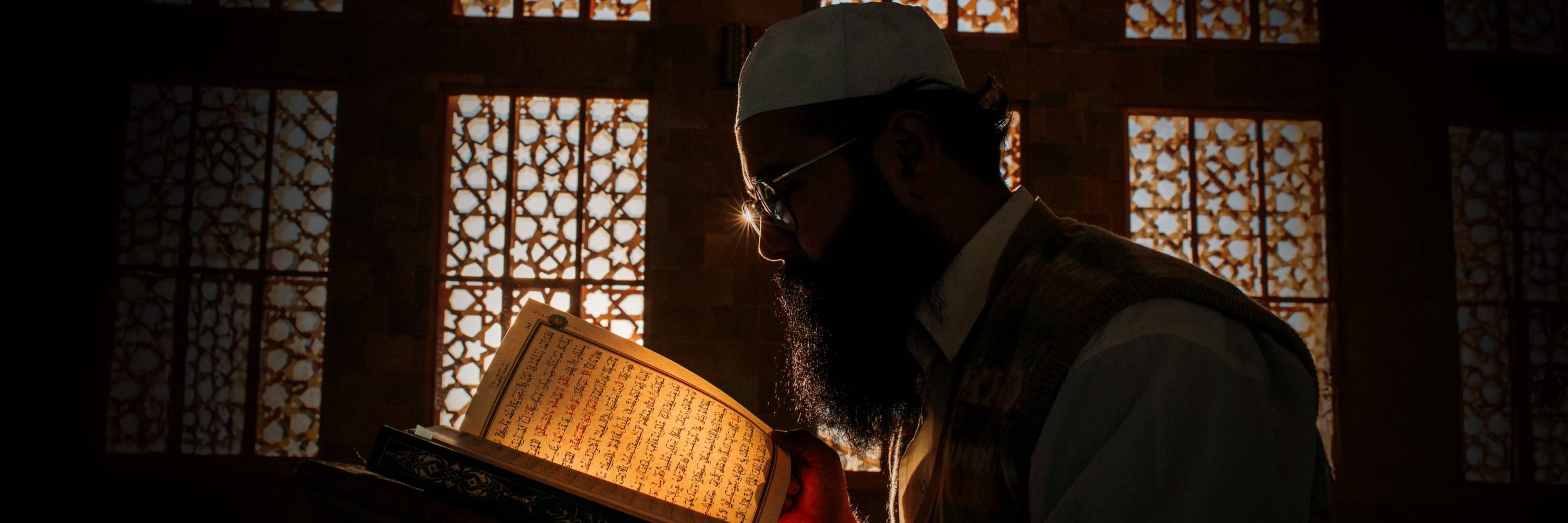
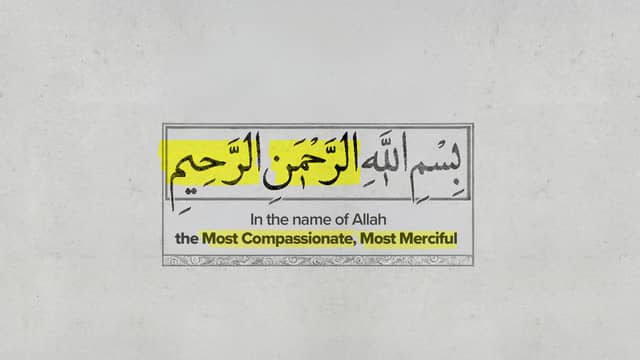
The verse (ayah) described by the Prophet ﷺ as the greatest ayah of the Qur’an, Ayat al-Kursi (the Verse of the Footstool), references the power of Allah, His names and attributes, His perfection, and His status as the One Lord deserving of all worship. This ayah is a powerful remedy for any human with an inkling of pride, reminding us of the fragility of mankind and our constant need for relief, rest, and reliance upon the Everlasting, the Ever-Living.
Ubayy ibn Kaʿb said: “Allah’s Messenger ﷺ said: ‘O Abu al-Mundhir, which verse from the Book of Allah is the greatest, according to you?’ I said: ‘Allah and His Messenger ﷺ know best.’ He again said: ‘Abu al-Mundhir, which verse from the Book of Allah is the greatest, according to you?’ I said: ‘
Allah, there is no god but He, the Living, the Eternal’
[i.e., Ayat al-Kursi]. Thereupon he touched me on my chest and said: ‘Rejoice in your knowledge, O Abu al-Mundhir!’”
32Commenting on this narration, Imam al-Nawawi (d. 676/1277) writes: “Scholars have stated that Ayat al-Kursi is distinguished as the greatest [verse] because it encompasses the fundamental principles of the divine names and attributes [of Allah]: divinity (
uluhiyya), oneness (
wahdaniyya), life (
haya), knowledge (
ʿilm), dominion (
mulk), power (
qudra), and will (
irāda). These seven are the foundational principles of the divine names and attributes.”
33Abu Hurayra reported: “Allah’s Messenger ﷺ assigned me to guard the charity funds of Ramadan. Then, someone began stealing from the supplies. I caught him and said, ‘I will take you to Allah’s Messenger!’… That person said [to me], ‘Please don’t take me to Allah’s Messenger ﷺ, and I will tell you some words by which Allah will benefit you. When you go to bed, recite Ayat al-Kursi, and a guardian from Allah will be [with you], protecting you throughout the night. Satan will not come near you until dawn.’ When the Prophet ﷺ heard about the incident he said to me, ‘He told you the truth, though he is a liar. It was a devil.’”
34One of the many reasons that the Prophet ﷺ refers to this verse as the greatest
ayah in the Qur’an may be found in the use of specific names and attributes of Allah the Almighty, since the Prophet ﷺ said: “Allah’s most magnificent name, which when used to implore Him, He responds, is found in three
surahs: al-Baqara, Aal ʿImran, and Taha (meaning [Allah’s name] al-Ḥayy al-Qayyūm).”
35 As Imam al-Ghazali (d. 505/1111) writes, these paired names are the ultimate expression of majesty, for “the meaning of al-Qayyūm is the One who exists by Himself and sustains everything else. His existence does not depend on anything, whereas the existence of all things depends on Him.”
36Just as al-Fatiha, the greatest
surah, must be recited in every prayer, it is recommended that the greatest verse, Ayat al-Kursi, be recited after every mandatory prayer. The Messenger of Allah ﷺ said: “Whoever reads Ayat al-Kursi at the end of [i.e., after] each mandatory prayer, nothing prevents him from entering Paradise except death.”
37This powerful ayah combines for its frequent reciter a fortress and protection against evil and harm, a source of spiritual renewal upon mindful recitation, a reward of Paradise, and accepted prayers.
A brief reflection on the Kursi and the Throne (ʿArsh)
The Throne (
ʿArsh) holds a central place in Islamic theology, symbolizing Allah’s supreme authority, majesty, and sovereignty. In a hadith, the Prophet ﷺ was asked about the origins of existence. He replied: “There was Allah, and nothing existed before Him, and His Throne was on the water. Then He created the heavens and the earth, and He wrote all things in the Preserved Tablet.”
38 The Throne predates the creation of the seven heavens and sits above them, surpassing them all in vastness and magnificence.
In an authentic narration, the Prophet ﷺ said: “I have been permitted to tell you about one of the angels who carry the Throne: The distance between the lobe of his ear and his shoulder is like that of seven hundred years of travel.”
39 This hadith not only conveys the colossal size of the Throne but also highlights the extraordinary might of the angels bearing it. These angels are entirely devoted to the worship and obedience of Allah, demonstrating their unique role in the divine order.
The significance of the Throne is further emphasized in another narration from the Prophet ﷺ, who said: “In Paradise, there are one hundred levels that Allah has prepared for the fighters who strive for the sake of Allah (
mujahidin). [The distance] between each two levels is like the distance between the heavens and the earth. When you ask of Allah, ask Him for al-Firdaws, for it is in the central part of Paradise and is the highest part of Paradise. Above it is the Throne of the Most Merciful, and from it spring forth the rivers of Paradise.”
40 The Throne’s proximity to al-Firdaws, the highest and most honored level of Paradise, is what inspired Ibn al-Qayyim’s statement, “The Throne is the roof of creation.”
41 In his work,
42 Ibn Abi al-ʿIzz al-Hanafi (d. 792/1390) discusses the
ʿArsh as the most significant created entity indicating Allah’s ultimate dominion. According to al-Tabari,
43 the
ʿArsh is situated above the heavens and the
Kursi, establishing a hierarchical cosmology in which the
ʿArsh represents the most exalted level of Allah’s power over His creation.
Thus, the
ʿArsh (Throne) is referenced in many verses of the Qur’an, as in “And He is the Lord of the Great
‘Arsh (Throne)”
44 and other verses,
45 whereas the
Kursi is a distinct creation.
According to eminent exegete Ibn Kathir (d. 774/1373), the
Kursi is a vast creation that demonstrates Allah’s sovereignty and control over the entire universe.
46 He also reports that Ibn ʿAbbas narrates: “The
Kursi is the place of the Feet, and [as for] the
ʿArsh (Throne)—no one knows its size except Allah, the Most High.”
47 It was also reported from Ibn ʿAbbas: “The
Kursi is the footstool, and no one can comprehend how great it is except Allah. The heavens and the earth in comparison to the
Kursi are like seven coins set in a shield.”
48 This saying of Ibn ʿAbbas aligns with the verse of the
Kursi itself, since Allah says, “His (Allah’s)
Kursi extends over the heavens and the earth.”
49 Similarly, Abu Musa al-Ashʿari (rA) said: “The
Kursi is the place for the two Feet, and it creaks as a saddle creaks.”
50 Undoubtedly, these statements are expressed and accepted in a manner befitting Allah’s majesty, as “nothing resembles Him.”
51On the other hand, Imam al-Tabari leans towards the interpretation that the Kursi represents Allah’s knowledge, citing a conflicting narration of Ibn ʿAbbas, where he states:
It [the Kursi] is His knowledge. This is indicated by the statement of Allah, Exalted is He: “And its preservation does not tire Him” . This affirms that it refers to His knowledge, as Allah informs us that preserving what He knows and encompasses of what is in the heavens and the earth does not burden Him. Similarly, He mentions His angels who say in their supplication: “Our Lord, You have encompassed all things in mercy and knowledge” (Qur’an 40:7). Allah, Exalted is He, thus informs us that His knowledge encompasses all things. Likewise, His statement: “His Kursi extends over the heavens and the earth” (Qur’an 2:255) aligns with this meaning.52
(Qur'an 2:255)
Furthermore, al-Tabari opines that the root meaning of
Kursi is knowledge, and that it is for this reason that a paper containing written knowledge is called a “
kurrāsa” (notebook). Similarly, scholars are referred to as “
al-karāsī” because they are relied upon for knowledge and understanding.
53The scholars who hold the view that the
Kursi is a physical entity rather than Allah’s knowledge argue that the evidence used for the figurative position—the statement of ‘Ibn Abbas that the
Kursi is knowledge—is weak and contradicts the many narrations that are authentic, both by Ibn ʿAbbas and other companions. Moreover, they assert, Allah the Exalted refers to physical characteristics of the ʿ
Arsh. For instance, Allah says: “And eight [angels] will bear the
ʿArsh (Throne) of your Lord on the Day of Resurrection,”
54 and He says, “the Possessor or the Owner of the Throne.”
55 Going back to a hadith mentioned previously in this paper, there is also the famous Prophetic command, “So if you ask Allah for Paradise, then ask Him for the highest degree of Paradise [al-Firdaws] because it is the central part of Paradise and the highest part of Paradise, and above it is the Throne (
ʿArsh) of the Most Merciful.”
56 It is also reported that the Prophet ﷺ himself said: “The seven heavens compared to the
Kursi are just like a ring thrown into a desert, and the size of the Throne (
ʿArsh) compared to the
Kursi is like the size of that desert compared to the size of that ring.”
57 Finally, the Prophet ﷺ is reported to have mentioned that people will be resurrected for Judgment Day after being unconscious, and that they, upon gaining consciousness, will see Musa (as) standing and holding the side of the Throne.
58 These narrations indicate that the Throne is a physical reality, though we are unable to comprehend its essence. As such, many scholars find it difficult to reinterpret the Throne (
ʿArsh) or the
Kursi to indicate knowledge or sovereignty. For instance, Ibn Taymiyya held that both the
Kursi and the
ʿArsh are real entities, with the
ʿArsh being among the greatest of Allah’s creations.
59 Ibn Taymiyya opposed allegorizing these terms, advocating for an understanding in line with the literal meanings unless there is strong evidence to interpret otherwise. He emphasized the distinction between the two, stating that the
Kursi is beneath the
ʿArsh and that both are part of Allah’s created universe, but Allah Himself is above His creation in a manner that befits His majesty. Ultimately, for both groups of scholars, the understanding of these concepts is “without how” (
bila kayf):
we accept these concepts without understanding the “how” of their reality because our minds cannot truly grasp them.
60 From theology to action
Understanding the divine Throne (Kursi) and the Footstool (ʿArsh) as two of Allah’s powerful creations adds profound depth to the recitation of Ayat al-Kursi. When the believer contemplates these majestic creations, it reinforces an awareness of Allah’s immense power, sovereignty, and knowledge, which are central themes in the verse itself. This theological understanding enriches the reciter’s spiritual experience in several ways.
1. The verse states, “To Him belongs whatever is in the heavens and the earth” (
lahu mā fī al-samāwāti wa mā fī al-arḍ).
61 By recognizing that both the
Kursi, which extends over the heavens and the earth, and the
ʿArsh, the greatest of all creations, fall under Allah’s dominion, the believer is reminded of Allah’s ultimate authority over all things. This realization helps the reciter internalize the meaning of Allah’s sovereignty in their personal life. They are not just reciting abstract words, but affirming their submission to the One who controls the entire universe, including these awe-inspiring creations.
2. The fact that Allah is beyond His creation, not confined by the limits of the Kursi or even the ʿArsh, underscores the concept of tanzīh—declaring Allah free from imperfection and beyond any resemblance to His creation. Reflecting on the immensity of the Kursi and ʿArsh should evoke in the believer a sense of profound humility and reverence, much as contemplating the vastness of the heavens and earth humbles one in the face of their Creator. This reflection fosters not only awe but also a deeper trust in Allah (tawakkul), reassuring the believer that nothing in the created world can rival His power or authority. All the while he maintains an attitude of “without how” (bila kayf), affirming these realities without delving into the “how.”
3. In numerous hadiths, the Prophet ﷺ mentioned the mercy of Allah in connection to the
‘Arsh, as in: “When Allah completed the creation, He wrote in His book with Him upon the Throne: Verily, My mercy prevails over My wrath.”
62 Allah’s mercy encompasses all creation, including the
Kursi and the
ʿArsh, and reflecting on this reality through the recitation of Ayat al-Kursi allows the reciter to feel more connected to Allah’s encompassing mercy, knowing that just as His
Kursi and
ʿArsh symbolize power and authority, they also represent His limitless mercy available to the believer.