fbpixel

The most blessed nights are here.

Donate Now

Blog

Sharia

Acts of Worship

The Nocturnal Religion: What the Night Means in Islam | Blog

Explore the importance of the night in Islam and how to reclaim its spiritual power while navigating the challenges of modern life.

Authored by

Published: March 12, 2026Ramadan 23, 1447

Updated: March 14, 2026Ramadan 25, 1447

Read time: 12 min

The Nocturnal Religion: What the Night Means in Islam | Blog
On this page
The year is 1346 Hijri, known to some as 1928 AD. The American writer and naturalist Henry Beston has just published The Outermost House, chronicling the year that he spent on the sand dunes of Cape Cod. 
“With lights and ever more lights, we drive the holiness and beauty of night back to the forests and the sea,” he writes, deep in its pages. “The little villages, crossroads even, will have none of it . . . Today’s civilization is full of people who have not the slightest notion of the character or the poetry of night, who have never even seen night.”
I remind you, again, that the year is 1346 Hijri, otherwise known as 1928 AD. Kerosene lamps are still used to light homes in the countryside, and nearly half of American households lack electricity.
Streetlights, headlights, flashlights, spotlights, floodlights—a century later, there’s scarcely a type of light we haven’t yet invented to help us hide the night. If Beston’s civilization was full of people who have never seen night, then ours is full of people who will never see it and in fact do not want to see it. General Electric, that multinational monument to energy, is the name of modern life. General Electric: everywhere, at every time, at every price. 
At some point we lost the night, and then forgot that we lost it. The price we paid for enslaving the electron was scrubbing the sky of its stars. We traded the planets for power plants and the galaxies for grids; we traded wonder for wealth, and the night for neon. This is life after the Electric Apocalypse—it happened too slowly to stop, and too quickly to remember. So now, when 80 percent of Americans can’t see or have never seen the Milky Way, the question we have to ask ourselves is, how do we live after losing the night? 
In this time, the time of the Gaza genocide and the Trump democide, the question of light pollution may not seem especially urgent. But I insist. To insist otherwise, I think, is to not really read the constellations of modern life—to not draw the shapes suggested by the dots of Gaza, Trump, General Electric, and everything in between. This illiteracy, too, is symptomatic of our nightless condition. 
We should reflect on what it means to live in a 24-7 civilization; we should acknowledge the phenomenological difference between a humanity that every night looked up into the expanse of eternity, and a humanity that every night looks down into the blue glare of pocket megacities. We should consider that losing night doesn’t just mean losing a pretty view; it means losing an entire dimension of human existence and spiritual experience. It means, in some deep sense, losing reality. 
In the Qur’an, we read, 
Indeed, in the creation of the heavens and the earth and the alternation of the night and the day are signs for those of understanding. (Qur’an 3:190)
This ikhtilaf, this contrast, between night and day is a central motif of the Qur’an, and the tragedy of the twenty-first-century (sub)urbanite is that she cannot experience the visceral truth of this ayah, not in the way its first listeners could. Night and day acquire identity relative to each other; but modern life, which fetishizes perpetual light and perpetual activity as the metrics of civilization, has made the night a grayer shade of the day—and so we no longer apprehend either. 
It is a great irony, indeed, that the modern city takes as ideal what the Qur’an delivers as warning: 
قُلْ أَرَءَيْتُمْ إِن جَعَلَ ٱللَّهُ عَلَيْكُمُ ٱلنَّهَارَ سَرْمَدًا إِلَىٰ يَوْمِ ٱلْقِيَـٰمَةِ مَنْ إِلَـٰهٌ غَيْرُ ٱللَّهِ يَأْتِيكُم بِلَيْلٍۢ تَسْكُنُونَ فِيهِ ۖ أَفَلَا تُبْصِرُونَ ٧٢
Say: “What do you think? If Allah made the day permanent for you till the Day of Rising, what god is there other than Allah to bring you night to rest in? Do you not then see?” (Qur’an 28:72)
We in fact do not see, because for the permanence of day—for its washed-out glare and burned-out stare, its humdrum droning and labored heaving, its shuffling and scraping and squalling and squawking—for all this day, we pay with our sight. Day every hour, day every day, day forever—isn’t this the future? What greater testament is there to our wealth, our brilliance, our omnipotence, than the day without end? Day without end, work without end, expense without end. 
So however much we squint and search, we can’t find night in the sky, and we can’t find it among ourselves, the disfigured products of productivity. This is always the trap sprung by light on those who do not respect it—that it takes sight as often as it lends it. Light is not the antithesis of blindness; here it is its source. 
“It is not for the sun to overtake the moon nor for the night to outstrip the day,” but we’ll have nothing to do with such temperance; with our light-emitting diodes and metal-halide lamps and mercury vapor, we summon the sun into the night. Light upon light! But what a perverse interpretation of light this is. It’s a brutish kind of light, harsh, lacking in grace, and vaguely obscene. How else to describe this gorging on radiation, this guzzling of photons? We’re confident that one can amass too many pounds, but too many lumens? Surely not. Surely gluttony is not a class of crime committed with light. Surely we can never rediscover luminosity as obesity. Overconsumption is a strictly fleshy affair. 
Again, the nightless do not know how to read constellations. 
The nightless do not know many things, and what the nightless know least is that they are without night. Their ignorance of their ignorance is masked by their preoccupation with the idea of night, by the doggedness with which they try to keep it at bay. It seems to me that nightless society tells itself at least three major stories about the night:
  1. In the first story, the night is bedtime, unless one is working a night shift to make ends meet or cramming for an exam or indulging in revenge bedtime procrastination. 
  1. In the second story, the night is a slumber party, a Bacchic carnival for letting loose and going wild. It is the enemy of sleep and the partisan of sin and the keeper of secrets. 
  1. In the third story, the night is danger and death—it is where ghosts glide and serial killers hide and secret police lie, in haunted forests and dark alleyways and unmarked vans.
So when I ask, how do we live after losing the night, I am not asking how we might lobby our local representatives to pass anti-light pollution ordinances, though that would be laudable (for evidence that city and night can coexist, search Flagstaff, Arizona). No, I am asking what it would mean to restore night in its transcendent meaning as a way of life, and what that would mean for us at this historical moment. 
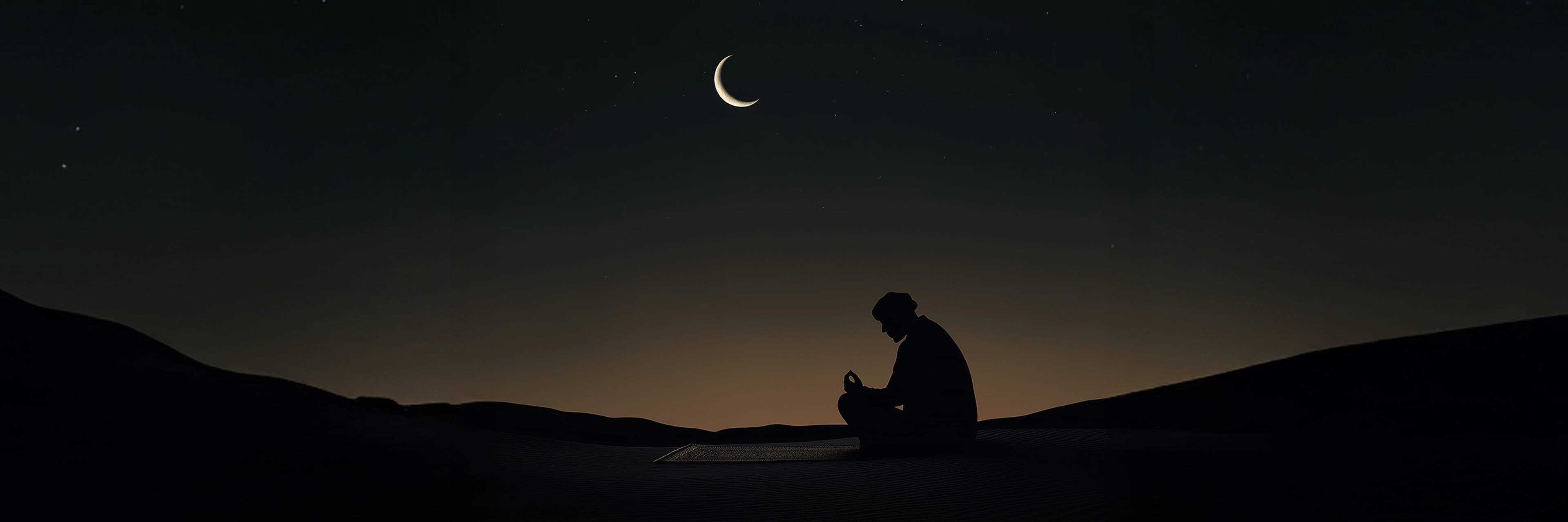
The insan forgets what he knows—and the answer to this question, of how to live after losing the night, he does know—and Ramadan returns to remind him. It does so by testifying that Islam is the deen of night. Ours is a nocturnal faith, one in which night is a gateway to the numinous, and nowhere is this truth more sharply illuminated than in the month of the fast, the month of the Qur’an, the month of Laylat al-Qadr. 
We find out when Ramadan is (re)visiting by consulting the Moon, that celestial sign by which we count our days and on which we hang our calendar. We begin our fast when the night ends and end the fast when the night begins. We rest at night with tarawih and we keep vigil with tahajjud. We eagerly anticipate not the last ten days, but the last ten nights. The centerpiece of that anticipation is Laylat al-Qadr, the night that the mission of the Prophet ﷺ began, the night when the Final Revelation descended, and the night when the divine decree is issued.
Ramadan testifies that night is not merely a physical reality. Night is a spiritual state, and a state of being. Night is stillness and silence, and, though we might not think it, it is light and life. Even though we fast during the day, the defining experiences of Ramadan follow nightfall, as they must. It is said that the Prophet ﷺ, when the last ten nights came, would tighten his waist belt and, through his worship, “give life to the night.” Ramadan is all about the nightlife, albeit not in a sense intuitive to Homo luminous
In other words, Ramadan, and the Islamic tradition more broadly, relate a story about the night quite at odds with the ones we enlightened moderns tell around our campfires. Against the night as bedtime, the night as slumber party, and the night as nightmare, Islam gives us three counterstories.


The night as labor

Allah identifies the night with rest, and this is a mercy; but Allah also identifies it with the worship of the wakeful, those who break with the natural order and thereby distinguish themselves from creation. 
The day demands nothing of us; the night makes us work for its treasures. A day is like a dog, if you’ll forgive the comparison—it gives its loyalty freely, and moves predictably. The sun is generous to the point of agony; the problem it poses is plenty, not scarcity. We shield our eyes and hunt for shade. The night is more feline—mysterious, elusive, demanding of time and care before its chill relents into warmth. The stars are initially few and illegible; with patience the eye adjusts, and they become many and readable. The stargazer, after weeks and years of conversation, is rewarded with a map of such absolute reliability and unwavering universality that never again can she know disorientation, no matter where or when she might be. 
Yes, the night is feline—I don’t think it a coincidence that historically, since at least Abu Hurayra, the cat has been the honorary animal of Islam. Nor can it be a coincidence that the companions and the poets alike reached for the moon, rather than the sun, to convey the beauty of the Prophet ﷺ. The sun is a zealous companion, searing and burning, and it inflicts its light with a most un-prophet-like bellicosity. The moon, too, is bright enough to cast shadows, but its gaze is gentle, the luminous equivalent of flowing water. The sun is shameless and proud, only ever obscured, unwillingly, by the passing clouds. The moon is demure and discreet, concealing and revealing, in phases advancing and retreating—yet when full in its presence, its grandeur is undeniable; the night seems to bend and submit to its glow.
The qiyam, the night prayer, honors the labor that night demands—the labor from which its fruit is born and by which its sweetness is tasted.

لَيْسُوا سَوَاءً ۗ مِنْ أَهْلِ الْكِتَابِ أُمَّةٌ قَائِمَةٌ يَتْلُونَ آيَاتِ اللَّهِ آنَاءَ اللَّيْلِ وَهُمْ يَسْجُدُونَ
They are not [all] the same; among the People of the Scripture is a community standing [in obedience], reciting the verses of Allah during periods of the night and prostrating [in prayer]. (Qur’an 3:113)

More like this

How to Power Through the Ramadan Dip: 10 Hadiths and Tips | Blog

How to Power Through the Ramadan Dip: 10 Hadiths and Tips | Blog

Struggling to Pray? How to Wake Up for Fajr | Blog

Struggling to Pray? How to Wake Up for Fajr | Blog

What does Allahu Akbar mean? | Blog

What does Allahu Akbar mean? | Blog

The night as speed limit

The name for the spiritual retreat constitutive of the Ramadan night—itikaf—comes from “akafa”: to adhere, to stick, to cling. It is, in other words, a declaration of immobility. This is deeply offensive to any card-carrying capitalist (i.e., all of us). Speed, dynamism, liquidity: These are our arkan al-iman. To succeed today is to become the human analog of the infinite scroll. Smooth and without friction, like the surface of our megacities. 
We are all more or less speedists, subscribed to the dogma of speedism, and oh so fearful of the slow. Stickiness, clinginess—there simply is neither time nor space for such slow. 
Itikaf is slow. Night is slow. Its temporality pools and trickles. When there is nothing but speed, there is no salvation but slow. 

The night as light

Only in a state of itikaf does one rediscover ikhtilaf: the difference between night and day. It is what we learn when we emerge from the warm night of the womb into the harsh day of delivery: that night precedes day. The layl is mentioned more than ninety times in the Qur’an, and nearly always before the day. Over and over and over we encounter the formula: “al-layl wa-l-nahar.”
It would be easy to map this natural sequence onto an emotional one of grief preceding relief, or a moral one of misguidance preceding guidance. On such a reading, the sorrow and confusion of night precedes the joy and clarity of daybreak. Certainly the Qur’an itself occasionally suggests such symbolism (10:27, 113:1–3). But that isn’t the whole story.
It was at the end of the Year of Sorrow, the most tragic in the life of the Prophet ﷺ, that he embarked on what would become the most famous night story in Islam: al-Isra wa-l- Miraj—the Night Journey. The miraculous journey of a single night, in which the Prophet ﷺ journeyed from Mecca to Jerusalem to the highest heaven and back. It is the night in which was established the central act of worship in Islam—the five daily prayers. It is the night in which the Prophet ﷺ came face to face with “the Light of the heavens and the earth” (Qur’an 24:35).
The paradox of light is that the brighter it glows, the more it blinds; the paradox of night is that the darker it grows, the brighter it becomes. One can only receive the radiance of the cosmos in absolute darkness. Every night teaches this lesson, for those able to perceive it, and Islam affirms it. It was deep in the night that the Prophet ﷺ was relieved from his year of grief, and the foundation of his ummah established. 
We need to break our reflexive association of night with darkness in the sense of misguidance and misfortune. To picture the night as optimistic and life-affirming—this is especially challenging for those of us raised in the bosom of English, a language from which one inherits all manner of night-phobic idioms. How long will we continue to speak of “benighted” men, of “the dead of night,” and the “dark night of the soul”? 
A nocturnal faith demands a nocturnal ethics. We need to readjust our nocturnal imaginary accordingly. Ours is the deen of the dawn and the dusk, the sunset and the sunrise—the stars and the silence and the slow. 
Beston was more right than he may have realized when he wrote, emphatically, that “to live thus, to know only artificial night, is as absurd and evil as to know only artificial day.” It is an obligation, not a luxury, to reflect seriously on the implications of living in a post-Enlightenment civilization ideologically and materially invested in the extermination of night. Come nightfall, we look up and see nothing, and after a time the nothing above seems to reflect the nothing within. It’s a muddy gray thing, the starless night and the nightless soul. 
Night as a physical phenomenon is unlikely to return within the lifetime of anyone reading this, but night in its deeper reality is always available to those who seek it. They are the ones who, in the night of early morning, supplicate, “O Allah, to You is praise, the Light of the heavens and the earth . . . ”

References

1.
Henry Beston, The Outermost House: A Year of Life on the Great Beach of Cape Cod (Henry Holt, 1988), 165-66.
2.
Ahmed Elbenni, “As Light Pollution Encroaches on Night Skies, Astronomers Dream of a Clear View of the Milky Way,” Toledo Blade, August 1, 2021, https://www.toledoblade.com/a-e/living/2021/08/01/night-light-as-light-pollution-encroaches-on-night-skies-astronomers-dream-of-a-clear-view-of-the-milky-way/stories/20210725016. See also Fabio Falchi et al., “The New World Atlas of Artificial Night Sky Brightness,” Science Advances 2, no. 6 (2016), https://doi.org/10.1126/sciadv.1600377.
3.
Qur’an 36:40.
4.
Qur’an 24:35.
5.
Ṣaḥīḥ al-Bukhārī, no. 2024.
6.
For good reason, astronomy was historically a major field of study in the Muslim world.
7.
The association of night with grief, sorrow, and misfortune is hardly exclusive to the English language; the point is that English furnishes few idiomatic counterweights to its many nightphobic expressions and turns of phrase.
8.
Beston, Outermost House.
9.
Ṣaḥīḥ al-Bukhārī, no. 7499.
Ahmed Elbenni

Ahmed Elbenni

Guest Contributor

Ahmed Elbenni is a Ph.D. candidate in Near Eastern Studies at Princeton University and senior editor at Muftah Magazine. He received his BA in History and Political Science from Yale University and MA in Near Eastern Studies from Princeton University. His doctoral dissertation examines the theorization, creation, and circulation of self-consciously "Islamic" novels in the modern Near East. More specifically, it explores how Muslim reformers in the twentieth century conceived “literature” as an epistemological and ethical problem-space which could, through the translation of “Islam” into an aesthetic experience and narrative strategy, birth a new human subject(ivity) at home in modernity. Ahmed’s other research interests include futurism, digital culture, techno-spirituality, and the history of history.

Disclaimer: The views, opinions, findings, and conclusions expressed in these papers and articles are strictly those of the authors. Furthermore, Yaqeen does not endorse any of the personal views of the authors on any platform. Our team is diverse on all fronts, allowing for constant, enriching dialogue that helps us produce high-quality research.

Want to appear on Yaqeen?