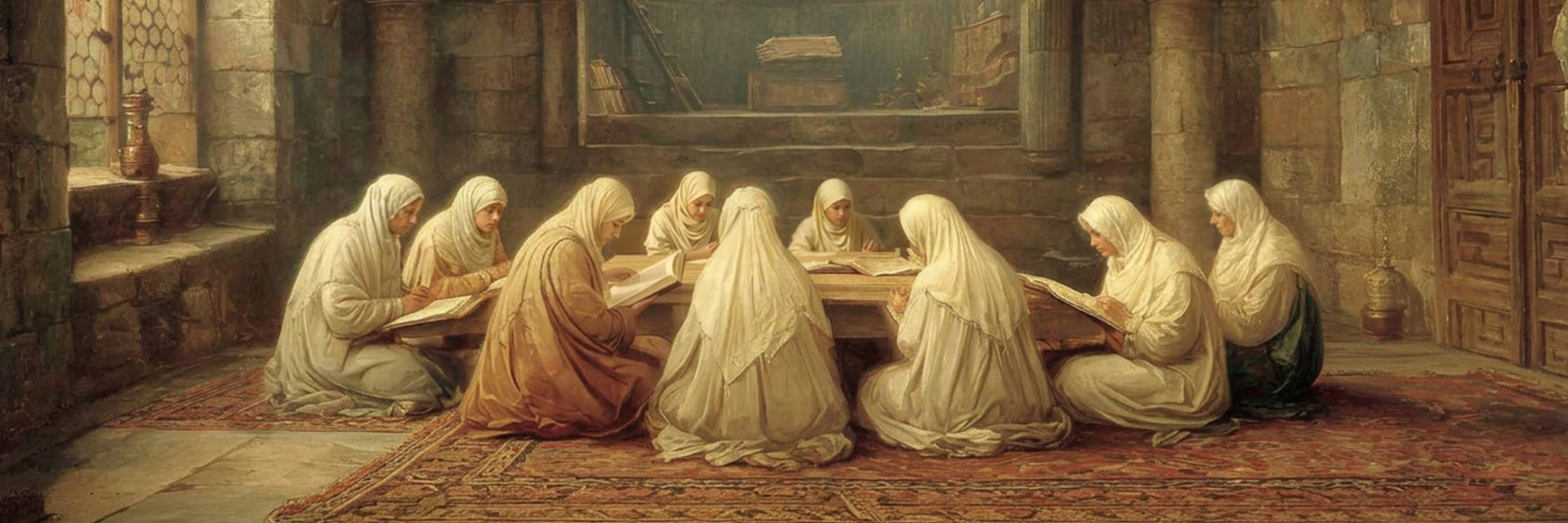
The historical record preserved by the early scholars of Islam bears witness to a reality that many today find surprising: Muslim women were, across the centuries, active and honored participants in the transmission of sacred knowledge. When the Orientalist Ignác Goldziher examined Ibn Ḥajar al-ʿAsqalānī's (d. 852/1449) biographical dictionary al-Durar al-kāmina, he was struck to find roughly two hundred entries devoted to female scholars praised for their intellectual authority, many of whom were Ibn Ḥajar's own teachers. These were not scattered exceptions but a sustained presence stretching from the seventh to the fifteenth centuries. Among them were figures such as Sitt al-Wuzarāʾ bint ʿUmar (d. 716/1316), who taught in Damascus and Egypt; Zaynab bint Abī al-Qāsim al-Shiʿriyya (d. 615/1218) of Nishapur, who held an ijāza from the exegete al-Zamakhsharī (d. 538/1143) and was sought out by jurists such as Ibn Khallikān (d. 681/1282); ʿĀʾisha bint ʿAbd al-Hādī (d. 816/1413); and Juwayriyya bint Aḥmad (d. 783/1381).
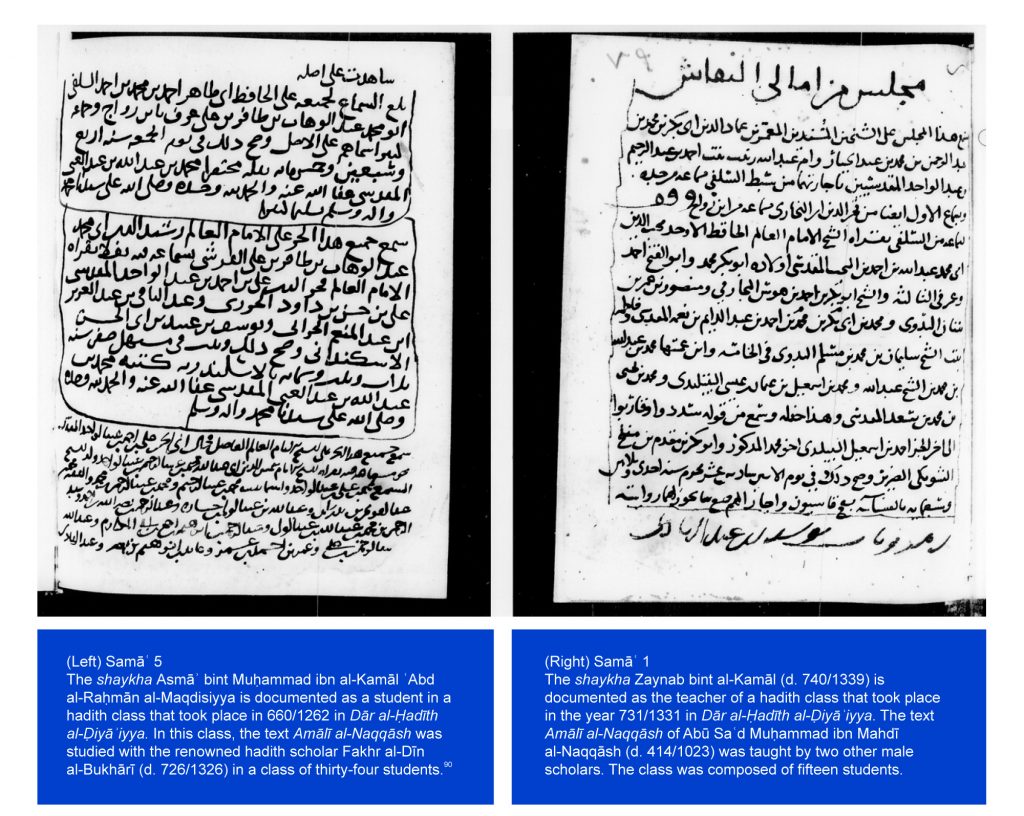
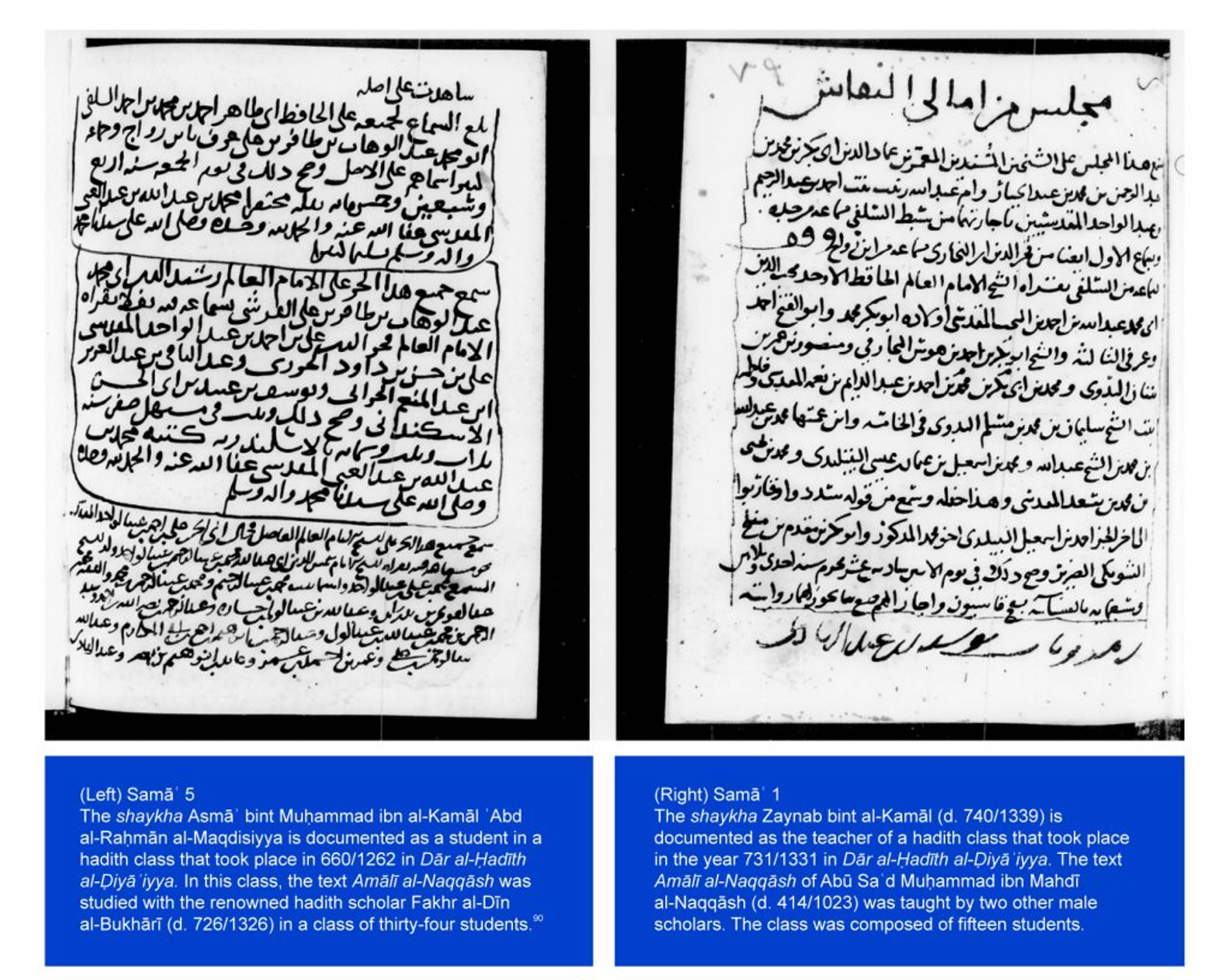
The esteem in which such women were held is plain in the words of the scholars themselves. Al-Dhahabī (d. 748/1348), writing of Zaynab bint al-Kamāl (d. 740/1339), said, "Whomsoever seeks the unparalleled prestige [of isnād], then let him hear from her, for if the seeker of knowledge travels for a month to hear one portion [of her knowledge], his journey would not be in vain." Her contemporaries described her as possessing a "camel load of ijāzāt," and she granted authorizations to major scholars including al-Ṣafadī (d. 764/1363), Taqī al-Dīn al-Subkī (d. 756/1355), and the traveler Ibn Baṭṭūṭa (d. 770/1369). So consequential was this participation that al-Suyūṭī (d. 911/1505) remarked that upon the death of Amat al-Khāliq al-Dimashqiyya (d. 902/1496), "people fell one rank in hadith," while al-Sakhāwī noted that the death of a single muḥadditha harmed hadith transmission in Egypt. These women were engaged not only in hadith but in fiqh, Qurʾanic sciences, language, and grammar.
Such participation was treated as normative rather than as a challenge to orthodoxy, following the precedent of the female Companions and tābiʿīn. A clear example is ʿAmra bint ʿAbd al-Raḥmān (d. 106/724), a jurist raised and taught by ʿĀʾisha bint Abī Bakr (d. 58/678), the Mother of the Believers, and regarded in the traditional sources as a ḥujja, a definitive authority. The question, then, is why this documented reality conflicts so sharply with the contemporary imagination of the Muslim woman, and which authentic records permit us to reconstruct that past faithfully.
A large part of the answer lies in a distorted picture inherited from Western colonial narratives, which portrayed Muslim women as passive, voiceless, and socially inconsequential. Early European travelers, diplomats, and writers claimed to "write about those who did not write about themselves," and at the heart of their approach lay the assumption that the Islamic tradition itself inhibits women's agency, such that agency could only be gained by breaking free from religious orthodoxy. Because epistemic authority was tied to social authority, the presumption of women's social subordination seeped into perceptions of their place in religious scholarship. This bred the false belief that materials documenting women as agents of knowledge were too rare for serious study, and that the only records available were those written by European visitors. This same premise underlies a strand of recent "feminist rereadings" of orthodox Islam, which rest on the ahistorical claim that women were excluded from scholarly circles by norms said to be inherent to the tradition. As a result, female Islamic scholarship has sometimes been mislabeled as a product of Western feminism and modern reform, a view that may have spread among some Muslims due to unfamiliarity with the historical record, and which risks the failure to grant qualified female scholars their due authority today.
As a remedy, two categories of sources authored and dictated by the early scholars themselves prove decisive: Arabic biographical dictionaries and ijāzāt al-samāʿ, the certificates of auditory transmission. Biographical dictionaries preserve extensive data on scholarly networks, while samāʿāt manuscripts record who taught and studied specific texts, enabling scholars to map activity across age, gender, social structures, and learning spaces. Drawing on these records establishes that female scholarship is firmly grounded in the orthodox tradition rather than a modern construct or an external ideological projection.
This method is illustrated through the career of Fāṭima bint Saʿd al-Khayr (d. 600/1203), a renowned hadith transmitter born in China, east of Kashgar, in 522 AH, and described as the "venerable and righteous shaykha." Her father, Saʿd al-Khayr (d. 541/1146), himself a scholar and muḥaddith, ensured her education under the most qualified teachers, undertaking long journeys with her—in keeping with the tradition's regard for sacred knowledge as an obligation upon women and men alike. In Isfahan she studied under Fāṭima al-Jawzādāniyya (d. 524/1129), whom al-Dhahabī called "the best hadith narrator of her time," reading al-Ṭabarānī's al-Muʿjam al-kabīr and al-Muʿjam al-saghīr. She then studied in Baghdad under eighteen scholars, including the female scholar Karīma bint al-Ḥāfiẓ Abī Bakr (d. 527/1133), and later settled in Cairo, where she narrated hadith extensively. Her study of al-Dāraquṭnī's (d. 385/995) Ḍuʿafāʾ wa-l-matrukīn shows engagement with ʿilm al-dirāya and hadith criticism, not mere transmission, and she later became a teaching authority for that very text in Cairo. She lived seventy-eight years and granted her final ijāza to Shaykh Aḥmad ibn Abī al-Khayr Salāma (d. 678/1279).
The recovery of such a detailed portrait rests first on the genre of biographical literature, which developed in the effort to authenticate hadith transmitters. Fāṭima's full lineage and dates appear in Ibn Nuqṭa's (d. 629/1232) al-Taqyīd, a work documenting the narrators of the six canonical collections and bound up with the science of jarḥ and taʿdīl. Al-Fāsī (d. 832/1429) cites her across eight biographical dictionaries, allowing cross-examination, and each of her teachers can likewise be verified in these works. This surplus of documentation, stretching over ten centuries and often covering the same person, distinguishes the Arabic tradition and filters out potential bias, since entries are frequently built upon reports (akhbār) with their isnād listed. The claim that male authorship must have suppressed female achievement is not borne out: Ibn Ḥajar refers to his female teachers as he does his male ones, without special justification; al-Sakhāwī composed entries for forty-six female scholars from whom he took ijāzāt; and Ibn ʿAsākir, taught by over eighty women, devoted a work to the muḥaddithāt from whom he narrated and recorded two hundred in his Tārīkh Dimashq. Ibn Taymiyya (d. 728/1328), who himself received hadith from women, "praised some of them fulsomely." Ibn Ḥibbān (d. 354/965) and al-Mizzī (d. 742/1341) preserve the words of Hishām ibn Ḥassān concerning Ḥafṣa bint Sīrīn (d. 100/719): "I did not meet anyone whom I can prefer over Ḥafṣa," ranking her above notable scholars.
The second category, the samāʿ record, is a certificate documenting the formal study of a text, derived from samāʿ, "to hear." Dictated by the certifier (musmiʿ) and appended to the studied text, it recorded the date, place, portions studied, the authorized teacher, and the full names of attendees—even noting latecomers, those who dozed, or a mother who left for a crying child. Such records confirm the biographical testimony: a dated samāʿ shows Fāṭima studying al-Baghdādī's (d. 463/1071) al-Jāmiʿ li-akhlāq al-rāwī in 529/1134, and another shows her teaching Ḍuʿafāʾ wa-l-matrukīn to a large, named gathering in Cairo in 595/1199, corroborating Ibn Nuqṭa, Ibn al-ʿImād, Ibn ʿAsākir, and al-Dhahabī. Because the system of authentication was standardized across the Islamic world and the isnād endured through political and ideological change, these records permit inquiry across regions and centuries; the Muʿjam samāʿāt al-Dimashqiyya alone compiles some four thousand manuscripts naming around fifty thousand men and women.
What emerges is not the invention of a new past but its faithful recovery—a corrective reading in which women form essential links in the chains of the Islamic sciences. Were their names struck from the isnāds, many chains would break and the transmission of sacred knowledge would be impeded. Their legacy was never truly hidden; it lies openly in the traditional texts, awaiting only careful study, so that the memory of figures such as Fāṭima bint Saʿd al-Khayr, Zaynab bint al-Kamāl, and ʿAmra bint ʿAbd al-Raḥmān may take its rightful place, affirming the legitimacy of women within traditional Islamic scholarship.