Once upon a time . . . ” is how most fairy tales begin. In real life, it’s how single mothers begin sentences about who they were before everything changed.
There was a time we believed life would be beautiful for us. Somewhere along the way, that kind of beauty became harder to reach. Not by choice. Just . . . no longer ours to expect. But every now and then, something happens that brings it back. Not all at once, but just enough to remind you of what used to come naturally.
When I look back now, it didn’t begin with a rose-gold balloon arch or an animatronic dinosaur. It began with a phone call in January.
My phone buzzed across the table. I glanced down and froze for a second—it was the operations manager of the local women’s shelter.
I hadn’t seen her name on my screen in months and seeing it again carried two feelings at once for me, a small knot of worry and a strange flicker of warmth.
“Assalamu alaikum, Shaimaa,” she said. “I hope you’re well. I didn’t catch you at a bad time, did I?”
“Wa alaikum assalam,” I said. “No, it’s okay.”
There was a small pause before she continued, the kind that makes you realize the real reason for the call is still coming.
“We’re planning the Ramadan gathering for the women again this year,” she said. “Just like last year.”
Last year.
The words brought the whole evening back: fluorescent lights too bright and somehow still too dim in a loud hall where the mic cut in and out, overextended staff trying to be present after a long day of work, paper plates bent under oily food that tasted like compromise and looked like fatigue. The “decor” looked like someone had run down a Dollarama aisle grabbing whatever they could without stopping the cart.
The women were packed into a room and told again to be grateful, by staff who sighed that theyʼd rather be home, who reminded us this was what the budget allowed, who said things like: At least thereʼs something. Itʼs better than nothing. Other shelters donʼt even do this.
I know what it’s like to be homeless during Ramadan, to feel forgotten, and to realize that even the invitation to break your fast begins with something simple: someone remembering you exist.
Which is why the phrase “it’s better than nothing” lands differently when you’re the one sitting at the table. You watch the math being done in other peopleʼs heads: The big budget belongs to the ballroom where the money is raised; the small budget belongs to the women whose lives are being discussed.
Her voice pulled me back to the present.
“So,” she continued carefully, “I was wondering if you might be willing to help organize the decor this year.”
I heard her clear her throat before adding one more thing.
“Maybe you could also give a short talk on empowerment?”
Empowerment? Me?
I found myself saying yes—how could I not? I too had sat in those same rooms and needed those same walls for myself and for my child. Still, when I hung up, the request rattled around inside me. At that moment I felt anything but empowered.
We were expected to be grateful. I am not blind to good intentions, but I also know what “be grateful” has been used to excuse: the minimum, and not an iota more. We heard the advice all too often: Donʼt attempt to create beauty where gratitude should be enough.
That line, unfortunately, is the unspoken policy in too many rooms that serve disenfranchised women. Once you hear it, you can’t stop hearing it, because it keeps being said even when no one moves their lips. The message beneath the message is simple: This is enough—for you.
We’re lectured about being “responsible with donations.” But responsible stewardship does not mean being as frugal as possible. It means avoiding waste and abuse—like executives and influencers taking extravagant cuts of donations—not stripping every ounce of care, beauty, or dignity from what is given to those in need. How something is given matters just as much as what is given. We often treat charity as something we give down, instead of something we give up; but charity reaches Allah before it reaches the hand of the one receiving it. Care isn’t just about meeting the bare minimum of survival; it’s about recognizing the humanity of those you’re serving.
Even when beauty arrives as a donation, some canʼt help but ask: Is that necessary?
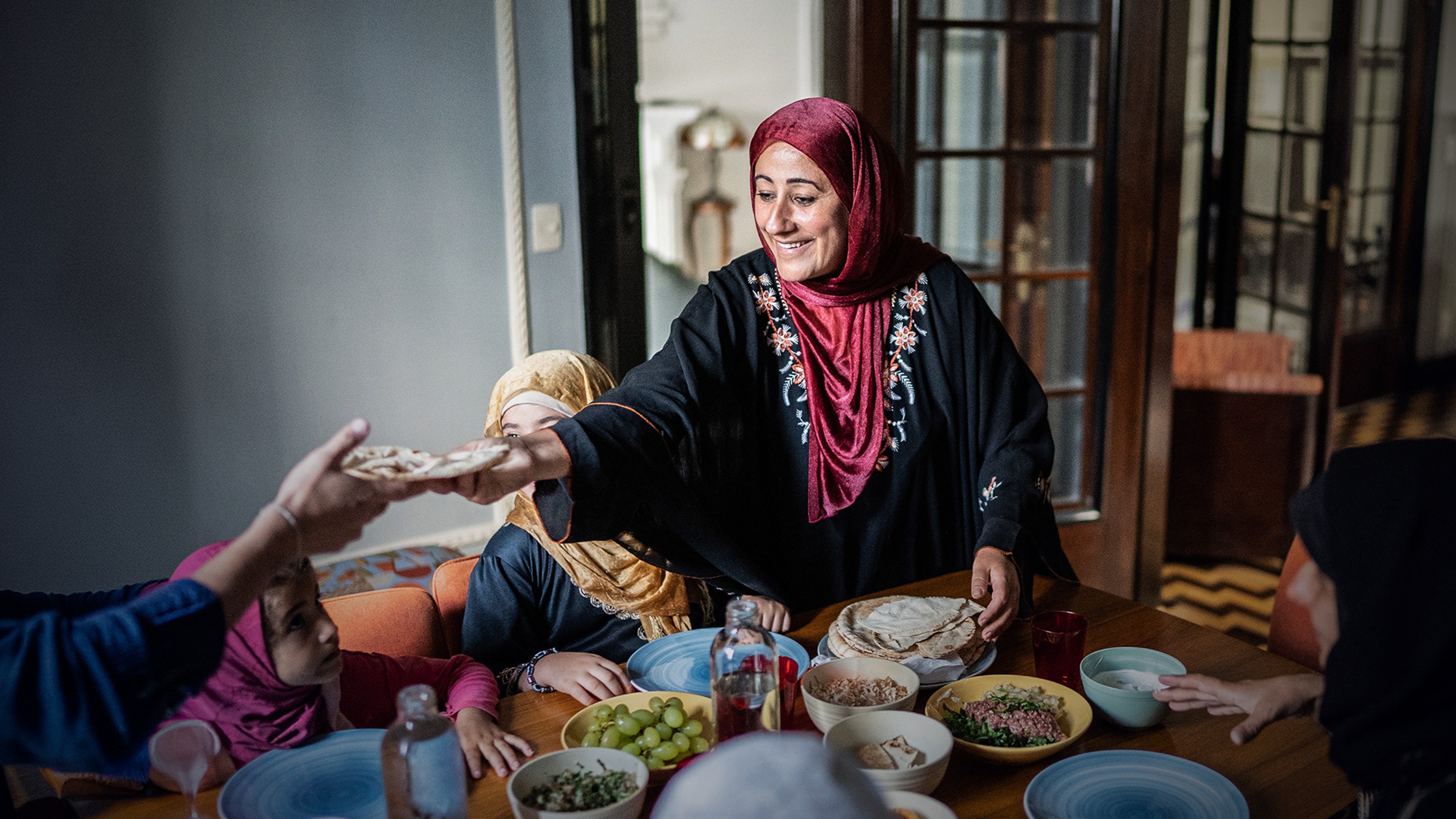
We know, instinctively, that we need beauty. During Ramadan, Muslims go out of their way to beautify iftar. Families set special tables, cook more thoughtfully, and share the experience online with pride. We don’t treat these like any other meal of the year. We understand that iftar is not just food; it’s an experience of dignity, warmth, and celebration.
Yet that understanding seems to disappear the moment that the people who are being catered to are poor.
In past years, those fasting at this women’s shelter were given fifteen-dollar gift cards for their iftar meal—an amount barely large enough to cover a sandwich, much less an actual plate of food. When someone at the shelter suggested pooling the gift cards so the women could share a family-style meal, the pushback immediately turned to cost: Why make a more meaningful iftar when the cheapest option is simply handing out the gift cards?
We do this all the time—offer poor solutions and call it help. Why do we accept less for those who need more?
Where is our ihsan (excellence)?
Where is loving for others what we love for ourselves?
What stung most was the contrast no one wanted to name out loud. Every year, this same shelter, like countless others, books the grandest banquet hall for their annual fundraising iftar. The kind of rooms that swallow sound in carpet. The kind of stamped napkins and crystal that tell you someone curated every choice with a donorʼs eye. Everything planned down to the last blossom, because thatʼs where the money comes from. Next yearʼs survival only becomes legible on a spreadsheet.
Clients from the shelter get free tickets to those banquets, and the gesture is presented as kindness, but what makes an iftar isnʼt the chandelier or the hall—itʼs whether the room was made for you.
You walk in as a client and the first thing you feel is the question: Where do I sit? You scan tables full of families and friends who already belong to one another, and you hover like a footnote trying not to interrupt a sentence thatʼs already been written. You sit politely as pledge cards are raised and numbers are called with the confidence of people who have never had to choose between laundry coins and lunch.
You stay still because you canʼt raise your hand; you know why you’re here. You are the line item theyʼre funding, the “impact” theyʼll report. If you give anything tonight, itʼs the kind of giving no one can tally: the discipline to smile and not ruin the mood. You nod while they talk about women like you in the third person at a table where no one knows a client is listening. Anonymity is supposed to protect you, but it just makes you lonelier.
You learn how to fold yourself so small that you donʼt brush against anyoneʼs certainty that this is a good thing. And it is a good thing, in the way a system can be good on paper. But goodness that forgets the person it’s intended for leaves a bruise, and bruises last longer than banquets.
The donors attending the banquets and the women receiving the gift cards are the same community, both Muslims observing the same Ramadan. When it comes to the rooms that fund us, beauty is nonnegotiable, something we cannot afford to go without—because they know that those who are present expect to feel valued. Yet when it comes to the women we serve, beauty becomes a cost no one can justify and its absence becomes something we are expected to receive with gratitude, as if that were enough.
Inside the quiet part of me, questions grew:
What exactly are we saying when we decide which room gets the care and which room gets the leftovers?
Why is beauty and care essential when serving the wealthy, but unnecessary when serving the poor?
If we can find the budget for chandeliers, why canʼt we find it for women who need light?
***
A couple months had passed since that January phone call, and by the time March rolled around, I had pretty much given up hope that this iftar was even going to happen. Every time I called to follow up, the manager would tell me that the head office still hadnʼt approved the budget. And we werenʼt talking chandeliers and centerpieces; we were talking about dinner. Dates to break our fast, water, soft drinks or maybe some juice. That’s it.
She finally called me a week before the event was supposed to happen. “Hey, I know itʼs short notice, but we finally got the approval. Can you still do the decor and your speech?”
I didnʼt know whether to laugh or cry.
She added quickly, “Itʼs just an iftar, it doesnʼt have to be fancy or anything crazy. I told you before: Even if we had more time, there’s no need to overthink it; it’s just an iftar.”
Something about the way she said that didnʼt sit right with me. It wasnʼt the words themselves, but the way they reduced something sacred—nourishment, tradition, dignity—to just.
Thatʼs when I knew: Whatever else happened, I couldnʼt let this be just an iftar, even with less than a week to pull it off.
Because of finals and the new semester starting, I couldnʼt start planning until two days before the event. I was running on fumes, caffeine, bismillah, tawakkul, and lots of dua. I just asked God to help me make it better than I imagined.
Those next forty-eight hours were a blur. And yet subhan Allah, somehow, the community showed up, and I mean showed up.
As I scrolled through Facebook Marketplace, I came across people who felt like theyʼd been placed in my path at exactly the right time. The event decor lady became my behind-the-scenes project manager. She told me which vendors to trust, how to tell if I was getting a good deal, where to find the best disposable plates, and which companies to avoid. She thought what I was trying to do was nearly impossible. “Even two weeksʼ notice would be hard,” she said, but she still guided me anyway.
Then came more. A group of Muslim girls volunteered to help watch the kids so their mothers could actually sit and enjoy the night. We had a henna artist, and my friend printed out coloring pages and brought pencils, markers, glue, and kid-friendly scissors for the childrenʼs table.
The balloon artist and face painter, a husband-and-wife team, mostly spoke Spanish. We texted through Google Translate, and when we met in person, we spoke through hand gestures, smiles, and a lot of pointing.
The people who rented out the bouncy castles also had a ride-on animatronic dinosaur, a triceratops named Sarah, and they decided to debut her at our event. On top of that, they gave me a huge discount and threw in cotton candy and popcorn on the house.
The decor lady had also suggested I hire a full team since time was so short, and somehow, I found a Muslim family willing to take it on. They offered me a special rate and, by pure coincidence, had that exact Friday, the first week of Ramadan, still available. Anyone in this industry knows—thatʼs unheard of.
It didnʼt matter whether they were Muslim or not, a small business owner or an established entrepreneur, every single person I reached out to listened, understood the vision, and said yes. The kind of yes that said, “Iʼm excited to be of service and be a part of the impact.”
It was as if Allah was stitching together every missing piece, closing every gap that the shelterʼs hesitation had left open.
By the day of the event, the hall was a whirlwind of activity. People who had been strangers only days before were now working side by side, setting up decor, arranging tables, and laughing as they worked.
The manager kept coming in to check on things, meaning well, Iʼm sure, but unable to stop herself from questioning my choices. Maybe she didnʼt even realize she was doing it. When youʼve been a client in the system, you can sense it—that tone, that second-guessing. Even when you’re no longer a “case,” you’re still not seen as a peer.
At one point she asked, “Are you sure this isnʼt too much for an iftar?” And I remember thinking, Why does it matter, if it’s beautiful? You trusted me with the vision, let me do what I do.
By five oʼclock, everything was coming together. The decorators were finishing up, the volunteers were prepping food, and the hall was starting to glow.
Then, when the children arrived and saw the dinosaur, that giant ride-on triceratops, rolling across the floor on hidden wheels, the room erupted. They screamed, laughed, and chased it like a parade.
We may not have converted pumpkins into carriages, but something truly spectacular happened that night. The womenʼs faces said it all. Their eyes widened. Phones came out to capture every smile, every shimmer, every surprise. For once, they werenʼt walking into a space that looked like shelter programming. They were walking into a space that looked like it had been created for them, not in spite of them.
Watching them take it in, seeing their shoulders soften and their backs straighten, something shifted in me. It was deliberate, every detail a quiet rebellion against the narrative that survivors should just be grateful for scraps. That’s the moment it all came together for me . . .
The room itself had already begun the speech I was about to give.
The manager stood at the front of the room, smiling in the slightly tired but proud way of someone who has spent the whole day running logistics. She welcomed everyone warmly, her voice carrying through the microphone that, for once, wasnʼt cutting in and out. She thanked the community partners and the vendors on the list I had given her just a day before, and acknowledged the staff who had worked behind the scenes to make the night possible. It was short, formal—the kind of introduction youʼd expect at any event.
But for me, standing just off to the side, it was the quiet drumroll before something bigger.
She handed me the mic. Tradition asked that we begin with the Qurʼan, so I started with Surah al-Fatiha, the prayer that ties every heart back to God. Then I recited the last verses of Surah al-Baqara, words about belief, resilience, and mercy, verses that felt heavier here, in a hall full of women who had endured storms and still kept their faith afloat.
لَا يُكَلِّفُ ٱللَّهُ نَفْسًا إِلَّا وُسْعَهَا ۚ لَهَا مَا كَسَبَتْ وَعَلَيْهَا مَا ٱكْتَسَبَتْ ۗ رَبَّنَا لَا تُؤَاخِذْنَآ إِن نَّسِينَآ أَوْ أَخْطَأْنَا ۚ رَبَّنَا وَلَا تَحْمِلْ عَلَيْنَآ إِصْرًۭا كَمَا حَمَلْتَهُۥ عَلَى ٱلَّذِينَ مِن قَبْلِنَا ۚ رَبَّنَا وَلَا تُحَمِّلْنَا مَا لَا طَاقَةَ لَنَا بِهِۦ ۖ وَٱعْفُ عَنَّا وَٱغْفِرْ لَنَا وَٱرْحَمْنَآ ۚ أَنتَ مَوْلَىٰنَا فَٱنصُرْنَا عَلَى
ٱلْقَوْمِ ٱلْكَـٰفِرِينَ
Allah does not require of any soul more than what it can afford. All good will be for its own benefit, and all evil will be to its own loss. [The believers pray,] “Our Lord! Do not punish us if we forget or make a mistake. Our Lord! Do not place a burden on us like the one you placed on those before us. Our Lord! Do not burden us with what we cannot bear. Pardon us, forgive us, and have mercy on us. You are our [only] Guardian. So grant us victory over the disbelievers.”
And then I began the only way I knew how.
“Salaams, ladies.”
I led with the truth.
Many people didnʼt want this iftar to happen. Budgets were tight. Some thought it wasnʼt necessary. “Itʼs just an iftar,” they said. But it isnʼt just an iftar.
I know what it feels like to walk into a room carrying shame like a shadow, to feel small, to be made small, to have your worth measured in budgets and spreadsheets. Tonight, none of that applies. Tonight, this room is yours, and by the end of this talk, you’ll know why.
When I was asked to speak about empowerment, at the time I thought, how could I, when I felt so deeply disempowered myself? But I couldnʼt say no. This place once sheltered me and my daughter. I owed it to the women sitting here tonight to at least try.
Thatʼs why I stand before you now, not as someone who has it all figured out, but as someone who has sat in your very seat. I know what it feels like to be in your shoes because I have walked in them.
Thinking about empowerment took me back to something I learned in a literary theory class: binary opposition. We only truly understand something by knowing its opposite. We know light because we’ve known darkness. Ease because weʼve known hardship. Joy because weʼve known sorrow. So if I felt anything but empowered, maybe that’s the perfect place to start, because in understanding my disempowerment, I could begin to name what empowerment really is.
Disempowerment can feel like a heavy cloak made of a thousand different emotions: shame, exhaustion, fear, loneliness. It’s hard to know where it begins or ends. Abuse, especially spiritual abuse, strips you down layer by layer until you donʼt recognize yourself. It weaponizes community perception, especially against single mothers. But when I sat with it, thinking of the stories of women like us, I could trace it back to three core things I had been stripped of or lost along the way. And if I had them, everything would change. It wasnʼt a house or a job or stability, although those do matter. It was something deeper, something you can carry inside you anywhere.
My confidence in God.
My confidence in myself.
My confidence in the community.
Without those, everything else felt impossible.
Confidence in God, because when faith is twisted and used against you, it shakes you. You wonder: Does God see me? Does He care? Am I worthy of His help? Thatʼs what disempowerment does; it puts distance between you and the very Source of strength.
Confidence in myself, because when someone chips away at you for years—at your decisions, your worth, your very sense of who you are—you start to forget. You forget your voice. You forget your power. You even forget the woman you were before the pain.
Confidence in community, because abuse isolates. It convinces you that you’re alone, that no one will believe you, that no one will care. And when you finally leave, you’re made to feel like: You’re a number on a grant sheet, a case file in a system.
If those three things returned—my confidence in God, my confidence in myself, and my confidence in my community—then no matter what storms came, I could stand again. Maybe thatʼs empowerment. Not pretending to have it all together. Not ever feeling weak. But knowing where to turn when the weight is too heavy.
And that’s why I donʼt accept that “it’s just an iftar.” For many people, maybe it is. But when you’ve lived through the kind of storms that push a woman and her children into a shelter, you learn something about what sustains a person. Iftar is not just food. It is presence. It is being seen. It is the quiet reassurance that you have not been forgotten. Living in a shelter, however necessary, is a constant reminder of what you’re missing. Ramadan magnifies it. Itʼs not just hunger; it’s the ache of the memories you donʼt have this year, the togetherness that seems to belong to everyone else. Ramadan is supposed to amplify community and mercy; when youʼre a single mother navigating homelessness, it amplifies absence. Iftar is not just food. It is who you break bread with.
Thatʼs why I say: This is not just an iftar. Dignity should not feel like it is earned by endurance; it is a right. And joy is not a luxury; it is survival.
People always ask why women stay. The truth is that being shamed by one abuser in private can feel less terrifying than being shamed by the collective in public. People see one chapter and think they know the whole book.
My gift to you tonight is this iftar banquet. This is your Cinderella moment—not the fairy tale where everything magically works out, but the real kind. The kind where, for a few hours before the clock strikes eight, the pain steps aside and you remember who you are. Soak it in. Soak in the sisterhood. Soak in the prayer when we stand side by side. Soak in the beauty of Ramadan, the reminder of God, the reminder of who you are.
Tonight, you came with one task: Pour into your own cup. Everything else is taken care of. Your children are laughing, fed, and safe. Tonight, you donʼt have to hush or hide them. Tonight, you just get to be you. Because this whole night was designed with you in mind. That is empowerment. True empowerment isnʼt pretending everything is fine; it’s restoration. The best gift we can give any woman is to restore her sense of self-worth, restore her trust in God, and restore her sense of community. Abuse can take so much from you, but it cannot take this.
When the clock strikes eight—and it will—and when you go back tonight and lie down on that thin, blue, waterproof mattress in that IKEA bunk bed, with the springs biting into your back; and when you see your children in the moonlight, their faces tired from laughter but shadowed with the exhaustion of it all; when the silence comes and the tears flow and the pain tries to replay itself like a cruel joke, let it be interrupted. Interrupted by tonight—by these smiles, by this food. By the memory of being seen. That memory belongs to you. It cannot be taken. You can replay it as often as you need.
This is not just an iftar. This is so much more. My hope is that if you walked in feeling disempowered, you leave with your head held high. Even if the feeling lasts only hours or days, you will know: You matter too.
I set the mic down.
My hands were shaking; my heart was racing. There was a moment of silence, then the sound of hands meeting, hesitant at first, then fuller, and then the room was alive with clapping, laughter, tears. Some women wiped their faces quietly; others nodded with that knowing look you only share when youʼve lived through the same storm. For the first time since January, I wasnʼt haunted by that phrase anymore. I knew I had reconciled it.
Then the room came to life. Plates were passed. Children darted between tables. Conversations grew louder, voices excited, joking, laughing.
Women posed for photos at the balloon arch while their kids tugged at sleeves, begging for another turn on the dinosaur ride. Cameras flashed. Rose-gold plates caught the dim light. For a few hours, it didn’t feel like something being handed to us. It felt like something we were part of.
By the time the last plates were stacked and the tables wiped down, my feet were throbbing. I sank into a chair at the edge of the hall and let myself breathe it in. Thatʼs when the manager found me. She sat beside me, her tone softer than I’d heard these last few weeks.
“You were right about the food,” she said, picking at a plate of finger foods. “It’s really good.”
I managed a tired smile, thinking about how much grief I’d gotten for even suggesting it. “I knew once you’d experienced it, youʼd understand.”
She nodded. “You really pulled it off. I’m proud of this. I’m proud of you.” Then she added, “The feedback about tonight is unlike any we’ve gotten before. Some women said theyʼve never been invited to anything so beautiful. One said even her wedding wasnʼt this beautiful. Another said she didnʼt know if sheʼd ever experience anything like this again and didnʼt want the night to end.”
Thatʼs when I felt the sting in my eyes. Not for the applause. Not for the photos. Not for the polite thanks. For the women, the ones I was serving. They were satisfied. They were happy. And that was enough for me.
Even the vendors were in tears. The family with the bouncy castles and the triceratops cried and said, “This is the most beautiful thing we’ve been part of. If you ever do this again, we want in.” The decor team said the same. Staff, clients, vendors, and people who walked in as strangers left wanting to contribute to something greater than themselves.
Thatʼs the part I wonʼt forget: the way dignity begets conviction, and conviction begets contribution, until everyone is building the good together.
***
When the last bag of garbage was tied and the lights finally turned off, I drove a few women home, the ones without rides, and then made the long trip across town to my own basement suite. I shifted into park, the glow of the dashboard light on my face, and let the silence wrap around me. My daughter was asleep in the back seat, her five-year-old body slumped against the seat belt, a soft snore escaping her mouth. Her fanus (lantern) face paint was smudged in with the crescent and stars, a sticky trace of cotton candy still clinging to her cheek. That kind of exhaustion only comes from joy, the kind of joy you donʼt realize you were starving for until you finally have it.
I sat there in the dark car, not wanting to go inside just yet, because I knew what waited for me: that basement suite, that cobbled path I hate walking down, the shadows that make the space feel like a punishment.
I reached for my phone. Notifications lit up the screen—messages from women, photos, videos, snippets of laughter captured in pixels. And thatʼs when it hit me.
For so many women in shelters, this little device is more than a phone. It’s a lifeline. Itʼs the desperate texts when danger erupts. It’s screenshots before he unsends the messages. Itʼs photos of bruises before they fade. It’s voice recordings of words meant to break her worth, proof of how she was told sheʼd never amount to anything without him.
A phone becomes a diary of wounds, a silent witness to violence in all its shapes and forms. But tonight, the gallery of abuse was interrupted. Tonight, beauty entered the chat.
In between the images of pain, there was proof of joy. Photos of lights and laughter. Children giggling on a dinosaur ride, cheeks painted like superheroes, butterflies, and unicorns. Women dressed in the best clothes they owned, smiling, their eyes finally unguarded, breaking bread with each other and standing foot to foot, shoulder to shoulder in congregational prayer.
The cycle of documenting abuse was broken by documenting beauty. That’s proof that survival isnʼt the only thing worth recording.
This night was a glass slipper. Not because it fits some princeʼs fairy-tale ending, but because it fit the women themselves, right where the world said nothing could. And that slipper wasnʼt delivered by a man. It was delivered by a community. It was being invited somewhere and not being asked to prove your pain to enter. It was Godʼs presence felt in prayer. It was the restoration of self-worth that abuse had tried to strip away.
And that slipper wasnʼt just theirs. It was mine too. Because as a single mother, this was my first Ramadan where I got to host an iftar. Not to scrape by or sit on the receiving end. Not to be reminded of everything I lack. For once, I got to give. And in giving, something in me was restored.
Maybe that’s why I fought so hard for beauty, because beauty isnʼt wasteful. Beauty is resistance in this dunya, and everlasting in the next.
And in that way, this night became our own sliver of “Happily ever after…”
I know the plot twist, though. In a few months, if I didn’t find work, I could be back on that same blue mattress, counting my days again. Shelters are like prisons that way, except men count down for freedom, while women count down in fear of starting over.
If I have learned anything in the long, crooked education of survival, it is this: Doing things right will always cost less than teaching a woman, again, to make peace with less. Until the world understands this, I will keep saying it the way a person breathes when they finally walk into a room made for them:
It’s not just an iftar.