At the conclusion of his treatise on the status of the
tarāwīḥ prayer as an established Prophetic practice—including the mode of performance and number of
rakʿas—the prominent Shāfiʿī scholar Taqī al-Dīn al-Subkī (d. 756/1355) takes an unexpected turn. Moving away from legal argumentation, he adopts a more reflective register: a meditation on the pursuit of knowledge itself. In doing so, he shifts from jurisprudential debate to offering thoughtful counsel for students and novice jurists on the ethics of research and the proper conduct of scholarly inquiry.
1 Al-Subkī’s counsel emerges from a concrete legal controversy, yet resonates far beyond it. Disputes over tarāwīḥ were never merely technical; they often reflected broader communal debates about authority, precedent, and the legitimate scope of scholarly disagreement. His remarks remind us that the integrity of the method matters as much as the conclusions we reach. This passage exemplifies a recurring concern in al-Subkī’s writings: the centrality of moral discipline in scholarly debate and the perils of adversarial overreach, even when one’s legal position is well-founded.
In the month of Ramadan, as debates over devotional practice continue to divide communities, I offer this translation, which remains as relevant today as in al-Subkī’s own time. The translation seeks to preserve his didactic tone while rendering his methodological vocabulary in accessible English. Technical terms are translated rather than transliterated where possible, while the original conceptual framework is maintained.
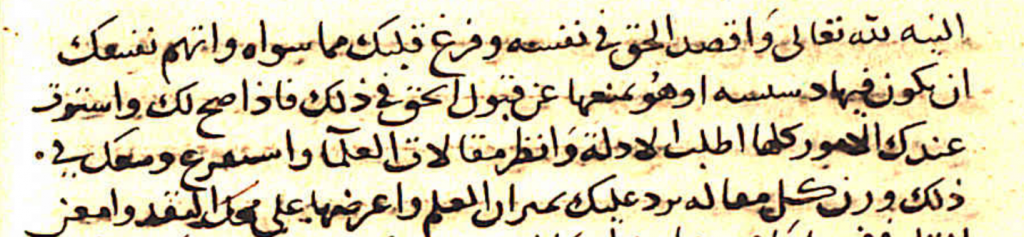
Manuscript image from al-Subkī’s treatise (Süleymaniye Library, Laleli 01098-001)
Al-Subkī’s text:
Know, O student of knowledge, that if you wish to investigate a scholarly question, begin by purifying your intention for God, Most High. Aim at the truth for its own sake; clear your heart of all else, and suspect yourself of harboring any hidden bias or inclination that might prevent you from accepting the truth in this matter.
Once your intention is sound and the matter has become clear to you, seek the evidence and examine the positions of the scholars, exerting your utmost effort. Weigh every view that comes before you against the standards of knowledge, subject it to the crucible of critical scrutiny, and delve deeply into its proper understanding. Do not reject a position merely because it presents difficulties until you have gathered as much of that scholar’s treatment of the issue as you can, understood his intention, examined it according to his own methodological principles, then according to the principles of other scholars, and finally weighed all of this against the principles of the Sharia. Throughout this entire process, remain a seeker of fairness, intent upon the truth wherever it lies—whether it supports you or opposes you.
If a meaning arises in your heart and you say, “This is correct,” do not hasten to assert it conclusively. Rather, re-examine your reasoning and consider carefully where it leads. Test it using the tools of the sciences: Arabic language, transmitted knowledge,
2 and the established criteria of rational inquiry and intellectual principles. Then pray:
O God, Originator of the heavens and the earth, Knower of the unseen and the seen, You judge between Your servants concerning that over which they differ. Guide me, by Your permission, to the truth in that over which they differ. Truly, You guide whom You will to a straight path.3
If you do this, I hope that God will inspire you with the truth and cast into your heart a light by which you may perceive what is correct.
Once you arrive at the truth and your heart finds rest in it, give thanks to God, Most High, for what He has granted you.
Maintain proper scholarly decorum (
adab) toward the scholars who did not reach the same conclusion as you, and do not attribute it to any deficiency on their part. Say: “My Lord, increase me in knowledge.”
4 Do not, from the outset or in the end, intend your inquiry to refute an opponent for the sake of argument or to prevail in dispute. Let your investigation be for your own guidance alone, or for the benefit of someone who may encounter your words—someone unfamiliar with the issue and with you—so that you may fall under the Prophet’s saying (peace be upon him): “That God guide through you a single person is better for you than red camels.”
5As for what may occur between you and another person in debate, where you aim to refute him through writing or extended analysis, do not place your hopes in this outcome. Rather, be fully aware that it is unlikely. For most people of this age, once they have voiced a position—especially before an audience—and seek victory, they do not retract it, even if every proof is presented to them.
We have witnessed this in this very issue:
6 one stubbornly seeking to prevail persisted while authoritative texts were recited and proofs established before him, yet outwardly he only grew more obstinate. Why, then, should a person waste his time with someone like this? Instead, one should attend to himself.
May God, Most High, grant us a good ending. We ask Him—He is the Most Generous of the generous—for the good of this world and the Hereafter; that He send blessings upon our Prophet Muḥammad, peace and blessings be upon him, his family, and his companions; that He benefit us through knowledge in this world and the next; and that He grant this to us, our parents, our children, those who love us, and all Muslims.