
Introduction
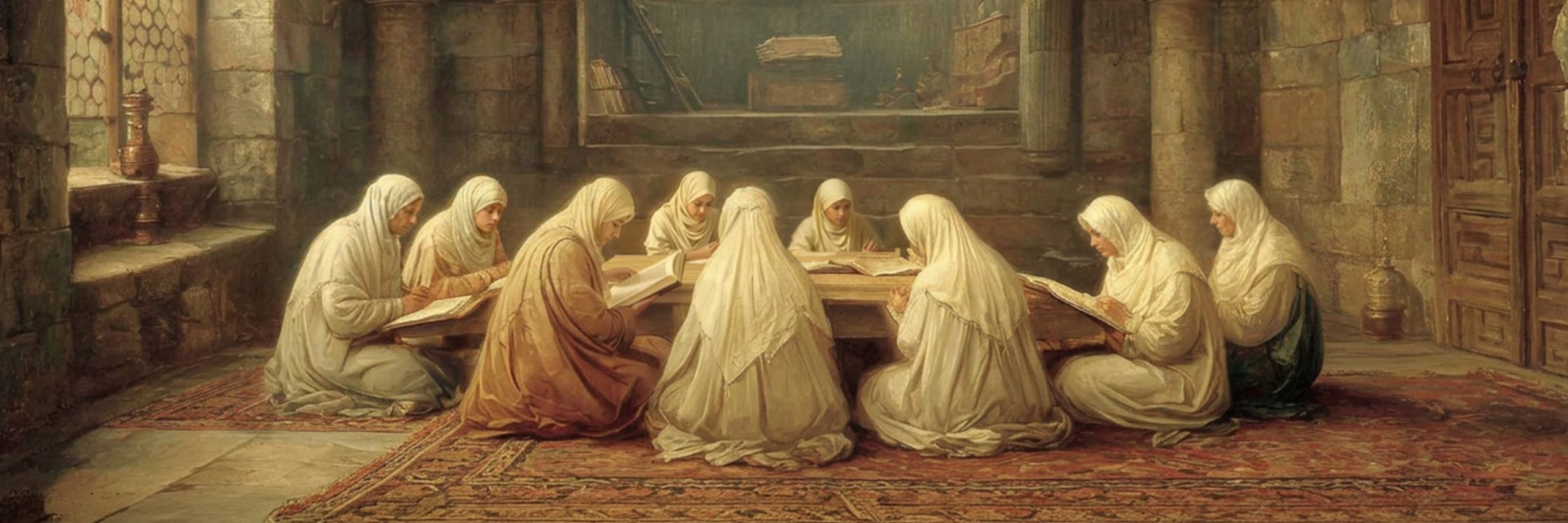
Picture this: It is the nineteenth century, and we are seated in the halls of a European university library. This academic space is predominantly male-exclusive, its tall shelves lined with literature authored almost entirely by men. Between these shelves stands Ignác Goldziher, a Hungarian Orientalist renowned for his critical approach to Islamic sciences, sifting through a fifteenth-century Arabic text by the Egyptian scholar Ibn Ḥajar al-ʿAsqalānī (d. 852/1449). In his hands is al-Durar al-kāmina, a multivolume biographical dictionary that compiles structured accounts of individuals regarded as critical scholars in Islamic history.
As Goldziher turns the pages of al-Durar al-kāmina, he is taken aback. He encounters something that directly disturbs the image he had conjured of the Islamic world. What was it that shocked him? The large number of female Muslim scholars. Entry after entry, female scholars from the seventh to the fifteenth centuries were heavily praised for their intellectual authority and influence in the transmission of traditional Islamic knowledge. Crucially, these women were not just a handful of unique outliers dispersed across time and geography. In this single work alone, Ibn Ḥajar devoted around two hundred entries to female scholars who had ascended to the heights of scholarship, many of whom were his own teachers.
Engraved in the pages of this multivolume text were figures such as Sitt al-Wuzarāʾ bint ʿUmar ibn al-Munajja (d. 716/1316), who taught across Damascus and Egypt, attracting committed students who traversed far distances to study under her. Goldziher also read about the scholar Zaynab bint Abī al-Qāsim al-Shiʿriyya (d. 615/1218) from Nishapur, who possessed a vast number of ijāzāt (teaching qualifications), including one from the renowned exegete al-Zamakhsharī (d. 538/1143). Her expertise was eagerly sought after by leading scholars and jurists such as Ibn Khallikān (d. 681/1282). In the same manuscript, ʿĀʾisha bint ʿAbd al-Hādī (d. 816/1413) is praised as among the most distinguished scholars of hadith, while Juwayriyya bint Aḥmad ibn al-Ḥusayn (d. 783/1381) is noted for teaching in the most prominent educational spaces of her time.
The extent to which female scholars were esteemed for their authority and scholarly standing is vividly illustrated in the biographical literature of al-Dhahabī (d. 748/1348). In his entry on Zaynab bint al-Kamāl (d. 740/1339), he writes, “Whomsoever seeks the unparalleled prestige [of isnād], then let him hear from her, for if the seeker of knowledge travels for a month to hear one portion [of her knowledge], his journey would not be in vain.” Zaynab’s education reflected the breadth of the Islamic scholarly world and was shaped by teachers from Baghdad, Aleppo, Damascus, Alexandria, Ḥarrān, and Cairo. By the end of her life, contemporaries described her as possessing a “camel load of ijāzāt,” a phrase conveying both their vast number and their scholarly weight. Students from various cities flocked to attend her theological lectures, eager to learn from her directly. In addition to al-Dhahabī and Ibn Ḥajar, she granted ijāzāt to prominent scholars, including Ṣalāḥ al-Dīn al-Ṣafadī (d. 764/1363), Taqī al-Dīn al-Subkī (d. 756/1355), and the famous historian Ibn Baṭṭūṭa (d. 770/1369).
As evidenced from the words of early Islamic scholars, women did not merely contribute to Islamic knowledge; their role had consequential implications for the trajectory of the field. For instance, al-Suyūṭī (d. 911/1505) states that upon the death of Amat al-Khāliq al-Dimashqiyya (d. 902/1496), “people fell one rank in hadith.” Similarly, al-Sakhāwī noted that the death of a single muḥadditha (female hadith scholar) adversely affected the transmission of hadith in Egypt. Such scholars were entrusted with transmitting vast collections of works on hadith and were deeply engaged in fiqh (jurisprudence), Qur’anic sciences, language, and grammar, contributing to the very foundations of the Islamic sciences.
These testimonies underscore that women’s participation in Islamic scholarly circles was historically treated as normative rather than a challenge to orthodoxy. Their contributions to sacred knowledge followed the precedent set by the early female companions and tābiʿīn (successors), who held significant scholarly authority. This is exemplified by figures such as ʿAmra bint ʿAbd al-Raḥmān (d. 106/724), a distinguished specialist in Islamic law raised and taught by one of the most authoritative transmitters of fiqh and hadith: ʿĀʾisha bint Abī Bakr (d. 58/678), the Mother of the Believers. Traditional sources consistently regard ʿAmra as a ḥujja (a definitive authority) due to her extensive scholarship and position as a jurist.
Why, then, does this well-documented historical reality drastically conflict with our contemporary imagination of the Muslim woman in Islamic history? And more critically, which authentic historical records allow us to reconstruct that past with accuracy and integrity?
Historical erasure and constructing the subordinate portrait
Muslim women have long been portrayed within Western colonial narratives as passive, voiceless, and socially inconsequential subjects. This view was shaped and reinforced by early European travelers, diplomats, and writers who documented and dramatized life in the East and women’s experiences within it. Claiming to “write about those who did not write about themselves,” they used such notions of passivity and lack of agency to engulf the image of the Muslim woman. At the crux of the colonial approach is the assumption that the Islamic tradition inhibits women’s agency, and that agency can only be attained by breaking free from the shackles of religious orthodoxy. Ultimately, these depictions of the “exotic Orient” served to entrench a clear ontological and epistemological distinction between women of the Islamic world and those of the Occident.
Given that epistemic authority has been largely linked to one’s capacity to exercise, maintain, and perpetuate authority in society, assumptions of Muslim women’s social subordination seeped into perceptions of their role within religious scholarly circles. This widespread misconception led many to presume that materials documenting women as agents of knowledge were simply too rare to allow serious historical study. Consequently, it was claimed that the only historical accounts of women in Islamic history at our disposal were those coming from the pens of early European visitors.
Fast forward to the most recent literature on gender and Islam: A popular and recurring theme has emerged under the banner of “twenty-first-century reinterpretations” or “feminist rereadings” of orthodox Islam and its associated texts. This body of work often rests on the ahistorical premise that religious material must be reinterpreted because women were historically excluded from scholarly circles. As a result, some academics have claimed that Muslim women in the past rarely attained religious education due to norms of the Islamic tradition that “inherently” prevent women’s participation. As a natural consequence of this dominant view, contemporary female Islamic scholarship has been labeled a product of Western feminism and twenty-first-century reform, and a protest against Islamic tradition. Such assumptions, which position female scholarship as foreign to the Islamic tradition, may have permeated some modern Muslim communities due to limited knowledge of Islamic historical records. This misunderstanding can have serious negative consequences, including a failure to recognize and grant due authority to qualified female scholars in Muslim communities today.
As a remedy to this fractured view of the past, this article highlights two critical categories of resources authored and dictated by early Muslim scholars: Arabic biographical dictionaries and ijāzāt al-samāʿ (certificates of auditory transmission). Each will be explored in detail to elucidate how they can be employed in the reconstruction of historical scholarly portraits. Biographical dictionaries provide extensive data on scholarly networks of their respective periods, while samāʿāt manuscripts record the names of individuals who taught and studied specific texts, enabling the mapping of scholarly activity and patterns relating to age, gender, social structures, and the use of public and private learning spaces. It is within these collections that we find large-scale evidence of the presence of muḥaddithāt, faqihāt (female jurists), ʿālimāt (female scholars), and shaykhāt (female preachers) throughout Islamic history. Drawing from historical records that come directly from the Islamic scholarly tradition is valuable for the modern Muslim reader because they establish that female scholarship is firmly grounded in orthodox tradition, rather than being a construct of modern reinterpretation or external ideological projection. This methodological approach will be illustrated through a case study of one female scholar: Fāṭima bint Saʿd al-Khayr (d. 600/1203).
Constructing her career: Fāṭima bint Saʿd al-Khayr
One of the thousands of female scholars inked in Islamic history is Fāṭima bint Saʿd al-Khayr, a renowned hadith transmitter who traveled across the world for the purpose of seeking and spreading Islamic knowledge. She was born in China, east of Kashgar, in the year 522 AH. Described as the “venerable and righteous shaykha,” she began her journey of seeking knowledge in her hometown and later extended it to major intellectual centers such as Bukhara, Nishapur, and Isfahan, before continuing to areas such as Baghdad, Damascus, and Cairo. She taught hadith widely, granting ijāzāt to students who then carried her knowledge to lands she herself had not yet traversed. Her father, Saʿd al-Khayr (d. 541/1146), was a well-established scholar, jurist, and muḥaddith. He played a pivotal role in ensuring Fāṭima’s education under the most qualified shaykhas (female scholars) and shaykhs (male scholars) of her time, even when this required embarking with her on long journeys.
In accordance with the Islamic tradition, which regards the attainment of sacred knowledge as a revered obligation for both women and men, Saʿd al-Khayr took his daughter to study under the renowned scholar Fāṭima al-Jawzādāniyya (d. 524/1129) in Isfahan. Al-Dhahabī described al-Jawzādāniyya as “the best hadith narrator of her time.” Under her instruction, Fāṭima bint Saʿd al-Khayr studied Abū Qāsim Sulaymān al-Ṭabarānī’s (d. 360/918) al-Muʿjam al-kabīr, which spans thirty-seven printed volumes, as well as al-Muʿjam al-saghīr, which can be seen under her isnād (authorized chain of authority) to Ibn ʿAsākir (d. 571/1176). After gaining expertise in these texts, she went on to transmit them across new regions, playing a significant role in their dissemination.
After two years of study under al-Jawzādāniyya, she migrated with her father to Baghdad, where she studied under eighteen notable scholars. Among them was another female scholar, Karīma bint al-Ḥāfiẓ Abī Bakr ibn al-Khāḍiba (d. 527/1133), as well as Yaḥyā ibn al-Bannāʾ (d. 531/1136), Abū al-Qāsim ibn al-Ḥuṣayn (d. 525/1130), and Hibatullāh ibn Aḥmad ibn al-Ṭabbar (d. 531/1136). She received ijāzāt from various scholars of Baghdad, Isfahan, and Khurasan. She later settled in Cairo with her husband, Imam Zayn al-Dīn (d. 599/1202), where many students traveled specifically to study under her, and where she is widely recorded to have narrated hadith extensively.
An assessment of the texts she studied highlights the depth and specificity of her knowledge in disciplines within the Islamic sciences. For instance, in the year 529/1134, she studied Ḍuʿafāʾ wa-l-matrukīn of ʿAlī ibn ʿUmar al-Dāraquṭnī (d. 385/995) from Shaykh Mansūr Muḥammad ibn ʿAbd al-Malik al-Khayrūn (d. 539/1144). Al-Dāraquṭnī’s work is considered one of the most important texts in the science of hadith criticism and authentication, alongside his other seminal texts, including Mizān al-iʿtidāl, Lisān al-mizān, and Tahdhīb al-kamāl. Attaining knowledge of this text exemplifies her engagement with hadith criticism, a science requiring rigorous intellectual evaluation beyond mere transmission. Like many muḥaddithāt (female hadith transmitters), Fāṭima bint Saʿd al-Khayr critically engaged inʿilm al-dirāya (the science of cognition). As a certified scholar of this text, she later became its teaching authority in Cairo. She also studied al-Jāmiʿ al-akhlāq al-rāwī wa-ādāb al-sāmiʿ, Khaṭīb al-Baghdādī’s (d. 463/1071) foundational work on the ethics and etiquette of hadith study, under Abū al-Qāsim al-Mubārak ibn Ḥasan (d. 372/982).
Fāṭima bint Saʿd al-Khayr is described as having transmitted hadith “extensively,” many of which are compiled in al-Ṭabarānī’s al-Kabīr, and the hadith compilations of al-Tirmidhī, Ibn Māja, Abū Yaʿlā, and Muslim. She transmitted various texts, including the hadith of al-Kharraqī (d. 334/945), al-Qudūrī (d. 428/1037), al-Abnūsī (d. 457/1065), and the Musnad of Abī Yaʿlā al-Mawṣilī (d. 307/919), to name a few. Many prominent scholars studied such texts under her, including the jurist Isḥāq ibn Muḥammad al-Ḥamāthānī (d. 623/1226), ʿAbdullāh ibn Ibrāhīm ibn Yūsuf al-Miṣrī (d. 592/1196), and ʿAbd al-Raḥmān ibn Makkī al-Saʿdī (d. 615/1218). Additionally, the likes of Abū Mūsā ibn al-Ḥāfiẓ (d. 629/1232), Muḥammad ibn Abī al-Qāsim al-Shāṭibī (d. 590/1194), and ʿAbd al-Raḥmān ibn Muqarrab (d. 643/1245) narrated from her. She lived for seventy-eight years and granted an ijāza to Shaykh Aḥmad ibn Abī al-Khayr Salāma (d. 678/1279), who was the final narrator to transmit from her before her death in the year 600 AH.
Her career trajectory reflects a sustained commitment to scholarship through rigorous study under renowned scholars, extensive travel across vast distances to acquire and transmit knowledge, and the active support of her father in facilitating her early Islamic education. How did such a detailed scholarly record, including her qualifications, geographical movement, and her teachers come to light? An accurate scholarly portrait emerges through the careful synthesis of biographical dictionaries and samāʿ records, both of which will be examined in the sections that follow.
The impetus for authentication: The genre of biographical texts
The shelves of Islamic libraries are lined with extensive biographical literature that developed under the hands of early Muslim scholars in their efforts to authenticate hadith. While scholars explored the linguistic, theological, exegetical, and legal dimensions of hadith, a paramount scholarly effort was dedicated to its methods of transmission, compilation, and authentication. To establish the isnād (the chain of transmission) of a hadith, scholars were required to verify the reliability (ʿadl, thiqa) of every transmitter in its chain. As a result, multivolume works, comparable to encyclopedias, were composed to record meticulous details about hadith transmitters, including their dates of birth and death, travel histories, teachers from whom they received ijāzāt, students, areas of expertise, and character testimonials. Such information was essential for establishing al-ittiṣāl (the continuity of transmission within chains of narration) and for verifying the reliability and integrity of each transmitter. Thus, in efforts to ascertain the validity of the connections between isnād chains, the movement of sacred knowledge through time and space was carefully recorded and preserved in biographical dictionaries.
Arabic biographical texts are primarily structured as retrospective indices documenting prominent individuals from the time of the Prophet ﷺ through the era of the biographer. These works are systematically organized according to various criteria, including personal name, geographical origin, chronological age, or, in certain instances, perceived notability. Among the earliest extant retrospective biographical collections is Ibn Saʿd’s (d. 230/845) Kitāb al-ṭabaqāt al-kabīr. The detailed records preserved by biographers concerning agents of knowledge transmission provide invaluable data on the pedagogical practices throughout Islamic history and serve as a major source for historical inquiry.
Knowledge of genealogy (nasab) had long been a prominent feature of early Arabian society, where tracing individuals through family lineages and social networks was commonplace. This genealogical awareness is also reflected in biographical texts, in which scholars took care to meticulously identify individuals. For example, the full name of Fāṭima bint Abū al-Ḥasan Saʿd al-Khayr ibn Muḥammad ibn Sahl al-Anṣārī al-Andalusī al-Balansī, along with her dates of birth and death, is preserved in Ibn Nuqṭa’s (d. 629/1232) biographical dictionary titled al-Taqyīd li-maʿrifat ruwāt al-sunan wa-l-masānīd. This work, in particular, documents every narrator appearing in the six canonical hadith compilations. The testimonies compiled in this seminal text are an intrinsic part of the science of jarḥ (invalidating) and taʿdīl (validating), through which hadith narrators were evaluated for competence and integrity in knowledge transmission.
Taqī al-Dīn al-Fāsī (d. 832/1429), in Dhayl al-taqyīd fī ruwāt al-sunan wa-l-asānīd, provides references for Fāṭima bint Saʿd al-Khayr drawn from eight different biographical dictionaries, including al-Takmila li-wafayāt al-naqala, al-Taqyīd, Tadhkirat al-ḥuffāẓ, Siyar aʿlām al-nubalāʾ, Shadharāt al-dhahab, Tārīkh al-Dubaythī, al-Nujūm al-ẓāhira, and al-Wafayāt of Ibn Rāfiʿ (d. 632/1234), all of which can be cross-examined. Each scholar from whom she studied and received an ijāza can also be identified in these biographical dictionaries, allowing her education to be verified. For instance, the biographical entry on ʿAbd al-Malik al-Khayrūn, under whom she studied Ḍuʿafāʾ wa-l-matrukīn, can be found in al-Dhahabī’s Siyar. Her extensive teaching of hadith in Cairo is specifically corroborated by both Ibn Nuqṭa (d. 629 /1232) and Ibn ʿAsākir (d. 571/1175), among others. Her prominence and scholarly influence in Egypt is further attested by her inclusion in Ibn Taghrī Bardi’s al-Nujūm al-ẓāhira under the section documenting the most notable individuals in Egypt who died in the year 600 AH. Her father, Saʿd al-Khayr, is documented in multiple sources, including in Samʿānī’s Kitab al-ansāb and al-Dhahabī’s Siyar and Tarīkh al-Islam. These biographical entries elucidate that he taught the likes of Samʿānī (d. 562/1166) and Ibn ʿAsākir (d. 571/1175). Mapping data on her family, teachers, and students thus provides a fuller understanding of her scholarly engagement and enables an evaluation of consistency and reliability across sources.
In addition to Fāṭima bint Saʿd al-Khayr, biographical dictionaries serve as vast compendiums of data on various female agents of scholarly exchange. For instance, volume eight of Kitāb at-ṭabaqāt al-kabīr is dedicated exclusively to women and contains 629 biographical entries. In al-Iṣāba fī tamyīz al-ṣaḥāba, Ibn Ḥajar includes 1,551 entries on female scholars. Ibn ʿAsākir, who studied in all major centers of hadith, was taught by over 80 women. In his renowned text Tarīkh Dimashq, he presents the biographies of 200 female hadith experts who lived in or visited Damascus, including Fāṭima bint Saʿd al-Khayr. Al-Sakhāwī (d. 902/1497) includes 1,075 entries on women in Kitāb al-ḍawʾ al-lāmiʿ li-ahl al-qarn al-tāsiʿ. In Ibn Ḥajar’s al-Muʿjam al-mufahras, under the section delineating the isnāds for seminal books, the scholar Zaynab bint al-Kamāl appears in 37 separate entries, acting as a chain of authority. In total, she appears as an essential link in the isnād of around 140 seminal texts received by Ibn Ḥajar.
While biographical dictionaries have long been employed for historical inquiry, critics have questioned their reliability due to the potential bias of a biographer’s own preoccupations and perceptions. However, what distinguishes Arabic biographical literature is the surplus of documentation that stretches over ten centuries, often covering the same individuals, which allows for extensive cross-examination. As mentioned above, Fāṭima bint Saʿd al-Khayr’s biography can be crossed-examined over eight independent biographical dictionaries, with each of her teachers’ biographies likewise assessable across texts. The corroboration of relevant sources filters out potentially biased or misleading data. Moreover, many biographical entries are constructed using various reports (akhbār), with the relevant isnād listed to verify claims.
Some critics have argued that because biographical dictionaries were authored by men, a male bias must necessarily underrepresent female scholarly achievement. However, a close reading of entries on female scholars in these male-authored works suggests that this assumption is largely unfounded. The biographers frequently noted the high caliber of female scholars, who were often the biographers’ own teachers, reflecting a historical context in which female scholarship was not framed as exceptional. Ibn Ḥajar, for instance, refers to his female teachers in the same manner as his male teachers, without any special justification or defense. Al-Sakhāwī composed biographical entries for forty-six female scholars from whom he personally received ijāzāt, as well as forty-three female scholars who taught his teachers, as well as nine other entries devoted to muḥaddithat who had taught his peers. Moreover, Ibn ʿAsākir authored a text dedicated to approximately eighty muḥaddithat from whom he narrated. Scholars such as Ibn al-Qayyim (d. 751/1350), Tāj al-Dīn al-Subkī (d. 771/1369), al-Zarkashī (d. 794/1392), Ibn Rajab al-Ḥanbalī (d. 795/1393), and Ibn Kathīr (d. 774/1372) likewise include accounts of female scholars that they received hadith from.
Ibn Taymiyya (d. 728/1328), who himself received hadith from female scholars, “praised some of them fulsomely,” highlighting their high level of knowledge, righteousness, and intelligence. Female scholars mentioned in Ibn Ḥajar’s al-Durar had received the titles of being the best hadith scholars in their respective period. Daqīqa bint Murshid (d. 746/1345) is similarly celebrated as a key muḥadditha who was educated by an array of other female scholars. Ibn al-ʿImād, al-Ṣafadī, and al-Dhahabī praise Umm al-Kirām al-Marwaziyya (d. 465/1073), attesting to her distinguished knowledge and accuracy in transmitting texts. Positive regard for female scholars is also expressed in earlier texts, such as in the biographical works of Ibn Hibbān (d. 354/965) and al-Mizzī (d. 742/1341), which record the narration of Hishām ibn Ḥassān (d. 147/764) regarding Ḥafṣa bint Sīrīn (d. 100/719). He is recorded to have said, “I did not meet anyone whom I can prefer over Ḥafṣa,” and when asked about al-Ḥasan al-Baṣrī and Muḥammad ibn Sīrīn, he said, “As for me, I do not prefer anyone over her,” thereby elevating her status above many notable scholars.
The extensive data contained in biographical dictionaries represent a critical resource, demonstrating the methodological rigor of authentication within the Islamic sciences. Accuracy in defining historical practices is ascertained through corroboration across various sources and instruments. The value of biographical work is further heightened when paired with extant samāʿāt manuscripts. Historically appended to hadith texts, these manuscripts record details of when, where, and with whom a text was studied. Data from these extant manuscripts have been found to validate and complement narratives in biographical works, providing a more comprehensive insight into Islamic pedagogical practices—a topic that will be explored in the next section.
Samāʿ records: Scenes from the past
Samāʿ records are certificates that document the formal study and transmission of texts, derived from the term samāʿ, meaning “to hear.” They played a central role in the transmission of authentic books of hadith and other Islamic sciences. In a samāʿ gathering, students studied texts under teachers who held an isnād tracing back to the original authors. Typically, the samāʿ record was dictated by the certifier (musmiʿ) and appended to the studied text or written in the margins, specifying who was authorized to teach it. To ensure authenticity, meticulous records were kept noting the date, place of study, the exact portions of the text studied, details of the authorized teacher, and the full names of attendees. Genealogical naming conventions further supported accurate identification of individuals.
When a student was said to have “heard” a text (samiʿa or samiʿat), it indicated that they had studied and mastered it. The verb “to have read” (qaraʾa or qaraʾat) signified training in recitation from memory. Authors or certified scholars could then grant authorization to students who demonstrated mastery through qirāʾa (recitation), thereby permitting them to transmit the text further.
A typical introductory statement in a samāʿ record reads:
This text [title and author] was heard, under the authority of [attending scholar], in the lecture of [lecturer], by [listeners]; this is written by [copyist], who guarantees its correctness, in [location] on [day, month, year].
The certifier (musmiʿ) dictated meticulous details of the gatherings, including the exact sections of texts studied, notes on students who arrived late or dozed off during lessons, or cases where mothers had to leave momentarily due to a crying child. Such details were included to clarify whether students properly received the content of the texts or if gaps existed in the process of transmission. Oftentimes, information on family relations and occupations would also be included.
Due to their detailed documentation of hadith gatherings, samāʿāt records have also been used as corrective tools in sketching historical timelines. For the purposes of this study, testimonies gathered from biographical dictionaries pertaining to female scholarship can be ascertained through these records. For instance, Fāṭima bint Saʿd al-Khayr studied the text al-Jāmiʿ al-akhlāq al-rawī wa-adāb al-sāmiʿ by Khaṭīb al-Baghdādī (d. 463/1071) under Abū al-Qāsim al-Mubārak, who had attained an ijāza from Abū Bakr al-Khaṭīb. This transmission was delivered by Ḥāmid ibn Abī al-Fatḥ al-Madanī al-Iṣbahānī in the year 529/1134, specifically during the months of Rabīʿ al-Awwal and Rabīʿ al-Ākhir. This information can be found in the samāʿ record appended to the first juzʾ of al-Baghdādī’s text.
Moreover, through a dated samāʿ record appended to the text, it can be delineated that Fāṭima bint Saʿd al-Khayr studied Ḍuʿafāʾ wa-l-matrukīn by ʿAlī ibn ʿUmar al-Dāraquṭnī (d. 385/995) from Mansūr ibn ʿAbd al-Malik al-Khayrūn (d. 539/1144) in the year 529/1134. In the following years, she is documented as a teaching authority for this text in another samāʿ record stating:
Al-Ḍuʿafāʾ wa-l-matrukīn was taught by “the honorable shaykha,” who had studied under Ibn al-Khayrūn, who had heard from al-Jawharī with an ijāza from al-Dāraquṭnī.
The manuscript also details that a large group attended her class in Cairo in the year 595/1199, listing each attending student by full name. Additionally, this manuscript affirms the claim of Ibn Nuqṭa, Ibn al-ʿImād, Ibn ʿAsākir, and al-Dhahabī that she transmitted hadith in Cairo. In this manner, the samāʿ records can be used in unison with biographical literature to consolidate our understanding of pedagogical practices of the past.
Employing samāʿ records for historical inquiry is also effective due to the current access to large folios of manuscripts, many of which can be carbon-dated for authentication. In Muʿjam samāʿāt al-Dimashqiyya (1996), approximately four thousand extant samāʿ manuscripts from Damascus have been compiled, recording the names of around fifty thousand men and women who engaged in hadith study from the sixth/twelfth to the eighth/fourteenth century. Many of these records have been analyzed and compiled into analytical indexes.
Through this primary source material, researchers can reconstruct historical educational settings by identifying teachers, students, the texts studied, and the venues in which instruction occurred. The data provided in these extant records allow for mapping scholarly activity, as well as for quantitative study through sampling and deciphering trends pertaining to age, gender, social structures, and the historical use of private and public spaces.
These sources are distinctive because they were originally produced to fulfill the practical and technical purposes of verifying the authenticity of knowledge transmission. Since the system of authentication was standardized across the Islamic world, these records enable historical inquiry across diverse geographical regions. Moreover, the isnād system, which endured across centuries and remained resilient to political and ideological shifts, allows scholarship to be traced across vast timelines.
Damnatio memoriae and corrective historical revisionism
Close your eyes and envision the honorable scholars of Islamic history who contributed to the development of the Islamic sciences. What image comes to mind? Most likely a male scholar draped in an elegant robe, bearing a long beard, and surrounded by his students. Yet after engaging deeply with the writings of renowned scholars, such as al-Dhahabī, Ibn Ḥajar, and al-Sakhāwī, we begin to see that alongside these honorable scholars existed a heavy presence of muḥaddithāt, faqīhāt, ʿālimāt, and shaykhāt who taught large numbers of students and transmitted Islamic knowledge across vast geographies. Their presence was never seen as a challenge to orthodoxy; on the contrary, they were praised in scholarly circles, and their knowledge was highly sought after, to the extent that many traveled for months to learn from them. Both the quantity and the high level of scholarship evident in their careers disrupts the prevailing view of Muslim women in scholarship as marginal and insignificant. Ultimately, if the names of women were removed from the isnāds of hadith and Islamic texts, many chains of transmission would be broken, rapidly impeding the spread of sacred knowledge.
While the phrase historical revisionism holds both positive and negative connotations, it can be used to imply the “legitimate reassessment of the past.” A critical assessment of authentic sources inherent to Islamic pedagogy allows for a corrective historical revisionism, replacing preconceived notions with detailed historical accuracy, in which female scholars form essential chains within the Islamic sciences. The traditional authentic resources required to reconstruct an accurate historical portrait of the Muslim woman exist and are at our disposal; we need only to read, study, and immerse ourselves in them. In doing so, our historical memory of the giants who shaped the Islamic sciences will expand to include figures such as Fāṭima bint Saʿd al-Khayr, Zaynab bint al-Kamāl, and ʿAmra bint ʿAbd al-Rahmān.
Damnatio memoriae is a Latin term referring to the intentional erasure of a person or event from history—with the caveat that, through surviving archival evidence, that person’s legacy can be revived against the odds. In the case of female scholarship, their contributions were never hidden; in fact, their names appear extensively throughout traditional Islamic texts. Yet the lack of research and meaningful engagement with these traditional sources has left their legacies largely unencountered by most people. Crucially, the construction of the past has a profound impact on the way individuals and societies understand and position themselves in the present. Correcting our historical memory of the Muslim woman not only provides a more accurate understanding of the Islamic intellectual tradition but also affirms the legitimacy and place for women within traditional Islamic scholarship today.
Appendix
Samāʿ Manuscript
Notes
[1] Ignác Goldziher, Muslim Studies (Muhammedanische Studien), trans. S. M. Stern and C. R. Barber (Allen & Unwin, 1967), 2:367.
[2] Mohammad Akram Nadwi, Al-Muḥaddithāt: The Women Scholars in Islam (Interface Publications, 2013), 105.
[3] Abū al-ʿAbbās Shams al-Dīn Ibn Khallikān, Wafayāt al-aʿyān wa-anbāʾ abnāʾ al-zamān (Dār Ṣādir, 1900), 2:344; Goldziher, Muslim Studies, 367.
[4] Asma Sayeed, Women and the Transmission of Religious Knowledge in Islam (Cambridge University Press, 2013), 164.
[5] Goldziher, Muslim Studies, 367.
[6] Sayeed, Women and the Transmission of Religious Knowledge, 164; Goldziher, Muslim Studies, 367.
[7] After the tenth century AH, scholarship in the Islamic sciences, including hadith studies, experienced a general decline among both male and female scholars. Nevertheless, notable female scholars continued to make important contributions, including Quraysh al-Ṭabarīyya (d. 1107/1695), who is recognized for her role in reviving hadith studies in the Ḥijāz. For further discussion of female scholars from the Ṭabarī family, see Lamyaʾ Aḥmad al-Shāfiʿī, The Position of Female Scholarship in the Meccan Arena, 7th–12th Century AH (N.p., 2004).
[8] Shams al-Dīn al-Sakhāwī, Kitāb al-ḍawʾ al-lāmiʿ li-ahl al-qarn al-tāsiʿ (Maktabat al-Quds, 1934), 12:133; Ruth Roded, Women in Islamic Biographical Collections: From Ibn Saʿd to Who’s Who (Gorgias Press, 2018), 65.
[9] Mona F. Hassan, “Relations, Narrations, and Judgments: The Scholarly Networks and Contributions of an Early Female Muslim Jurist,” Islamic Law and Society 22, no. 4 (2015): 360.
[10] Shams al-Dīn Muḥammad ibn Aḥmad al-Dhahabī, Siyar aʿlām al-nubalāʾ, 19 vols. (Dār al-Fikr, 1997), 5:417.
[11] Georgina Lock, Performance and Performing in Lady Mary Wortley Montagu’s Letters from Istanbul (Cambridge Scholars, 2011), 105; Eva Johanna Holmberg, Outrageous Rites: Early Modern English Encounters with Levantine Religious Rituals (Cambridge Scholars, 2011), 25.
[12] Lock, Performance and Performing, 105.
[13] Cynthia Nelson, New Wine Old Bottles: Reflections and Projections Concerning Research on Women in Middle Eastern Studies (Syracuse University Press, 1988), 113.
[14] Min Pun, The East-West Dichotomy: From Orientalism to Postcoloniality (N.p., 2019), 75.
[15] Pierre Bourdieu, Distinction: A Social Critique of the Judgement of Taste, trans. Richard Nice (Harvard University Press, 1984), 177–79; Michel Foucault, The Archaeology of Knowledge, trans. A. M. Sheridan Smith (Pantheon Books, 1972), 9–10; Edward W. Said, Representations of the Intellectual: The 1993 Reith Lectures (Vintage Books, 1994), 20–22.
[16] Barbara D. Metcalf, “Review of Women in Middle Eastern History: Shifting Boundaries, edited by Nikki R. Keddie and Beth Baron,” Middle Eastern Studies 29, no. 3 (1993): 588.
[17] Leila Ahmed, “Medieval Islam,” in Women and Gender in Islam: Historical Roots of a Modern Debate (Yale University Press, 1992), 121.
[18] Hilary Kalmbach, “Social and Religious Change in Damascus: One Case of Female Islamic Religious Authority,” British Journal of Middle Eastern Studies 35, no. 1 (2008): 43.
[19] Juliane Hammer, American Muslim Women, Religious Authority, and Activism: More than a Prayer (University of Texas Press, 2012), 100–124; Lisa Worthington, “Progressive Islam and Women’s Religious Leadership,” Journal for the Academic Study of Religion 29, no. 2 (2016): 167–81.
[20] This statement represents a preliminary observation by the author and warrants further qualitative research.
[21] Omaima Abou-Bakr, “Teaching the Words of the Prophet,” Hawwa 1, no. 3 (2003): 307.
[22] Akram Nadwī, al-Wafāʾ bi-asmāʾ al-nisāʾ (Dār Al Minhāj, 2021), 19:62.
[23] Nadwī, al-Wafāʾ bi-asmāʾ al-nisāʾ, 19:62.
[24] Al-Dhahabī, Siyar aʿlām al-nubalāʾ, 21:413.
[25] Muḥammad ibn ʿAbd al-Ghanī Ibn Nuqṭa al-Ḥanbalī al-Baghdādī, al-Taqyīd li-maʿrifat ruwāt al-sunan wa-l-masānīd (Dār al-Kutub al-ʿIlmiyya, 1988), 498–99; Nadwi, al-Muḥaddithāt, 93: “Many travelled to hear from her.”
[26] Zakī al-Dīn al-Mundhirī, al-Takmila li-wafayāt al-naqala (Muʾassasat al-Risāla, 1981), 2:14.
[27] Al-Dhahabī, Siyar aʿlām al-nubalāʾ, 19:504.
[28] Nadwī, al-Wafāʾ bi-asmāʾ al-nisāʾ, 64.
[29] Shams al-Dīn al-Dhahabī, Tārīkh al-Islām (Maktabat al-Tawfīqiyya, 2006), 469.
[30] Nadwī, al-Wafāʾ bi-asmāʾ al-nisāʾ, 64.
[31] Ibn al-ʿImād al-Ḥanbalī, Shadharāt al-dhahab, 4:347; Ibn Nuqṭa, al-Taqyīd, 25:499.
[32] Nadwī, al-Wafāʾ bi-asmāʾ al-nisāʾ, 76.
[33] Al-Dhahabī, Siyar aʿlām al-nubalāʾ, 16:450.
[34] Abou-Bakr, Teaching the Words of the Prophet, 316.
[35] Abou-Bakr, Teaching the Words of the Prophet, 316.
[36] Nadwī, al-Wafāʾ bi-asmāʾ al-nisāʾ, 64.
[37] Al-Mundhirī, al-Takmila li-wafayāt al-naqala, 2:14.
[38] Nadwī, al-Wafāʾ bi-asmāʾ al-nisāʾ, 91–94. See also al-Ṭabarānī, al-Muʿjam al-kabīr, no. 12228; Sunan al-Tirmidhī, no. 1403; Sunan Ibn Māja, no. 2687, bāb al-qadar; Musnad Abī Yaʿlā, no. 6452; Ṣaḥīḥ Muslim, no. 2664, kitāb al-qadar.
[39] Al-Dhahabī, Siyar aʿlām al-nubalāʾ, 21:413.
[40] Mustafa A. Shah, “Ḥadīth, Language of,” in Encyclopedia of Arabic Language and Linguistics, ed. Lutz Edzard and Rudolf de Jong (Brill, 2011), 1.
[41] Michael Cooperson, “Ibn Hanbal and Bishr al-Hafi: A Case Study in Biographical Traditions,” Studia Islamica 86 (1997): 71–101, 72.
[42] Michael Cooperson, Classical Arabic Biography: The Heirs of the Prophets in the Age of al-Maʾmūn (Cambridge University Press, 2000), 10.
[43] Roded, Women in Islamic Biographical Collections, 4.
[44] Nadia El Cheikh, Professional Mobility and Social Capital: A Note on the Muḥaddithāt in Kitāb Tārīkh Baghdād (Brill, 2021), 40; Mohamad El-Merheb, Introduction Professional Mobility as a Defining Characteristic of Pre-Modern Islamic Societies (Brill, 2021), 1.
[45] Cooperson, Classical Arabic Biography, 2.
[46] Ibn Nuqṭa al-Ḥanbalī al-Baghdādī, al-Taqyīd, 25:499.
[47] Ibn Nuqṭa al-Ḥanbalī al-Baghdādī, al-Taqyīd, 1:1.
[48] Taqī al-Dīn al-Fāsī, Dhayl al-taqyīd fī ruwāt al-sunan wa-l-asānīd (Dār al-Kutub al-ʿIlmiyya, 1990), 2:391.
[49] Al-Dhahabī, Siyar aʿlām al-nubalāʾ, 20:23–28.
[50] Ibn Nuqṭa al-Ḥanbali al-Baghdādī, al-Taqyīd, 25:499; Abū al-Qāsim Ibn ʿAsākir, Kitāb tārīkh Dimashq (Dār al-Fikr, 1995), 70:25.
[51] Ibn al-ʿImād, Shadharāt al-dhahab, 10:12
[52] Abū Saʿd al-Samʿānī, Kitāb al-anṣāb (Ibn Taymiyya Library, 1984), 2:297.
[53] Al-Samʿānī, Kitāb al-anṣāb, 2:297.
[54] Roded, Women in Islamic Biographical Collections, 2.
[55] Roded, Women in Islamic Biographical Collections, 3.
[56] Roded, Women in Islamic Biographical Collections, 3.
[57] Roded, Women in Islamic Biographical Collections, 3.
[58] Ibn ʿAsākir, Kitāb tārīkh Dimashq, 70:25; Muhammad Zubayr Siddiqi, Hadith Literature: Its Origin, Development and Special Features (The Islamic Texts Society, 1993), 117.
[59] Al-Sakhāwī, Kitāb al-ḍawʾ al-lāmiʿ, 12:133.
[60] Sayeed, Women and the Transmission of Religious Knowledge, 167.
[61] Amira Naim Abou-Taleb, “Gender Discourse in Kitab al-Tabaqat al-Kubra: Deconstructing Ibn Sa'd’s Portrayal of the Model Muslim Woman” (master's thesis, American University in Cairo, 2012), AUC Knowledge Fountain, 31.
[62] Abou-Taleb, “Gender Discourse in Kitab al-Tabaqat al-Kubra,” 31.
[63] Abou-Taleb, “Gender Discourse in Kitab al-Tabaqat al-Kubra,” 46.
[64] Nadia El Cheikh, Reading Women and Gender in Early Islam (Mujadilah, 2024), 2.
[65] Roded, Women in Islamic Biographical Collections, 73.
[66] Nadwi, Al-Muḥaddithāt, 141.
[67] Nadwi, Al-Muḥaddithāt, 141.
[68] Nadwi, Al-Muḥaddithāt, 141.
[69] Goldziher, Muslim Studies, 367.
[70] Al-Dhahabī, Tārīkh al-Islām, 233; Ibn al-ʿImād al-Ḥanbalī, Shadharāt al-dhahab, 3:314.
[71] Nadwi, Al-Muḥaddithāt, 57.
[72] Nadwi, Al-Muḥaddithāt, 57.
[73] George Makdisi, The Rise of Colleges: Institutions of Learning in Islam and the West (Edinburgh University Press, 1981), 140–41.
[74] Nadwi, Al-Muḥaddithāt, 85.
[75] Stefan Leder, Yāsīn Muḥammad al-Sawwās, and Maʾmūn al-Ṣāgharjī, eds., Muʿjam al-samāʿāt al-Dimashqiyya (Institut Français de Damas, 1996), “Muqaddima,” 29.
[76] Makdisi, Rise of Colleges, 140–41.
[77] See the Appendix. Makdisi, Rise of Colleges, 140–41.
[78] Nadwi, Al-Muḥaddithāt, 89.
[79] Leder et al., Muʿjam al-samāʿāt al-Dimashqiyya, 29.
[80] Nadwī, al-Wafāʾ bi-asmāʾ al-nisāʾ, 77.
[81] Nadwī, al-Wafāʾ bi-asmāʾ al-nisāʾ, 76.
[82] Nadwī, al-Wafāʾ bi-asmāʾ al-nisāʾ, 76.
[83] Ibn Nuqṭa al-Ḥanbali al-Baghdadī, al-Taqyīd, 25:499; Ibn ʿAsākir, Kitāb tārīkh Dimashq, 70:25; al-Dhahabī, Kitāb tārīkh al-Islām, 469, 591–600.
[84] Sayeed, Women and the Transmission of Religious Knowledge, 164–68.
[85] Leder et al., Muʿjam al-samāʿāt al-Dimashqiyya, 27.
[86] Huda Lutfi, “Al-Sakhawi’s Kitab al-Nisaʾ as a Source for the Social and Economic History of Muslim Women During the 15th Century A.D.,” The Muslim World 71, no. 2 (1981): 106.
[87] Sayeed, Women and the Transmission of Religious Knowledge, 152.
[88] Michal Kopeček, Past in the Making: Historical Revisionism in Central Europe After 1989 (Central European University Press, 2008), 2.
[89] Geoff Eley, “The Past Under Erasure? History, Memory, and the Contemporary,” Journal of Contemporary History 46, no. 3 (2011): 556.
[90] Leder et al., Muʿjam al-samāʿāt al-Dimashqiyya, 111, ms. 3778, risāla 7, samāʿ 1 and 7, waraqa 79a and 85b. Referenced in Nadwi, Al-Muḥaddithāt, 76.